
Official statement
Other statements from this video 8 ▾
- □ Comment Google découvre-t-il réellement vos pages via le crawling et les liens ?
- □ Comment le Googlebot crawle-t-il et indexe-t-il réellement votre site web ?
- □ Comment Google construit-il réellement son index et pourquoi ça change tout pour votre SEO ?
- □ Google personnalise-t-il vraiment tous les résultats selon l'utilisateur ?
- □ Les résultats organiques Google reposent-ils vraiment uniquement sur la pertinence du contenu ?
- □ Peut-on vraiment payer Google pour améliorer son positionnement organique ?
- □ Google distingue-t-il vraiment ses annonces des résultats organiques de manière efficace ?
- □ Les ressources officielles Google suffisent-elles vraiment à optimiser votre visibilité SEO ?
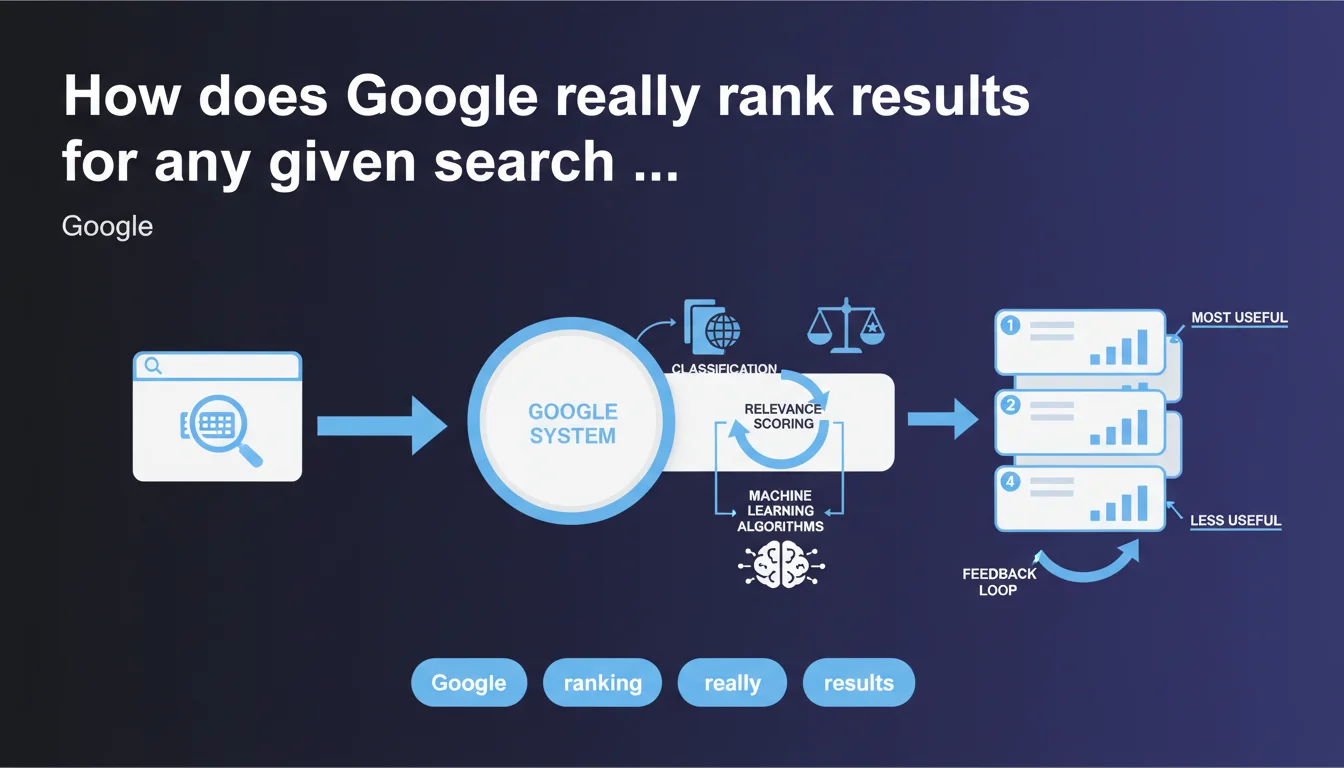
Google defines ranking as the process that instantly classifies pages from its index to display the most useful and relevant results based on the user's query. This official statement deliberately remains vague about the precise criteria and their weighting, leaving it to SEO practitioners to interpret what constitutes "usefulness" and "relevance".
What you need to understand
What exactly does Google mean by the term "ranking"?
The ranking refers to the algorithm that sorts and orders indexed web pages in response to a query. In practical terms, when a user performs a search, Google queries its index — not the live web — and applies hundreds of signals to determine the display order.
This process is instantaneous, which implies that calculations are optimized and certain decisions are pre-calculated or based on machine learning models trained in advance. Ranking is therefore not a simple keyword-to-content match, but a complex orchestration of qualitative and contextual signals.
What criteria determine "usefulness" and "relevance"?
Google never precisely defines these terms in this statement. Usefulness could encompass content freshness, depth of treatment, user experience, source reliability. Relevance likely includes semantic matching, detected search intent, behavioral signals.
Let's be honest: these concepts remain deliberately vague. Google maintains massive room for interpretation, which allows it to adjust its algorithms without having to publicly justify every change.
Does ranking occur after indexation?
Yes, this is a crucial point often misunderstood. Ranking only applies to pages already indexed. If your content isn't in Google's index, it's not even a candidate for ranking — no matter how high quality it is.
This means SEO efforts must first focus on indexability and crawlability, before even thinking about ranking optimization. A site that's technically flawless but invisible to Googlebot will never rank properly.
- Ranking only processes pages already present in Google's index
- The process is instantaneous thanks to pre-optimized calculations and machine learning
- "Usefulness" and "relevance" remain deliberately vague and multifactorial concepts
- The display order results from an orchestration of hundreds of weighted signals
- Indexation is an absolute prerequisite for ranking
SEO Expert opinion
Does this statement really reveal anything new?
No. This assertion is so generic it borders on tautology. Saying that ranking classifies results to display the most relevant ones is like explaining that a car engine serves to propel the car forward. Zero actionable information.
This type of official communication mainly serves to establish Google's vocabulary and maintain an appearance of transparency without revealing actual mechanisms. For an SEO practitioner, this statement provides no exploitable data about ranking criteria, their respective weights, or their evolution.
What gray areas does this definition leave?
Everything. Absolutely everything that would actually matter: how does Google precisely define usefulness? What weight for domain authority versus freshness? How do behavioral signals influence ranking? What proportion for technical factors versus content?
[To verify] — Google claims ranking seeks the "most useful" results, yet field observations regularly show SERPs dominated by mediocre sites that are technically optimized and well-linked. The gap between official theory and measurable reality remains significant.
Furthermore, the mention of "instantaneous" masks a reality: certain signals (links, mentions, aggregated behavioral signals) take days or even weeks to impact rankings. Ranking is "instantaneous" only for the end user, not for the SEO professional waiting for an optimization to bear fruit.
Is this vision of ranking consistent with observed practices?
Partially. A/B tests and correlation studies show that certain factors carry heavy weight: quality backlinks, semantic depth, engagement signals, Core Web Vitals. But the weighting varies enormously depending on query type (informational, transactional, navigational), vertical, geolocation.
The issue is that Google presents ranking as a unified process when we know specialized algorithms exist (BERT for natural language understanding, RankBrain for learning query patterns, anti-spam filters like SpamBrain). "Ranking" is actually a cascade of successive treatments, not a single magic formula.
Practical impact and recommendations
What should you concretely do to improve your ranking?
Since Google claims to seek the "most useful and relevant" results, first optimize for user intent. Analyze current SERPs for your target query: which format dominates (list, guide, comparison)? What content depth? What editorial angle?
Next, ensure your pages answer better than the competition: topic comprehensiveness, clear structure, smooth reading experience, updated data. Ranking rewards content that reduces "pogo-sticking" — when users immediately return to results because they didn't find their answer.
Technically, verify that your strategic pages are crawlable, indexable, and fast. Perfect content invisible to Googlebot or loading in 4 seconds will never rank correctly.
What mistakes should you avoid when optimizing for ranking?
Don't confuse indexation and ranking. Too many sites waste time over-optimizing pages that aren't even properly indexed. First verify in Search Console that your strategic URLs are in the index before refining title tags and internal linking.
Also avoid keyword stuffing obsession. Google talks about "relevance", not keyword density. Modern semantic algorithms (BERT, MUM) understand context and synonyms — prioritize semantic richness and comprehensive topic coverage over mechanical repetition.
Finally, don't neglect indirect signals: load time, bounce rate, session duration, navigation depth. Even if Google doesn't officially confirm their use, the observed correlations are too strong to ignore.
How do you measure and track the effectiveness of your ranking optimizations?
Monitor your average positions in Search Console by query and page, but also your CTR. Position improvement without CTR growth signals a title tag or meta description problem — your snippet isn't compelling enough.
Watch your impressions: if they stagnate despite optimizations, Google doesn't consider your page relevant for the targeted queries. If they increase but clicks don't follow, it's a display issue in results.
Compare your SERP visibility with direct competitors (tools like SEMrush, Ahrefs, Sistrix). If you're stagnating while they progress, analyze what they're doing differently: editorial depth, internal linking, backlinks, social signals.
- Analyze search intent by studying current SERPs for your target queries
- Ensure your strategic pages are crawlable and indexed before optimizing
- Prioritize semantic comprehensiveness over keyword density
- Optimize user experience to reduce pogo-sticking
- Track positions, impressions, and CTR in Search Console to guide your optimizations
- Compare your progress with that of direct competitors
- Test your hypotheses with A/B testing when possible to measure actual impact
Google's ranking remains a black box whose precise criteria constantly evolve. Rather than seeking the magic formula, focus on real user usefulness, technical soundness, and rigorous measurement of your actions.
These optimizations require technical, editorial, and analytical expertise that's often difficult to consolidate in-house. If you find your efforts aren't producing expected results despite significant time investment, it may be wise to get support from a specialized SEO agency that can bring an outside perspective, professional tools, and proven methodology to maximize your organic visibility.
❓ Frequently Asked Questions
Le ranking s'applique-t-il uniquement aux pages indexées ?
Combien de temps faut-il pour qu'une optimisation impacte le ranking ?
Google utilise-t-il le même algorithme de ranking pour toutes les requêtes ?
Les signaux comportementaux influencent-ils directement le ranking ?
Peut-on prédire précisément le ranking d'une page avant sa publication ?
🎥 From the same video 8
Other SEO insights extracted from this same Google Search Central video · published on 24/02/2022
🎥 Watch the full video on YouTube →
💬 Comments (0)
Be the first to comment.