
Official statement
Other statements from this video 10 ▾
- □ Are snippets really the most underestimated SEO lever to boost your CTR?
- □ How do you write page titles that won't get truncated by Google?
- □ Do you really need to repeat your keywords in titles to rank higher on Google?
- □ Does Google really generate different snippets for the same page based on each search query?
- □ Can Google really override your title tags and meta descriptions?
- □ Should your meta description really be a sales pitch?
- □ Should you really forget about the 155-character limit for meta descriptions?
- □ Should you really write meta descriptions as complete sentences?
- □ Should you really write a unique meta description for every single page?
- □ How can you technically optimize title tags and meta descriptions to maximize their SEO impact?
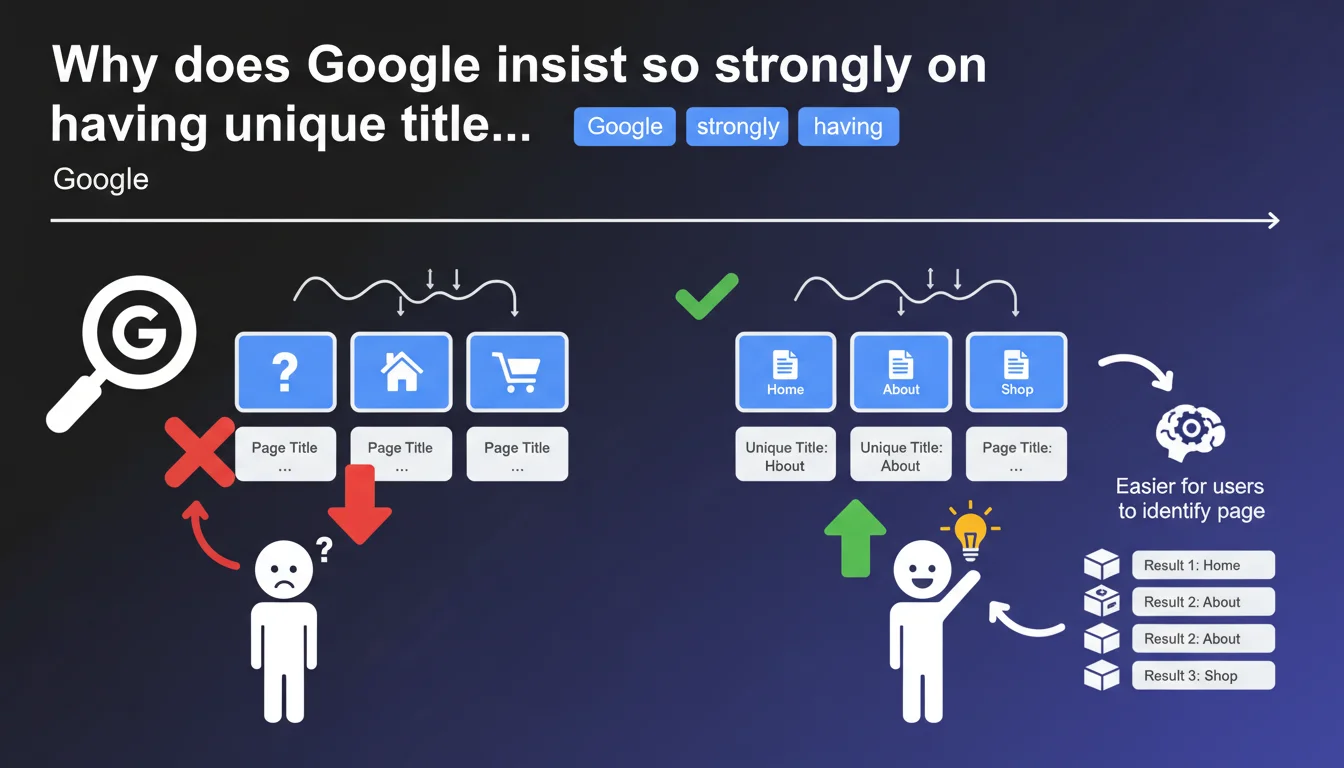
Google reaffirms that each page must have a unique title to make it easier for users to identify the page. If uniqueness is impossible, Google recommends using different meta descriptions to differentiate pages in the SERPs. A directive that seems straightforward but hides more complex underlying issues.
What you need to understand
What is Google really trying to solve with this directive?
Google is fighting a recurring problem: websites that duplicate their title tags out of laziness or poorly calibrated automation. The same title tag appearing on 50 pages creates a severe lack of context for users in search results.
The search engine wants to prevent its SERPs from displaying 10 identical results from the same website. User experience suffers directly — it becomes impossible to distinguish which page actually answers the user's search intent.
What does "if using the same title is unavoidable" concretely mean?
Google is implicitly acknowledging that maintaining strict uniqueness is sometimes difficult. Think of e-commerce sites with thousands of product variants (colors, sizes) or listing sites with nearly identical product pages.
The proposed solution? Use differentiated meta descriptions to compensate. It's an admission: Google knows that technical reality sometimes demands compromises.
Why does Google explicitly mention snippets in this directive?
Because Google no longer looks at only the title tag in isolation. It creates its own titles in the SERPs by pulling from page content, link anchors, and even meta descriptions.
If your titles are too similar, Google will attempt to rewrite them. But this rewriting is unpredictable and rarely optimal for your strategy. Better to control what appears by providing distinctive elements from the start.
- Each page must have a unique title to make identification easier for users in the SERPs
- If uniqueness is impossible (product variants, pagination), compensate with differentiated meta descriptions
- Google may rewrite your titles if they're too similar — better to maintain control by differentiating them yourself
- The primary objective remains user experience in search results, not just crawling or indexing
SEO Expert opinion
Is this directive actually being applied in practice?
Let's be honest: we regularly see well-ranked websites with nearly identical titles across dozens of pages. Google doesn't penalize this practice frontally the way it would for massive duplicate content.
What it does is rewrite titles on its own terms. The result? You lose control of your message in the SERPs. CTR can drop without you understanding why — Google displays a generated title that matches neither your strategy nor user intent.
What nuances should we add to this recommendation?
The directive doesn't distinguish between different types of websites. A blog with 50 articles can easily have 50 unique titles. A marketplace with 100,000 auto-generated product pages is a different story.
Google says "if it's unavoidable," but provides no threshold. At what point do similar pages become problematic? [To verify] — no public data clarifies this. We're in operational gray area.
In what cases does this rule not really apply?
Pagination pages, for example. Many websites keep the same title across all pages in a paginated series, adding only "Page 2," "Page 3." Google doesn't seem particularly bothered by this.
Same goes for faceted filter pages in e-commerce. If you're indexing every filter combination, you'll create thousands of pages with necessarily similar titles. Google prefers that you use canonical or noindex rather than force uniqueness at all costs.
Practical impact and recommendations
What should you concretely do to follow this directive?
Start with a title tag audit. Export them via Screaming Frog or your preferred tool and identify duplicates. If you have fewer than 5% duplicates, it's manageable manually. Beyond that, you need automation.
For e-commerce sites, build dynamic title templates that include at minimum: product name, distinguishing attribute (color, size, model), and optionally a parent category. Example: "Nike Air Zoom Running Shoes — Men — Black" rather than "Nike Air Zoom Running Shoes" repeated 12 times.
What mistakes should you absolutely avoid?
Don't fall into the keyword stuffing trap in titles under the guise of differentiating them. "Running shoes Paris," "Running shoes Lyon," "Running shoes Marseille" — no one is fooled and Google may consider this over-optimization.
Another common mistake: thinking that varying just one word is enough. If 80% of the title is identical, Google might still rewrite it. Uniqueness must be substantial, not cosmetic.
How can you verify that your site is compliant?
Use Google Search Console — the "Performance" section, export queries and pages. Compare the titles displayed in the SERPs with those you actually coded. If Google is rewriting extensively, that's a signal.
Also check your CTR per page. Abnormally low CTR on well-ranked pages can indicate that the displayed title (rewritten by Google) doesn't match user intent.
- Audit title tags to identify duplicates (Screaming Frog, SEMrush, Ahrefs)
- Create dynamic templates for automatically generated pages (e-commerce, listings)
- Include at least 2-3 distinctive elements per title (product attribute, location, category)
- Check Search Console to see if Google rewrites your titles — compare what displays vs what's coded
- Monitor CTR: low CTR can signal a poorly adapted or rewritten title
- If uniqueness is impossible, compensate with varied and relevant meta descriptions
- Avoid keyword stuffing: uniqueness doesn't justify over-optimization
❓ Frequently Asked Questions
Google pénalise-t-il les sites avec des balises title dupliquées ?
Quelle longueur minimale de différence entre deux titles pour que Google les considère uniques ?
Peut-on utiliser le même title sur des pages en noindex ou canonical ?
Les meta descriptions compensent-elles vraiment des titles similaires ?
Comment gérer les titles sur des sites multilingues avec des structures identiques ?
🎥 From the same video 10
Other SEO insights extracted from this same Google Search Central video · published on 24/02/2022
🎥 Watch the full video on YouTube →
💬 Comments (0)
Be the first to comment.