
Official statement
Other statements from this video 8 ▾
- □ Is page content really the most important relevance factor for Google?
- □ Does Google really strip stop words from your search queries?
- □ Does Google really preserve stop words within named entities, and how does this affect your SEO?
- □ Does Google really expand your search queries with synonyms automatically?
- □ Does your geographic location really reshape the search results Google shows you?
- □ Does page quality or site quality matter more in Google's ranking algorithm?
- □ Does a page's relative importance really impact its quality according to Google?
- □ Does Google really show different SERP features based on what you're searching for?
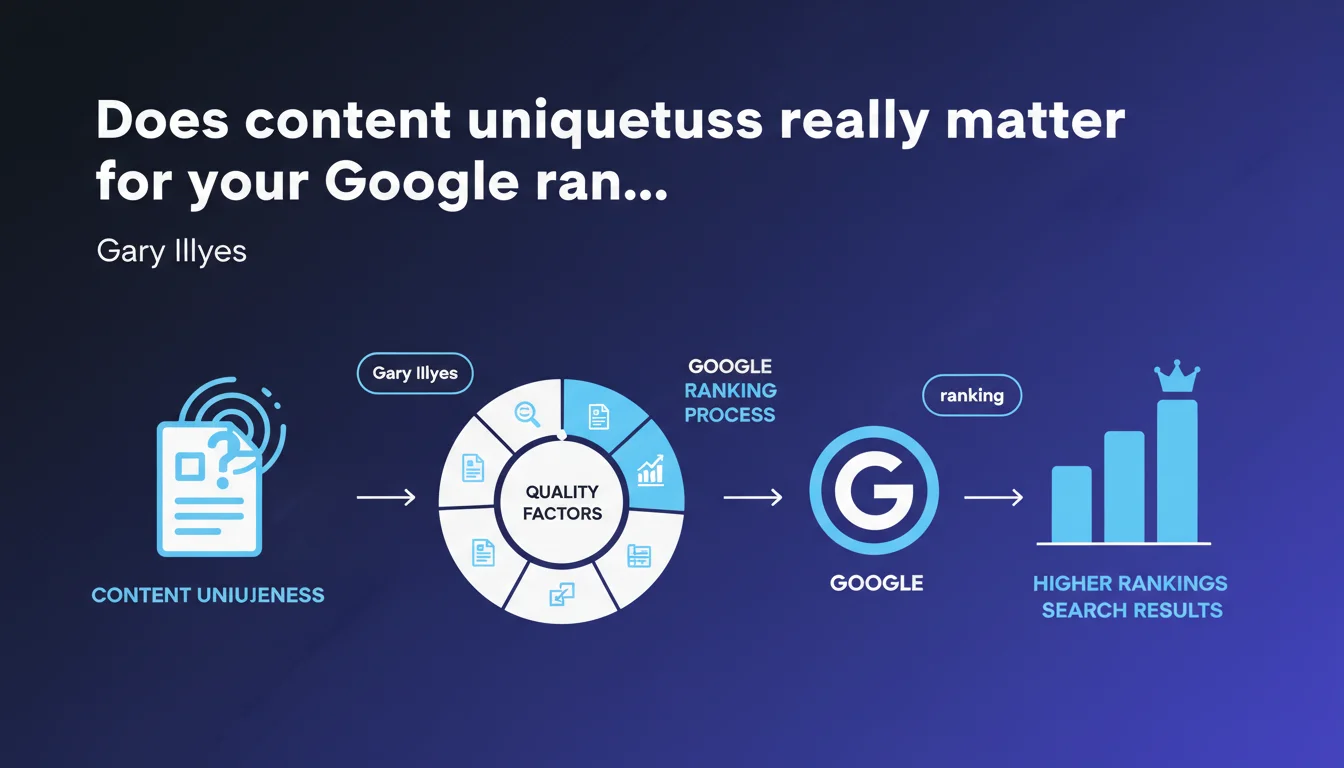
Google confirms that content uniqueness is a quality signal taken into account during ranking. This statement from Gary Illyes validates what practitioners have observed for years: duplicate or generic content penalizes visibility. The remaining question is how Google precisely defines 'uniqueness.'
What you need to understand
What does 'content uniqueness' concretely mean for Google?
Google isn't talking strictly about duplicate content here — though it's related. Uniqueness refers to a page's ability to deliver distinctive value compared to what already exists in the index.
A page can be technically unique (no copy-paste) while remaining generic: same angle, same recycled information, no added depth. That's precisely what Google is trying to filter out.
How is this different from simply avoiding duplication?
Strict duplicate content — copying a text word-for-word — remains problematic, especially internally. But Google goes further by evaluating whether your content stands out qualitatively from the competition.
Two pages can cover the same topic with different wording and still be considered redundant if they offer no new perspective, no unpublished data, no original angle.
Which types of pages are most at risk?
E-commerce product sheets copying vendor descriptions, category pages with bland introductions, generalist blog articles paraphrasing the top 10 Google results — all this content risks being demoted or ignored.
Affiliate sites republishing brand content without added value are also in the crosshairs, as are aggregators compiling without enriching.
- Uniqueness goes beyond the absence of technical duplication
- Google evaluates the distinctive value of a page relative to existing content
- Generic or recycled content can be filtered even if technically unique
- Product sheets, category pages, and affiliate content are particularly sensitive
SEO Expert opinion
Is this statement consistent with field observations?
Yes, and it's actually one of the rare points where Google's discourse perfectly aligns with empirical findings. Sites that rewrite their product sheets, that add original buying guides, that produce exclusive case studies — all tend to perform better.
Conversely, sites that merely reproduce vendor content or compile information already available everywhere stagnate or decline, even with flawless internal linking and solid backlinks.
What's the fuzzy boundary Google never clarifies?
The problem is Google says nothing about the threshold above which content becomes 'sufficiently unique.' 30% textual difference? An exclusive 200-word section? Unpublished data? We're flying blind.
[To verify]: Google claims uniqueness is one factor among others, but what proportion does it really weigh against domain authority, backlinks, or freshness? No figures, no clear hierarchy.
Is AI-generated content necessarily penalized?
Not necessarily. If AI-generated text brings an original perspective, integrates exclusive data, or proposes unprecedented structure, it can be considered unique — even if the prose is machine-written.
The real risk is unedited AI content, which regurgitates the same generalities that ChatGPT or Claude spew to everyone. There, Google easily detects semantic redundancy with thousands of other pages.
Practical impact and recommendations
What should you concretely do to maximize uniqueness?
First, audit your existing content: which pages on your site reproduce vendor content, copy competitors, or recycle generalities? These pages are anchors diluting your overall authority.
Next, systematically enrich: add customer testimonials, annotated screenshots, exclusive comparisons, original video tutorials. The goal is for each page to deliver something found nowhere else.
What mistakes should you absolutely avoid?
Don't confuse length with uniqueness. Padding a text with generic filler doesn't solve anything — and can even worsen the problem if Google detects disguised keyword stuffing.
Another trap: creating minor page variations to target similar keywords. If you publish 'best CRM 2025' and 'best CRM enterprise' with 80% identical content, Google will index only one version — or neither.
How do you verify your content is sufficiently unique?
Use tools like Copyscape or Siteliner to detect internal and external duplication. But don't stop there: manually compare your pages with the top 10 Google results for your target queries.
If your content says the same thing, in the same order, with the same examples — even with different words — it's insufficient. You need a distinct angle, superior depth, or exclusive data.
- Audit all pages reproducing vendor or generic content
- Enrich each page with exclusive elements (customer reviews, screenshots, proprietary data)
- Avoid publishing minor page variations on similar keywords
- Manually compare your content with the top 10 Google results
- Use Copyscape or Siteliner to detect technical duplication
- Prioritize depth and original angle over simple text length
❓ Frequently Asked Questions
Le contenu généré par IA est-il considéré comme non unique par Google ?
Quel pourcentage de différence textuelle est nécessaire pour qu'un contenu soit considéré unique ?
Les fiches produits reprenant les descriptions fournisseurs sont-elles pénalisées ?
Peut-on publier plusieurs pages similaires ciblant des mots-clés proches ?
Comment gérer l'unicité dans des secteurs très normés où les formulations sont standardisées ?
🎥 From the same video 8
Other SEO insights extracted from this same Google Search Central video · published on 09/04/2024
🎥 Watch the full video on YouTube →
💬 Comments (0)
Be the first to comment.