
Official statement
Other statements from this video 8 ▾
- □ Is page content really the most important relevance factor for Google?
- □ Does Google really strip stop words from your search queries?
- □ Does Google really preserve stop words within named entities, and how does this affect your SEO?
- □ Does your geographic location really reshape the search results Google shows you?
- □ Does page quality or site quality matter more in Google's ranking algorithm?
- □ Does content uniqueness really matter for your Google rankings?
- □ Does a page's relative importance really impact its quality according to Google?
- □ Does Google really show different SERP features based on what you're searching for?
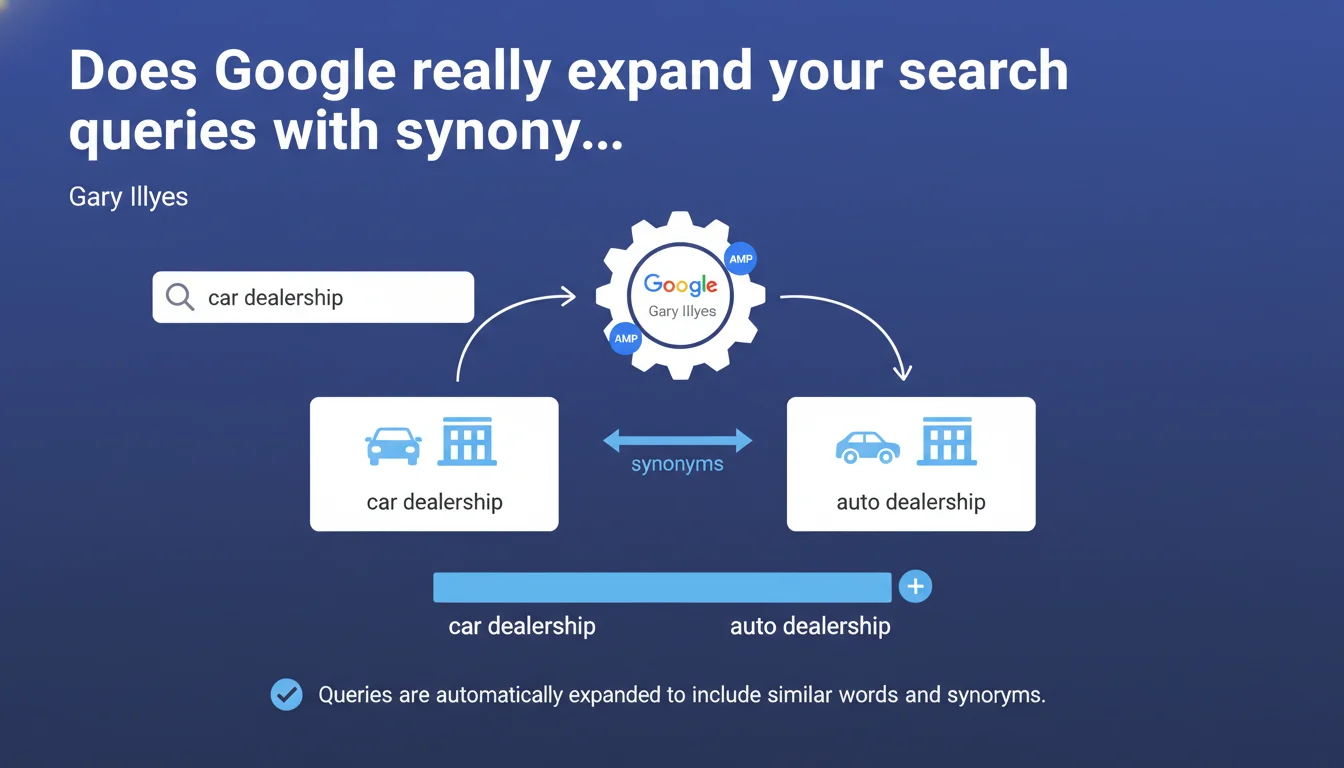
Google automatically applies semantic expansion to search queries by including synonyms and similar terms. A search for 'car dealership' therefore also includes 'auto dealership' without user intervention. This mechanism directly impacts how you should think about your keyword strategy and semantic coverage.
What you need to understand
What is automatic query expansion?
Google doesn't just display results for the exact words typed by the user. The search engine automatically enriches each query with terms it considers semantically close: synonyms, linguistic variations, equivalent terms in the same lexical field.
The example given by Gary Illyes — 'car' and 'auto' — illustrates the most basic version of this mechanism. But concretely, the expansion goes much further: abbreviations, generic brands, technical versus vulgar terms. Google interprets the intent behind the query and decides which terms can legitimately answer it.
Why does Google do this?
The stated objective: improve the relevance of results by compensating for gaps in natural language. Users don't always formulate their queries with optimal vocabulary — and Google wants to avoid a simple lexical variation preventing them from finding what they're looking for.
From the engine's point of view, this expansion also allows densifying SERPs by exploiting a larger corpus of documents, even when exact matching is weak. This is particularly visible on long-tail queries or niche searches with low volume.
How long has this feature existed?
Semantic expansion is not new. Google has been using synonym mechanisms for over a decade, but their sophistication has exploded with the arrival of BERT, MUM, and contextual language models.
What's changing today: transparency. Gary Illyes explicitly confirms a behavior that many suspected but remained unclear. And that's strategically important for us.
- Expansion is automatic: no need for a specific operator or parameter
- It concerns all queries, not just those deemed ambiguous or rare
- Google decides alone which terms are considered synonyms — your opinion doesn't count
- This mechanism impacts both semantic indexing and query-document matching
- It theoretically reduces the importance of exact keyword stuffing, but not that of overall semantic coverage
SEO Expert opinion
Is this statement consistent with what we observe in the field?
Yes and no. Semantic expansion is an observable reality that has existed for years. You just need to compare the Search Console queries with your initial targeting to see that Google matches your pages on variants you never used.
But — and this is where it gets tricky — the intensity and reliability of this expansion are extremely variable. On obvious pairs like 'car/auto', it works. On more nuanced terms, or in specialized contexts, Google sometimes makes questionable associations. [To verify]: does this expansion apply with the same force across all languages and markets? Nothing proves it.
What are the practical limits of this expansion?
First limitation: Google doesn't publish the list of synonyms it uses. You're navigating blind. A term you consider equivalent may not be treated as such by the algorithm — and vice versa.
Second limitation: expansion can dilute your targeting. If Google associates your content too broadly with peripheral queries, your CTR risks dropping. You generate impressions, but not qualified clicks. And that, Search Console shows you every day.
In what cases does this rule not apply fully?
Quoted queries force exact matching and bypass expansion. Professionals who use advanced search operators know this well.
Highly specialized technical terms or neologisms can also escape this logic, simply because Google hasn't yet built a sufficient semantic graph around them. In these niches, exact match retains disproportionate importance.
Practical impact and recommendations
What should you do concretely with this information?
First, stop panicking about exact variations of your keywords. If you wrote 'sports car' instead of 'performance automobile', Google makes the connection. What matters is the overall semantic density of your content, not mechanical repetition of a key phrase.
Next, leverage the Search Console to identify synonyms and variations that Google already associates with your pages. Go to Performance > Queries, and analyze the terms that generate impressions without you explicitly targeting them. That's a goldmine for enriching your semantic field.
Third point: revise your content strategy. Instead of creating 10 nearly identical pages to cover 10 variants of the same term, consolidate your content and enrich it semantically. Google prefers one robust page that covers broadly rather than fragmented content.
What mistakes should you absolutely avoid?
Don't count on expansion to compensate for poor initial targeting. Google can expand your reach, but it won't work miracles if your content is off-topic or too superficial. Expansion amplifies what exists, it doesn't create relevance from nothing.
Also avoid over-optimizing by stuffing your pages with synonyms artificially. Google detects these patterns and it can harm readability — therefore user engagement, therefore rankings. Be natural, vary vocabulary, but don't force it.
How do you verify that your semantic strategy is solid?
Compare your target queries with the queries actually served in Search Console. If you notice a massive gap, two scenarios: either Google is associating you with irrelevant queries (bad sign), or it's intelligently expanding your reach (good sign).
Use semantic analysis tools (like TF-IDF, NLP entities) to audit the lexical richness of your content. If your page on 'car dealerships' never mentions 'garage', 'reseller', 'showroom', you're missing obvious semantic touchpoints.
- Analyze Search Console queries to identify synonyms Google associates
- Consolidate redundant content rather than multiplying clone pages
- Enrich your texts with varied, natural vocabulary, without keyword stuffing
- Verify consistency between your target keywords and actual impressions
- Use entities and co-occurrences to strengthen your semantic field
- Test the impact of synonyms by tracking organic traffic evolution after optimization
Automatic query expansion changes the game for SEO: it values semantic depth over mechanical repetition. But be careful, this mechanism doesn't replace a true structured content strategy.
These semantic optimizations require pointed technical expertise and a fine understanding of Google's matching mechanisms. If you lack internal resources or want to accelerate your results without trial and error, the support of a specialized SEO agency can prove particularly valuable for auditing your semantic coverage and deploying a strategy adapted to your market.
❓ Frequently Asked Questions
L'élargissement synonymique fonctionne-t-il dans toutes les langues ?
Peut-on désactiver l'élargissement sémantique pour forcer un exact match ?
Dois-je quand même utiliser des variantes de mots-clés dans mes contenus ?
L'élargissement peut-il nuire à mon positionnement sur ma requête cible principale ?
Les outils SEO prennent-ils en compte cet élargissement dans leurs métriques ?
🎥 From the same video 8
Other SEO insights extracted from this same Google Search Central video · published on 09/04/2024
🎥 Watch the full video on YouTube →
💬 Comments (0)
Be the first to comment.