
Official statement
Other statements from this video 8 ▾
- □ Is page content really the most important relevance factor for Google?
- □ Does Google really strip stop words from your search queries?
- □ Does Google really preserve stop words within named entities, and how does this affect your SEO?
- □ Does Google really expand your search queries with synonyms automatically?
- □ Does page quality or site quality matter more in Google's ranking algorithm?
- □ Does content uniqueness really matter for your Google rankings?
- □ Does a page's relative importance really impact its quality according to Google?
- □ Does Google really show different SERP features based on what you're searching for?
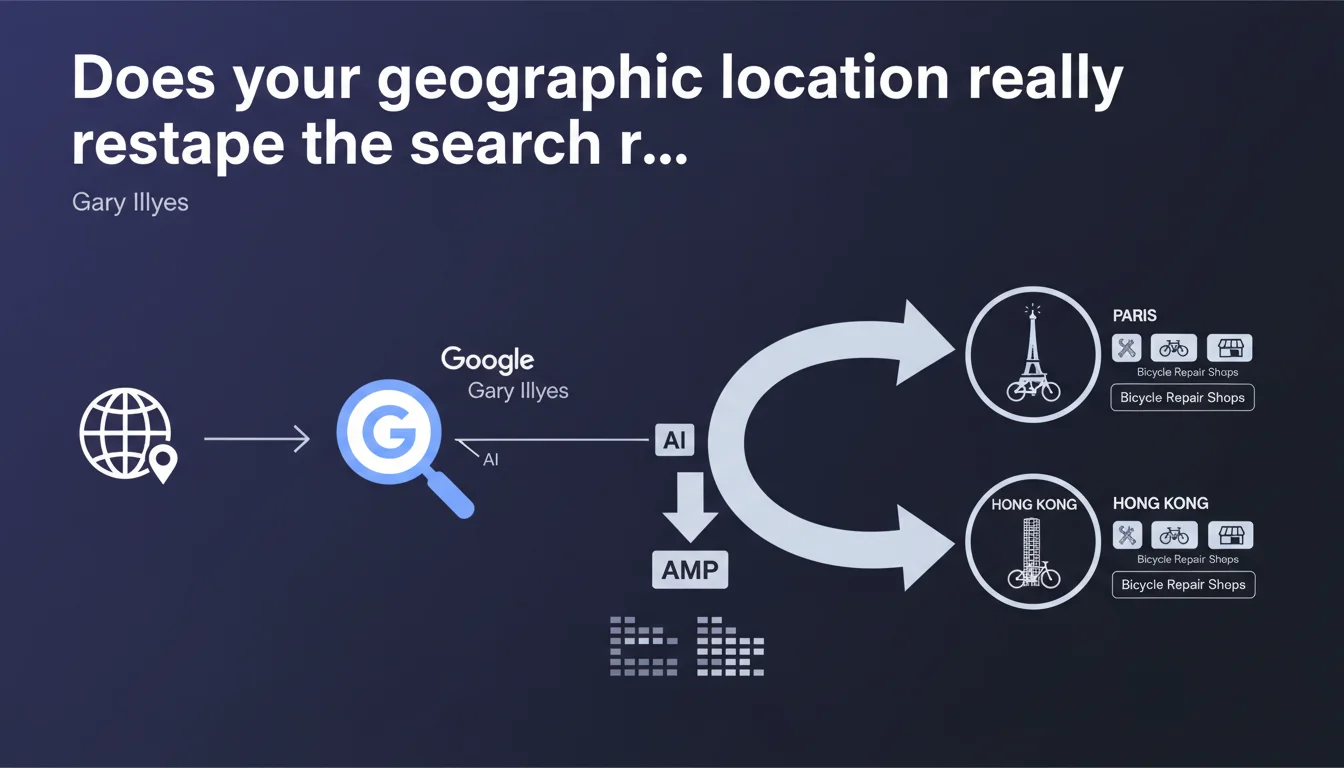
Google confirms that the user's geographic position directly modifies the displayed results. The same search query generates completely different SERPs depending on whether you search from Paris or Hong Kong. The impact primarily concerns queries with local intent, but not exclusively.
What you need to understand
What is the true scope of this statement?
Gary Illyes reminds us of a central principle in how Google operates: the user's physical location conditions the results they see. The example of "bicycle repair shops" illustrates an obvious query — searching for a repair service naturally implies a proximity need.
What deserves attention is the scale of the phenomenon. Google uses multiple signals to determine where you are: IP address, browser location parameters, GPS data if enabled, and even your search history. These signals combine to personalize the SERP.
Are all queries affected?
No. The intensity of personalization varies depending on the search intent Google detects. Local transactional queries ("restaurant", "plumber", "pharmacy") undergo massive geo-personalization.
Generic informational queries ("how does photosynthesis work") remain largely identical from one country to another — except if the language changes. Between the two extremes, a gray zone exists: searching "best universities" will return national results, even without mentioning a country.
Which signals does Google prioritize to determine location?
IP address remains the dominant signal when no precise geolocation permission is granted. Google detects your country, often your city, through this bias.
If you enable location in your browser, Google switches to GPS coordinates that are far more precise. Results can then vary from one neighborhood to another in the same city. History also counts: if you regularly search from Lyon, Google may favor Lyon results even if you're temporarily elsewhere.
- Location modifies SERPs for any query with local intent, explicit or implicit
- IP address remains the primary signal if no precise geolocation is authorized
- Google multiplies signals: IP, GPS, browser parameters, search history
- The intensity of personalization depends on query type — local transactional vs. generic informational
- Results can vary from one neighborhood to another in a large city if GPS is enabled
SEO Expert opinion
Does this statement really bring anything new?
Let's be honest: no. Every SEO practitioner has known for years that Google geo-personalizes results. What's surprising is that Gary Illyes takes the trouble to state it publicly — as if this obvious principle still needed official confirmation.
The value lies elsewhere: this statement validates that Google fully owns this personalization. No ambiguity, no blurriness. Location is a direct ranking factor for certain queries, not merely a filter applied afterwards.
What are the limitations of this explanation?
Gary Illyes remains vague on one crucial point: how does Google decide that a query deserves geo-personalization? The "bicycle repair shops" example is too obvious. What about "best VPN", "SEO training", "commercial law attorney"?
[To verify] Google documents nowhere the threshold that triggers geo-personalization for ambiguous queries. Our field tests show inconsistencies: some informational queries display local results for no apparent reason, others remain global when local intent seems obvious.
In what cases does this rule create problems?
Geo-personalization creates a major methodological bias for position tracking. Checking your ranking from Paris tells you nothing about what a user sees from Marseille. SEO tools compensate by multiplying proxies, but accuracy remains imperfect.
Second problem: a site can rank perfectly in one geographic zone and be invisible 50 km away, without understanding why. Google provides no tool to diagnose these local variations finely — Search Console aggregates data without sufficient granularity.
Practical impact and recommendations
What should you concretely do to optimize your local visibility?
First reflex: Google Business Profile. If your business has a local dimension, it's non-negotiable. Complete every field, update regularly, collect reviews. Google massively favors establishments with a complete and active profile.
Next, work on local relevance signals in your content: address visible in the footer, pages dedicated by geographic zone if you cover multiple cities, mentions of neighborhoods and local landmarks in your texts. Google analyzes these micro-signals to evaluate your territorial anchor.
How can you avoid errors that dilute your geographic visibility?
Classic mistake: hosting your site on a foreign server with a foreign IP, then wondering why you rank poorly locally. Server IP matters little, but it can create inconsistencies if it contradicts all your other signals.
Another trap: creating generic content without local anchor, then hoping to rank on geo-personalized queries. If you target "plumber Paris 15", your page must explicitly discuss the 15th arrondissement — not just Paris in general.
Last point often overlooked: local citations (directories, local reference sites). Google checks the consistency of your NAP (Name, Address, Phone) across the web. Inconsistencies degrade your territorial credibility.
How can you verify your site is correctly perceived locally?
Use position tracking tools that simulate different locations. SE Ranking, BrightLocal, or Local Falcon allow you to map your visibility neighborhood by neighborhood. Compare with what you see from your office — the gap can be dramatic.
Check Search Console to identify where your impressions come from. If you target Lyon but 80% of your impressions come from Paris, that's a warning signal: your local signals lack coherence.
- Create or optimize your Google Business Profile with all available information
- Integrate local signals into your content: addresses, neighborhoods, geographic landmarks
- Verify consistency of your NAP (Name, Address, Phone) across all directories and citations
- Create dedicated pages by geographic zone if you cover multiple cities or regions
- Monitor your positions with multi-location tools, not from your own connection
- Analyze Search Console to identify the geographic zones generating your impressions
- Avoid inconsistencies between your server IP, your content, and your local signals
- Collect local reviews regularly to strengthen your territorial anchor
❓ Frequently Asked Questions
La localisation affecte-t-elle aussi les résultats organiques classiques ou seulement le Local Pack ?
Un VPN peut-il fausser mes analyses de positionnement ?
Google utilise-t-il la langue du navigateur ou uniquement la localisation physique ?
Comment Google gère-t-il les utilisateurs qui voyagent fréquemment ?
Faut-il créer un domaine local (.fr, .be) ou un .com suffit-il ?
🎥 From the same video 8
Other SEO insights extracted from this same Google Search Central video · published on 09/04/2024
🎥 Watch the full video on YouTube →
💬 Comments (0)
Be the first to comment.