
Official statement
Other statements from this video 10 ▾
- □ Les snippets sont-ils vraiment le levier SEO le plus sous-estimé pour booster votre CTR ?
- □ Comment rédiger des titres de page qui ne seront pas tronqués par Google ?
- □ Faut-il vraiment répéter ses mots-clés dans les titres pour ranker ?
- □ Pourquoi Google insiste-t-il autant sur l'unicité des balises title ?
- □ Comment Google génère-t-il vraiment les snippets de vos pages dans les résultats de recherche ?
- □ Google peut-il vraiment ignorer vos balises title et meta description ?
- □ La meta description doit-elle vraiment être un argumentaire commercial ?
- □ Faut-il vraiment oublier la limite de 155 caractères pour les meta descriptions ?
- □ Faut-il vraiment rédiger une meta description unique pour chaque page ?
- □ Comment optimiser techniquement les balises title et meta description pour maximiser leur impact SEO ?
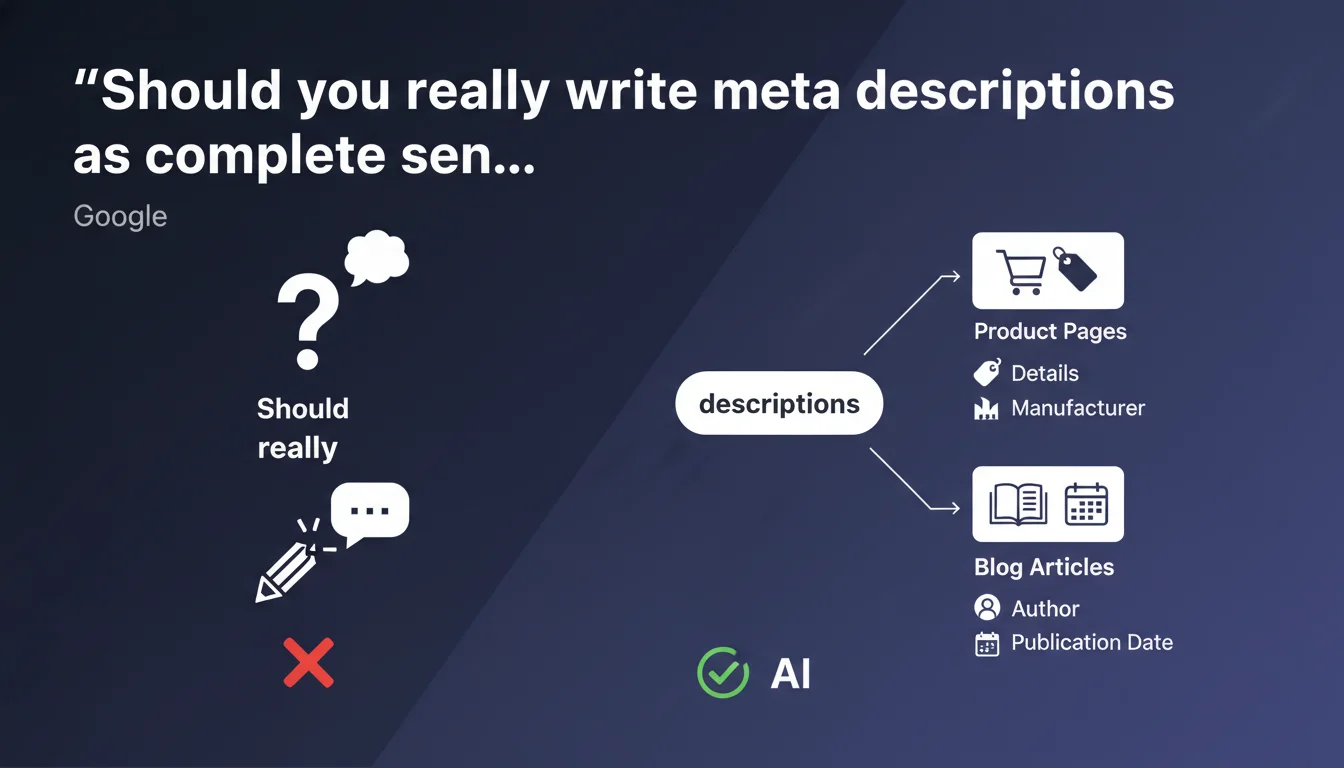
Google confirms that meta descriptions don't need to be written as sentences. For product pages, prioritize technical specifications and manufacturer details. For editorial content, include the author and publication date. This data-structured approach can improve how your pages appear in the SERPs.
What you need to understand
Why is Google challenging the traditional format of meta descriptions?
Google's statement shatters a deeply ingrained dogma in SEO best practices: writing meta descriptions as polished marketing pitches. The stated objective is to enable users to identify relevant information more quickly in search results.
This approach aligns with the logic of rich snippets and displaying structured data directly in the SERPs. Google is trying to maximize information density visible at a glance, not prose to be read.
What types of content does this recommendation apply to?
Google clearly distinguishes two use cases. For e-commerce product pages, the meta description becomes a condensed set of specifications: model, brand, dimensions, price, availability. No need for storytelling—just facts.
For editorial content (blog articles, news), displaying the author and publication date takes priority. This practice enhances perceived freshness and strengthens credibility through E-E-A-T.
What does this actually change in SERP display?
Google already generates its own snippets in 70 to 80% of cases, ignoring the meta description you've written. By structuring your tag differently, you guide the algorithm toward elements to display as a priority.
The "raw data" format also facilitates information extraction for featured snippets and direct answers. This is especially true for transactional queries where the user is looking for specs, not a sales pitch.
- Meta descriptions are not a ranking factor, but they influence CTR
- Google massively rewrites meta descriptions based on search query context
- The "structured data" format improves quick readability in the SERPs
- Author and date strengthen E-E-A-T signals for editorial content
- Technical specs convert better than marketing phrases on product pages
SEO Expert opinion
Does this approach contradict traditional on-page SEO recommendations?
Yes and no. SEO training has repeated for years that a meta description should be a marketing pitch with a call-to-action, limited to 155-160 characters, and so on. Google isn't saying that's wrong—it's saying that's not the only viable option.
In practice, we observe that e-commerce sites displaying product characteristics in meta descriptions often achieve better CTR on transactional queries. Why? Because users scan, they don't read. They're looking for "iPhone 15 Pro 256GB Titanium"—not "Discover the smartphone that will revolutionize your daily life".
In what cases doesn't this logic apply?
For category pages, institutional pages (About, Contact), or SEM landing pages, the "classic sentence" format still makes complete sense. You're selling a promise, not specs.
Similarly, in highly competitive sectors where all competitors display the same specs, a differentiated and emotional meta description can make the difference. Context always trumps the general rule.
[To verify] Google provides no metrics on the actual impact of this alternative format on CTR. The claim remains theoretical—large-scale A/B testing would be needed to validate the hypothesis sector by sector.
How does Google interpret this structured data in the meta description?
The real question is: does Google semantically parse the meta description content to extract entities (brand, model, date)? Or does it simply display the raw text as-is?
If Google truly extracts entities, then structuring the meta description becomes an additional weak signal of semantic consistency. If it's just passive display, the impact is limited to user CTR. We lack official data to settle this.
Practical impact and recommendations
How should you restructure meta descriptions for product pages?
For an e-commerce product page, abandon the marketing sentence in favor of a series of attributes separated by commas or dashes. Typical format: "Brand Model – Feature1, Feature2, Feature3 – Price – Shipping".
Concrete example: instead of "Buy the best smartphone on the market with fast shipping," prefer "Apple iPhone 15 Pro 256GB Titanium – A17 Pro, USB-C, 48MP Camera – $1,229 – 24h Shipping". Maximum information density.
What approach should you take for editorial content?
On a blog article or news item, systematically include the author and date at the beginning of the meta description. Format: "By [Author] – [Date] – [Article Summary]".
Example: "By Marie Dupont – March 15 – 7 Advanced Internal Linking Techniques That Increase Crawl Budget Without Touching Your Site Architecture". The date strengthens perceived freshness, the author boosts E-E-A-T.
Should you systematically abandon classic sentences?
No. The hybrid format works well: a first structured part (specs or author-date), followed by a short hook. You maximize both information density and click incentive.
Test both approaches via A/B testing in Search Console: compare CTR for pages with "classic" vs "structured" meta descriptions on similar queries. Let the data decide.
- Audit your current meta descriptions and identify which ones apply to product pages vs editorial content
- Restructure product pages by listing Brand, Model, Key Specs, Price, Shipping
- Add Author + Date to all blog articles and news content
- Maintain the 155-160 character limit to avoid truncation in desktop SERPs
- Align Schema.org structured data (Product, Article) with meta description content
- Monitor CTR in Search Console before/after modifications to validate impact
- Test hybrid formats (data + hook) if your sector is highly competitive
❓ Frequently Asked Questions
Google affiche-t-il toujours la meta description que j'ai rédigée ?
La meta description a-t-elle un impact direct sur le ranking ?
Quelle est la longueur maximale recommandée pour une meta description structurée ?
Faut-il dupliquer les informations présentes dans les données structurées Schema.org ?
Peut-on automatiser la génération de meta descriptions structurées sur un gros site ?
🎥 From the same video 10
Other SEO insights extracted from this same Google Search Central video · published on 24/02/2022
🎥 Watch the full video on YouTube →
💬 Comments (0)
Be the first to comment.