
Official statement
Other statements from this video 10 ▾
- □ Les snippets sont-ils vraiment le levier SEO le plus sous-estimé pour booster votre CTR ?
- □ Comment rédiger des titres de page qui ne seront pas tronqués par Google ?
- □ Faut-il vraiment répéter ses mots-clés dans les titres pour ranker ?
- □ Pourquoi Google insiste-t-il autant sur l'unicité des balises title ?
- □ Comment Google génère-t-il vraiment les snippets de vos pages dans les résultats de recherche ?
- □ La meta description doit-elle vraiment être un argumentaire commercial ?
- □ Faut-il vraiment oublier la limite de 155 caractères pour les meta descriptions ?
- □ Faut-il vraiment rédiger les meta descriptions comme des phrases complètes ?
- □ Faut-il vraiment rédiger une meta description unique pour chaque page ?
- □ Comment optimiser techniquement les balises title et meta description pour maximiser leur impact SEO ?
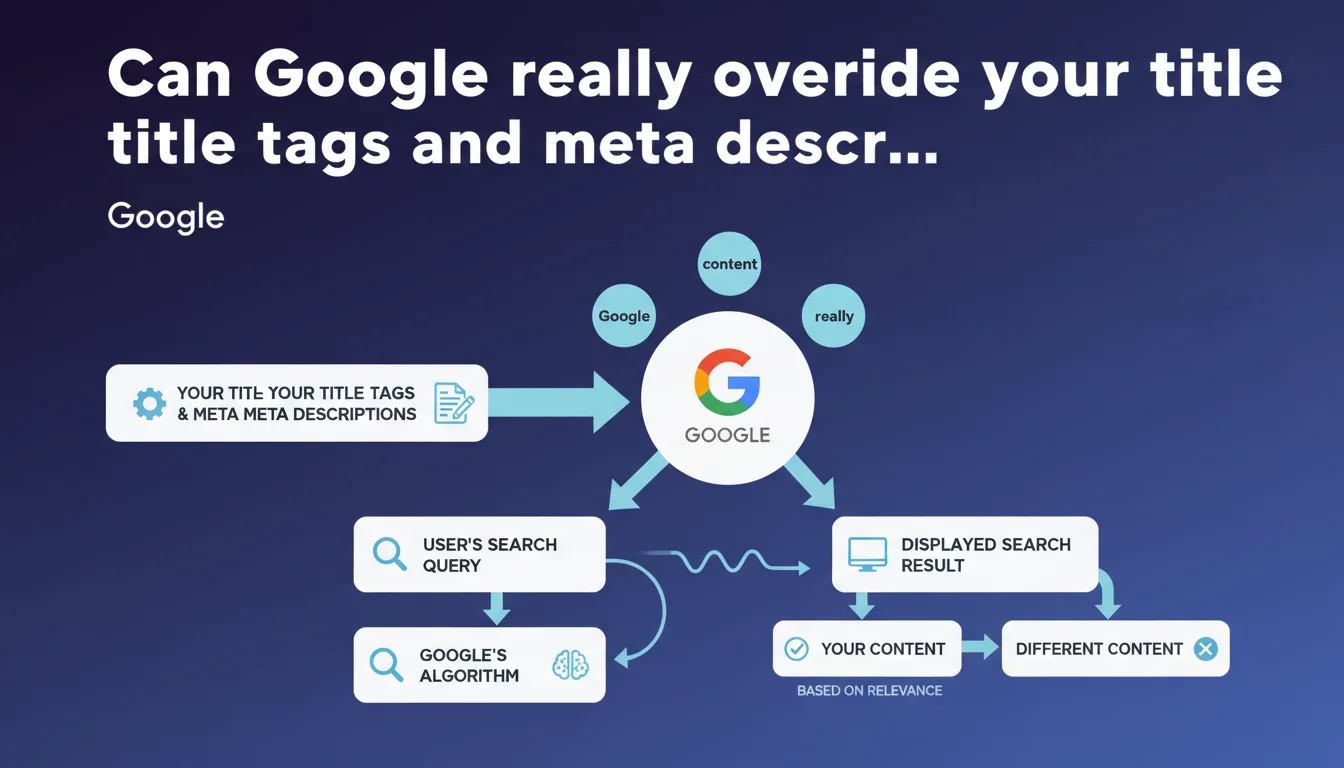
Google reserves the right to rewrite your title tags and meta descriptions based on the user's search query, regardless of what you've coded. No method guarantees 100% that your tags will display exactly as written. The stated objective: serve more relevant snippets for each specific search.
What you need to understand
Why does Google rewrite the snippets you've carefully optimized?
Google believes that contextual relevance takes priority over the webmaster's editorial intent. In practice, the algorithm scans your content and dynamically generates a snippet it deems better aligned with search intent.
This rewriting occurs in several cases: title tag too short or too long, stuffed with keywords, not representative of actual content, or simply deemed less effective than an excerpt from the H1 or body text. For meta descriptions, it's even more frequent — Google pulls directly from visible content if the description doesn't match the query.
What proportion of your snippets actually gets rewritten?
Field studies show rewrite rates between 60% and 80% for title tags, and even higher for descriptions. Suffice it to say your tags are more suggestions than instructions.
The rate varies by site type: e-commerce, media, corporate. The richer and more structured your content, the more Google is free to disregard your tags. Conversely, on thin pages, it often falls back to the default title.
Does Google provide specific criteria to limit rewrites?
Official documentation remains vague. Google talks about "relevance" and "usefulness" without defining specific thresholds. No public metrics allow you to predict when a snippet will be rewritten.
In practice, we observe that concise titles (50-60 characters), descriptive and without keyword stuffing are more likely to be respected. But it's far from a guarantee — and that's precisely what's problematic.
- Google rewrites the majority of snippets displayed in SERPs, regardless of your tags.
- Rewriting depends on the user's query, not solely on the quality of your tag.
- No technical method forces the display of your title or description.
- Observed rewrite rates exceed 60% for titles, 80% for descriptions.
- Google publishes no numerical criteria to anticipate rewriting.
SEO Expert opinion
Is this statement consistent with field observations?
Yes, and that's precisely the problem. Every SEO has experienced this frustration: a perfectly optimized, tested, validated title… that Google displays 3 times out of 10. The rest of the time, it's a random mix between H1, subheading, and snippet pulled from the content.
Google isn't lying in this statement; it simply asserts total control. What's questionable is the lack of feedback: no Search Console tool tells you why a snippet was rewritten, or how often. You optimize blindly.
What nuances should be added to this official stance?
Google implies that its rewrites always improve relevance. [To be verified] — many cases show absurd, truncated, or downright misleading generated snippets. Machine learning is far from infallible.
Another point: Google talks about "relevance to the query," but some SEOs suspect a CTR testing logic. The algorithm might test different snippets to maximize click-through rate, independent of actual relevance. Nothing officially confirms this hypothesis, but the variations observed on stable queries suggest it.
In what cases does this rewriting pose a business risk?
For e-commerce sites, a rewritten snippet can display an old price, expired promotion, or unavailable stock. Result: skyrocketing bounce rate, customer dissatisfaction, lost revenue.
B2B sites suffer differently: a generic snippet replaces carefully crafted differentiating messaging. Competitors gain visibility on wordings you deliberately avoided. Editorial control becomes illusory.
Practical impact and recommendations
What should you concretely do to limit rewrites?
First rule: write title tags and descriptions aligned with your actual content. If your title promises X and the H1 says Y, Google will choose Y (or worse, a mix of both). Semantic consistency between tags and visible content reduces rewrite risk.
Next, test your snippets across multiple target queries. A title that works for "buy running shoes" might be rewritten on "best marathon shoes." Adapt your tags to dominant search intents for your pages.
Avoid keyword stuffing in titles — Google systematically rewrites tags loaded with keywords. Favor natural wording with a single primary keyword and an emotional or differentiating hook.
What mistakes should you absolutely avoid?
Never duplicate your meta descriptions across multiple pages. Google ignores them massively in such cases. Every page deserves a unique description, even if time-consuming.
Don't write descriptions that are too short (under 120 characters) or too long (over 160). Google truncates or replaces them. Aim for 140-155 characters optimal to maximize display.
Don't use exotic special characters (stars, arrows, emojis) in titles. Google often filters them, degrading display and triggering rewrites. Keep it simple.
How do you verify your snippets display as intended?
Use SERP tracking tools (SEMrush, Ahrefs, Rank Tracker) to monitor actual snippet display on your priority queries. Compare with your HTML tags. A 30% gap is acceptable; beyond that you need to investigate.
Regularly inspect Search Console — "Performance" section — to identify pages with low CTR despite good ranking position. It's often a sign of a rewritten, unengaging snippet.
- Write unique title tags, 50-60 characters, aligned with visible content.
- Write meta descriptions of 140-155 characters, unique per page, without keyword stuffing.
- Ensure semantic consistency between title, H1, and opening paragraphs.
- Test your snippets across multiple target queries to anticipate variations.
- Monitor actual display via SERP tools and Search Console.
- Avoid special characters, descriptions too short or too long, massive duplications.
- Quickly correct rewritten snippets displaying obsolete or misleading information.
❓ Frequently Asked Questions
Peut-on forcer Google à afficher nos balises title et meta description ?
Quelle est la fréquence réelle de réécriture des balises title par Google ?
Faut-il encore optimiser les meta descriptions si Google les réécrit massivement ?
Google réécrit-il les snippets pour améliorer le CTR à son avantage ?
Comment savoir si mes snippets sont réellement affichés dans les SERPs ?
🎥 From the same video 10
Other SEO insights extracted from this same Google Search Central video · published on 24/02/2022
🎥 Watch the full video on YouTube →
💬 Comments (0)
Be the first to comment.