
Official statement
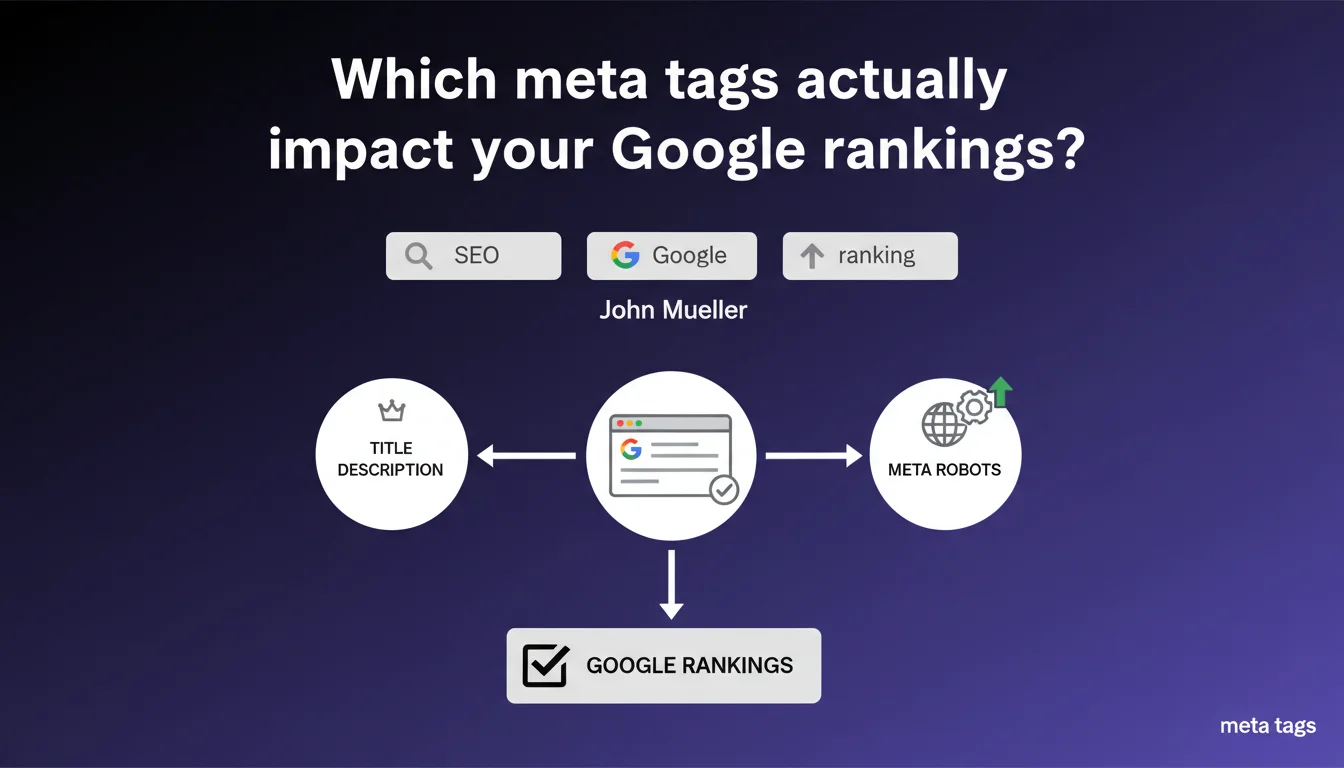
Google confirms that only the meta description, meta robots, and the title tag (although technically not a meta tag) actually affect SEO. All other meta tags have zero direct impact on search results. This clarification ends years of debate about the usefulness of dozens of obsolete or overestimated meta tags.
What you need to understand
Why does Google clarify that so few meta tags actually matter?
This statement puts an end to years of inherited practices from the past. For a long time, SEOs have been implementing dozens of meta tags — keywords, author, copyright, revisit-after — out of habit or out of an abundance of caution.
Google is refocusing the debate on what truly matters: meta description (for CTR), meta robots (for indexation control) and title (for relevance). Everything else? Just noise.
The title tag isn't a meta tag, so why does Google mention it here?
Technically, the <title> element is not a meta tag — it's a separate HTML element. But Google treats it as one in this context because it plays a similar role: conveying information to the search engine.
This distinction is mostly semantic. What matters: the title tag remains one of the most decisive on-page ranking factors.
What about all the other meta tags present in the source code?
If they're not listed by Mueller, they have zero effect on SEO. This includes the meta keywords tag (dead since 2009), meta author, meta copyright, or even exotic tags like geo.position.
They may serve other purposes — analytics, social networks (Open Graph, Twitter Cards), browsers — but they won't change your position in Google.
- Meta description: influences CTR, not ranking directly
- Meta robots: controls indexation and link following
- Title tag: major on-page relevance factor
- All other meta tags: zero SEO impact on Google
SEO Expert opinion
Is this statement consistent with real-world observations?
Yes, absolutely. For years, A/B tests have shown that adding or removing tags like meta keywords causes zero ranking variation. Log analysis tools confirm that Google doesn't even pay attention to these tags during crawling.
On the other hand, modifying the title tag almost always has an impact — positive or negative depending on relevance. The meta description, meanwhile, plays a role in CTR and therefore indirectly in user signals.
What nuances should we add about the meta description?
Mueller says the meta description "has an effect," but let's be precise: it's not a direct ranking factor. Google reads it, sometimes displays it in the SERPs, but it won't push a page up in results by itself.
Its impact is indirect. A well-written meta description improves CTR, which sends positive signals to Google. But be careful: Google rewrites these descriptions in more than 60% of cases. In other words, your meta description is a suggestion, not an order.
Does meta robots deserve as much attention as the title tag?
No, and it's a mistake to put them on the same level. Meta robots is a control tool, not an optimization lever. You use it to tell Google "don't index this page" or "don't follow these links."
The title tag, on the other hand, is a relevance signal. It directly influences how Google understands your page's topic. A bad meta robots blocks your indexation. A bad title tag loses you traffic. The stakes aren't the same.
Practical impact and recommendations
What should you do concretely with this information?
Start by conducting a meta tags audit. Identify all tags present in your <head> and remove those that serve no SEO purpose. Clean code makes crawling easier and reduces page weight.
Next, focus your efforts on the three elements that truly matter. Audit your title tags — are they unique, relevant, optimized for your target keywords? Check your meta robots — have you accidentally blocked strategic pages?
How do you effectively optimize these priority tags?
For the title tag: 50-60 characters, main keyword at the beginning, natural wording. Avoid keyword stuffing, Google has penalized that since Hummingbird.
For the meta description: 150-160 characters, clear call-to-action, obvious added value. But again, don't overdo it — Google often rewrites it. Prioritize pages with high traffic potential.
For the meta robots: use noindex on low-value pages (filters, unnecessary pagination, "thank you" pages), nofollow only if you want to block link juice to certain links. By default, leave as index, follow.
What mistakes must you absolutely avoid?
- Stop wasting time on meta keywords or other obsolete tags
- Never duplicate your title tags — uniqueness is critical
- Don't accidentally use
noindexon strategic pages (verify via Search Console) - Don't over-optimize your meta descriptions — Google rewrites them anyway
- Don't neglect the title tag just because Google sometimes rewrites it — it remains a strong signal
- Don't leave title tags empty or generic (like "Home" or "Page with no title")
❓ Frequently Asked Questions
La balise meta keywords a-t-elle encore un effet sur Google en 2025 ?
Google affiche-t-il toujours la meta description que j'ai rédigée ?
Si je modifie ma balise title, combien de temps avant que Google prenne en compte le changement ?
La balise meta robots peut-elle remplacer le fichier robots.txt ?
Dois-je optimiser les meta descriptions de toutes mes pages ?
🎥 From the same video 4
Other SEO insights extracted from this same Google Search Central video · published on 15/03/2022
🎥 Watch the full video on YouTube →
💬 Comments (0)
Be the first to comment.