
Official statement
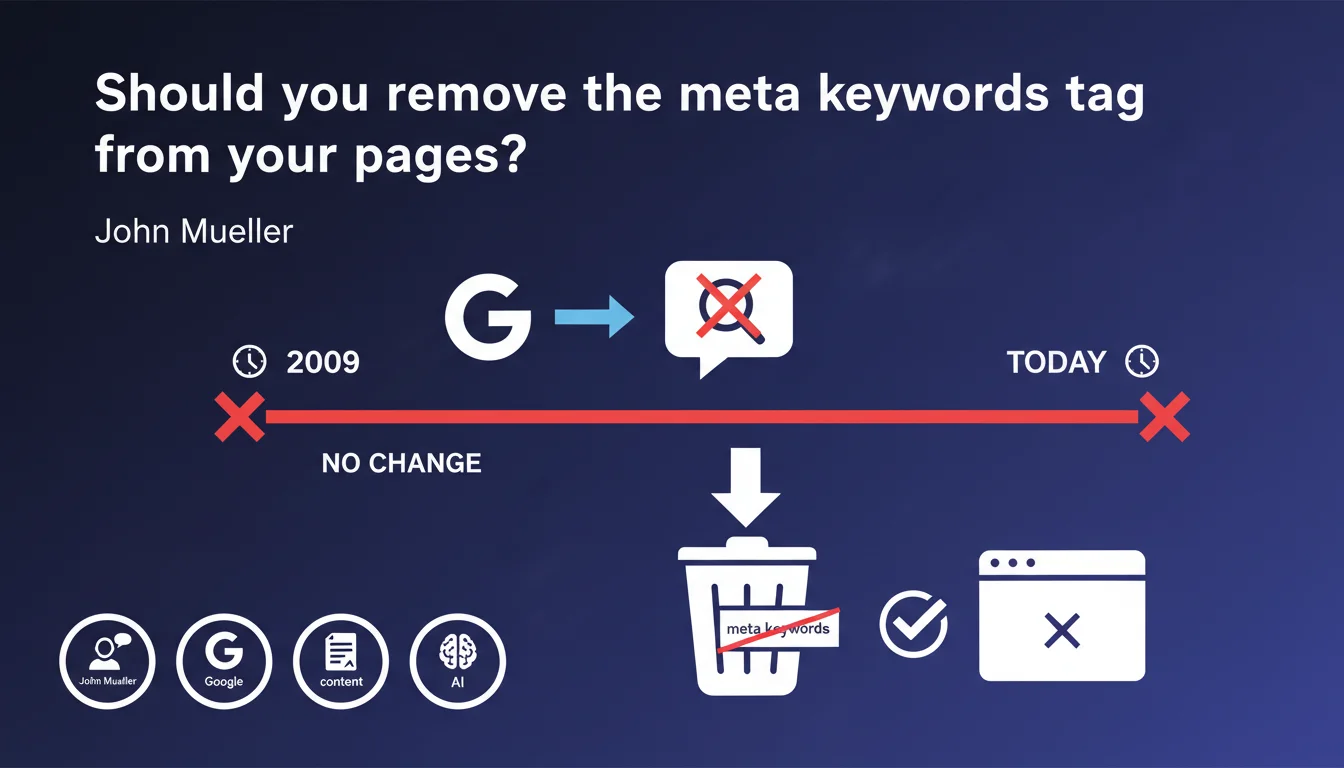
Google Search has completely ignored the meta keywords tag since at least 2009. This position has never changed and remains valid today. In concrete terms, filling in this tag brings absolutely no SEO benefit for Google — it's wasted time.
What you need to understand
Why did Google abandon the meta keywords tag?
The meta keywords tag was created in the 1990s to help search engines understand the content of a page. Except it quickly became a playground for spammers who stuffed hundreds of keywords unrelated to the actual content.
Google officially abandoned this tag in 2009, arguing that its content was unreliable and too easily manipulated. Since then, this position has never evolved — and John Mueller regularly reaffirms it to put misconceptions to rest.
Do other search engines still use this tag?
That's where it gets complicated. Google is not the only search engine in the world. Some search engines — notably Bing and Yandex — have in the past claimed they could use the meta keywords tag, but with virtually no weight.
In practice, no major search engine clearly communicates its current use of this tag. The industry consensus: even if it were read elsewhere, its impact would be insignificant.
What are the risks of filling in this tag anyway?
The direct risk is low. Filling in the meta keywords tag will not penalize your site — Google ignores it, plain and simple. However, exposing your strategic keywords in the source code can give valuable clues to your competitors.
Some paranoid SEO professionals therefore avoid filling it in to keep their strategy hidden. Others leave it empty or have removed it entirely from their templates.
- Google completely ignores the content of the meta keywords tag since 2009
- No major search engine gives it significant importance today
- Filling in this tag = waste of time and risk of exposing your strategy to competitors
- Removing it or leaving it empty has no negative impact on your search engine rankings
SEO Expert opinion
Is this statement consistent with what we observe in practice?
Absolutely. SEO tests conducted for years show that adding, modifying, or removing the meta keywords tag results in no change in rankings on Google. Even if you stuff it with hundreds of terms, no measurable impact.
SEO audit tools sometimes continue to flag the absence of this tag as a "warning" — it's just a remnant of poorly configured parameters. A good modern SEO crawl shouldn't even mention it anymore.
Are there cases where this tag can still be useful?
Let's be honest: very few. If you're targeting local or alternative search engines (like Baidu, Naver, or certain regional engines), there might be a micro-utility. But even there, data is scarce — [To verify].
Some internal search systems (site-specific search engines, closed CMS) may still read this tag. But it's such a marginal use case that it doesn't justify including it by default on all your pages.
Why do some SEO professionals continue to fill it in?
Out of habit, mainly. Or because their CMS adds it automatically and they don't question it. Some clients also require seeing it filled, believing that "it looks professional" — pure SEO cargo cult.
The problem is that maintaining this tag takes time. Time that could be invested in optimizations that actually have an impact: title tags, meta descriptions, content, internal linking.
<meta name="keywords" content="">) can sometimes cause small display bugs depending on your CMS. Test first on a few pages.Practical impact and recommendations
What should you concretely do with the meta keywords tag?
The recommendation is simple: don't waste time on this tag. If it's already on your site, you can leave it (as long as it doesn't reveal strategic keywords), or remove it to clean up your source code.
If you're launching a new project, simply don't include it in your templates. That's less code to maintain, and no SEO benefit to expect.
What mistakes should you avoid regarding this tag?
The classic mistake: spending time optimizing it when that time could be invested elsewhere. Some webmasters spend hours refining their keyword lists in this tag — pure waste of resources.
Another trap: believing it can "compensate" for weak title tags or H1s. It compensates for nothing at all since it's not read.
How can you verify your site doesn't depend on it?
Do a quick crawl with Screaming Frog, Oncrawl, or your favorite tool. Filter for the presence of the meta keywords tag. If it appears on all your pages with generic or duplicate content, that's a sign of a misconfigured template.
Also check if your CMS or SEO plugin (Yoast, RankMath, etc.) automatically fills this tag. If so, disable the option — these tools often propose it by default for historical reasons.
- Don't include the meta keywords tag in new projects
- Remove or leave empty this tag on existing sites (no negative impact)
- Never spend time optimizing it — invest instead in title, H1, content
- Check that your CMS or SEO plugin doesn't fill it automatically
- Crawl your site to identify any meta keywords tags present
- If you remove it on a large scale, test first on a sample of pages
❓ Frequently Asked Questions
La balise meta keywords peut-elle pénaliser mon site si je la remplis ?
Dois-je supprimer la balise meta keywords de toutes mes pages existantes ?
Yoast SEO ou RankMath remplissent automatiquement cette balise — dois-je désactiver cette option ?
D'autres moteurs de recherche comme Bing utilisent-ils encore la balise meta keywords ?
La balise meta keywords peut-elle aider mon moteur de recherche interne ?
Thematic analysis
🎥 From the same video 4
Other SEO insights extracted from this same Google Search Central video · published on 15/03/2022
🎥 Watch the full video on YouTube →
💬 Comments (0)
Be the first to comment.