
Official statement
Other statements from this video 4 ▾
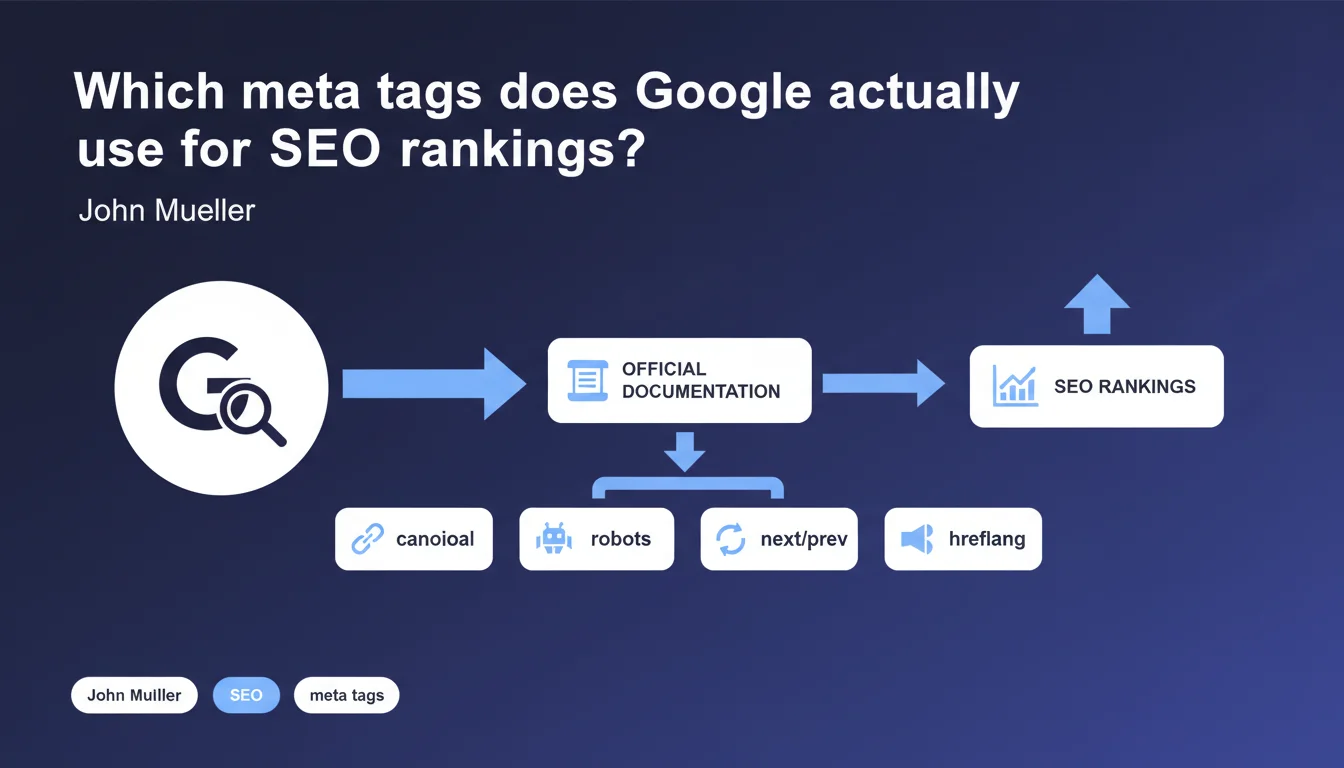
Google has published official documentation exhaustively listing all the meta tags that its search engine understands and uses. This resource finally makes it possible to distinguish meta tags relevant for SEO from those that are obsolete or ignored. An essential reference to avoid wasting time on unnecessary optimizations.
What you need to understand
Why is Google publishing this list now?
Google is finally centralizing in a single official document all the meta tags it recognizes and uses. For years, this information was scattered across different help pages, forums, and scattered statements.
This initiative responds to a recurring request from SEO professionals: to know precisely which tags actually have an impact and which have become obsolete. Rather than relying on third-party guides that are sometimes inaccurate, we now have a direct source of truth.
Are all meta tags equal in terms of SEO impact?
No, and that's the whole point of this documentation. Some tags directly influence crawl and indexation (robots, googlebot), others affect display in search results (description, title), while some have no weight in SEO but serve other Google functionalities.
The list also distinguishes between tags universally supported and those specific to certain contexts (Google News, Discover, products). Understanding this hierarchy prevents you from over-investing in marginal elements.
Does this list replace other Google resources on the subject?
It doesn't replace but rather consolidates and completes existing documentation. Specific guides (Search Console, Google News Publisher Center) remain relevant for deepening understanding of each functionality.
The advantage here is the overall vision: we now know what exists, what works, and what falls into SEO myth perpetuated without foundation.
- Centralized documentation of meta tags recognized by Google
- Clear distinction between tags with direct SEO impact and functional tags
- Official reference to settle debates about the usefulness of certain tags
- Regular updates reflecting the evolution of search engine standards
- Comprehensive but does not replace specialized guides by functionality
SEO Expert opinion
Does this documentation really address all blind spots?
Honestly? It brings clarity but doesn't solve everything. Listing the tags Google understands says nothing about their respective weight in the algorithm. We know that robots and description exist, but what role do they play compared to semantic content analysis?
The documentation remains descriptive rather than explanatory. It confirms that a tag is read, not how it is interpreted or what impact it has compared to other signals. [Needs verification] on the field for each context.
Are some listed tags overestimated by the SEO community?
Absolutely. Take the meta keywords tag: Google has officially confirmed for years that it has no SEO impact. Yet technical audits in 2025 still flag it as "missing" or "poorly optimized".
Similarly, some tags like news_keywords or syndication-source are useful in very specific niches (press, aggregators) but incorrectly applied to e-commerce or corporate sites where they add nothing.
Do observed field practices match the recommendations?
Partially. On fundamental tags (robots, canonical, description), alignment is good — high-performing sites use them correctly. However, we still observe too many syntax errors or conflicting directives (noindex + canonical, for example).
More problematic: some tags like googlebot-news or unavailable_after remain underutilized even though they can solve specific use cases (automatic deindexing post-event, fine-grained control of news crawl). The documentation helps rediscover them.
Practical impact and recommendations
What concretely should you do with this documentation?
First action: audit your current meta tags by cross-referencing them with the official list. Identify those that are recognized, those that are ignored (and therefore unnecessary to maintain), and those that are missing but could serve your context.
Second step: clean up obsolete or misused tags. Remove meta keywords, correct conflicting directives (noindex + index on the same set of pages), standardize syntax (robots vs googlebot depending on needs).
What errors should you avoid during implementation?
Classic error: stacking tags "just in case" without understanding their function. Adding tags that don't correspond to your content type (for example, Google News tags on a site without news) pollutes the code and can create ambiguous signals.
Another trap: neglecting consistency between tags. A noindex directive in meta robots should be consistent with robots.txt and the X-Robots-Tag HTTP header. Inconsistencies slow down indexation or create Search Console errors.
How do you verify that your site properly leverages relevant tags?
Use Search Console to identify indexed or non-indexed pages, then cross-reference with your meta tags. A tool like Screaming Frog or Oncrawl lets you extract all present tags and quickly spot anomalies (orphaned pages with noindex, looping canonicals).
Also test your tags in real conditions: submit a URL via the URL Inspection tool and verify that Google correctly interprets your directives (particularly robots, canonical, refresh).
- Cross-reference your current tags with the official Google list
- Remove all obsolete tags (keywords, revisit-after, etc.)
- Verify consistency between meta robots, robots.txt, and HTTP headers
- Implement missing relevant tags for your sector (ex: unavailable_after for events)
- Audit syntax: no conflicting directives (noindex + canonical on the same page)
- Test actual interpretation via Search Console URL Inspection
- Document internally which tags are used and why
❓ Frequently Asked Questions
La balise meta keywords a-t-elle encore un impact SEO en 2025 ?
Quelle différence entre la balise robots et googlebot ?
Faut-il utiliser la balise canonical sur toutes les pages ?
La balise meta description influence-t-elle directement le classement ?
Peut-on combiner plusieurs directives dans une seule balise robots ?
🎥 From the same video 4
Other SEO insights extracted from this same Google Search Central video · published on 15/03/2022
🎥 Watch the full video on YouTube →
💬 Comments (0)
Be the first to comment.