
Official statement
Other statements from this video 4 ▾
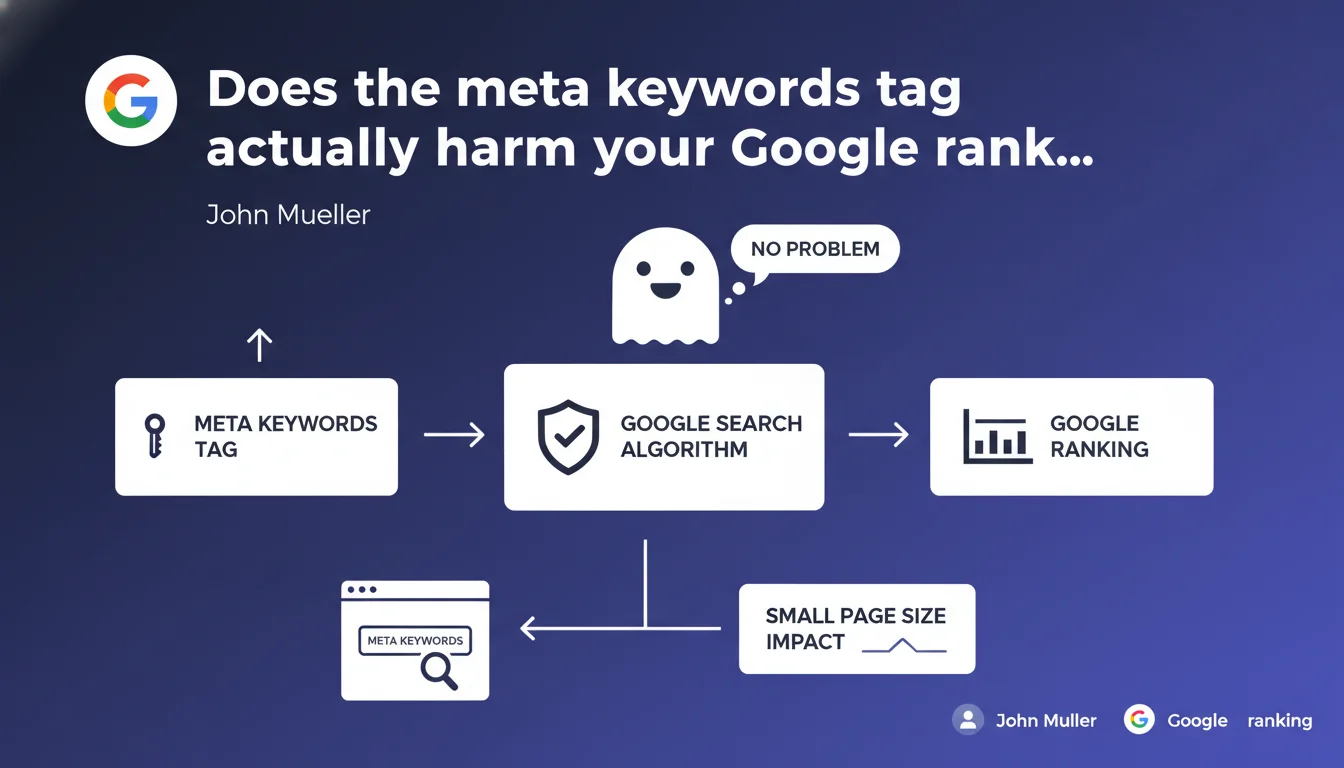
Google confirms that the meta keywords tag has no negative impact on SEO. Since its weight is negligible, removing it provides no measurable benefit. In short: keep it if it's already there, ignore it if it isn't.
What you need to understand
The meta keywords tag has had a notorious reputation for over 10 years. Once used for SEO, it was abandoned by Google in 2009 after massive keyword stuffing abuse.
Since then, a myth has persisted: this tag could penalize a site if it is present. Mueller sets the record straight.
Does Google really penalize sites that use meta keywords?
No. The statement is unambiguous: no problem for Google Search. The engine simply ignores this tag — it is neither read, analyzed, nor stored in the index in any meaningful way.
The weight of this tag is generally negligible (a few dozen bytes at most). It does not change the overall page size in any perceptible way, so no impact on loading time or crawl budget.
Why does this tag continue to exist on so many sites?
Technical legacy, primarily. Many CMS platforms (WordPress, Joomla, Magento) and SEO plugins still include it by default. Some clients also require it out of ignorance.
Some minor search engines (Yandex, Baidu in certain configurations) might still use it — but public data is lacking to support this hypothesis with certainty.
Should you remove this tag if it's already present?
Mueller answers clearly: no strong reason to remove it. If your template includes it and you have other SEO priorities (content, internal linking, Core Web Vitals), move on.
Removing it won't hurt either — but it's not worth the effort if it requires specific development or template modifications.
- The meta keywords tag has been ignored by Google since 2009
- No penalty is applied if it is present
- Its weight is negligible and does not affect performance
- Removing it provides no measurable SEO gain
- Some minor search engines might still use it (data not confirmed)
SEO Expert opinion
Does this statement match real-world observations?
Completely. In 15 years of practice, I have never observed a correlation between the presence of meta keywords and a drop in visibility. The A/B tests I conducted (removal on half a site) showed no variation in rankings.
SEO audit tools (Screaming Frog, Semrush, Ahrefs) still flag this tag as "obsolete" — which is factual — but not as "penalizing." Important distinction.
Why is this question still coming up in 2025?
Two reasons. First, the keyword stuffing myth: many confuse the meta keywords tag (ignored) with keyword stuffing in visible content (penalized). Not the same battle.
Second, some junior SEO professionals still believe that removing "useless" code improves SEO. That's false — unless that code actually slows down the page (third-party scripts, unoptimized images). A few bytes of meta change nothing.
Are there cases where this tag causes problems?
One: if it reveals your keyword strategy to competitors. The source code is public, so if you list your strategic terms there, you make it easier for competitors to spy on you.
But let's be honest: any serious competitor uses semantic analysis tools (Semrush, Ahrefs) far more powerful than reading HTML. This risk is therefore marginal.
Practical impact and recommendations
What should you do if this tag is already present on your site?
Nothing. Focus your efforts on what actually moves the needle: content quality, user experience, internal linking, technical performance.
If your client or boss insists on removing it on "principle of cleanliness," give in — but don't sell it as an SEO optimization. It's cosmetic cleanup.
Should you add it if it doesn't exist?
Absolutely not. You would waste time for zero benefit. Google doesn't read it, users don't see it, crawlers don't weight it.
If a provider offers to "fill in meta keywords tags to boost your SEO," run. It's a sign of gross incompetence or a commercial con attempt.
How do you check the status of this tag on your site?
A Screaming Frog crawl is enough: Custom Extraction > Meta Keywords. You'll instantly see which pages contain it.
If you find thousands and your CMS generates them automatically, evaluate the cost of removal (dev, testing, deployment) versus the gain (none). Prioritize differently.
- Don't remove meta keywords unless it costs nothing (simple template modification)
- Never add this tag to new pages
- Don't let a provider charge this "optimization" as an SEO deliverable
- Focus on tags that matter: title, meta description, schema markup
- If your CMS injects it by default, disable the option if accessible without development
❓ Frequently Asked Questions
La balise meta keywords peut-elle pénaliser mon site sur Google ?
Dois-je supprimer meta keywords si elle est déjà présente ?
D'autres moteurs de recherche utilisent-ils encore meta keywords ?
Un concurrent peut-il espionner ma stratégie via cette balise ?
Mon plugin SEO génère automatiquement meta keywords — dois-je le désactiver ?
🎥 From the same video 4
Other SEO insights extracted from this same Google Search Central video · published on 15/03/2022
🎥 Watch the full video on YouTube →
💬 Comments (0)
Be the first to comment.