
Official statement
What you need to understand
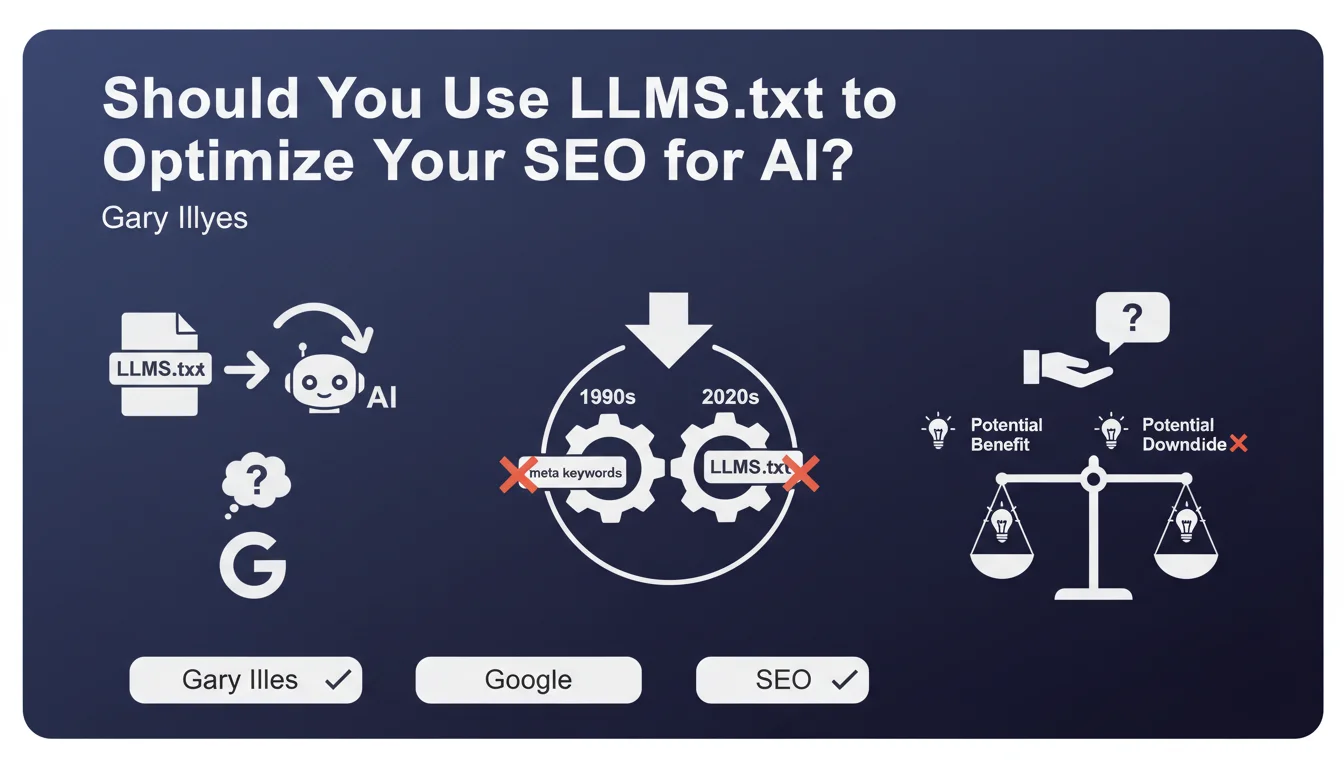
The LLMS.txt file is a recent initiative aimed at allowing website owners to control language models' (LLMs) access to their content. The idea is to be able to specify which parts of the site can be indexed and used by generative AI.
Gary Illyes, from Google, has drawn a critical parallel with the meta keywords tag, that HTML tag from the 1990s that allowed webmasters to declare their target keywords. It was quickly abandoned because it was massively manipulated by SEOs, losing all value for search engines.
This comparison suggests that Google does not intend to take the LLMS.txt file into account in its content processing. The search engine seems to prefer its own control and analysis mechanisms rather than relying on declarations from site owners.
- LLMS.txt is considered potentially ineffective by Google, just like meta keywords
- Google favors its own analysis systems rather than webmasters' declarations
- The absence of a downside does not mean there is a real advantage to using it
- This position reflects Google's general skepticism towards external control attempts
SEO Expert opinion
This statement is perfectly consistent with Google's history regarding control attempts by webmasters. The engine has always preferred its own analyses to site owners' declarations, precisely to avoid manipulation.
However, it's important to nuance this: the context of LLMs is different from that of the 1990s. The issues of intellectual property and content respect are more sensitive today. Other AI players could potentially respect this file, even if Google doesn't.
The real question is not so much whether Google will use LLMS.txt, but rather to focus your efforts on recognized and effective optimizations rather than on speculative initiatives that may never be adopted.
Practical impact and recommendations
- Don't prioritize creating an LLMS.txt file in your current SEO strategy
- Use robots.txt correctly to control Google bot access (including Google-Extended for AI)
- Focus your efforts on quality content that addresses real search intents
- Optimize for featured snippets and direct answers, which already feed Google's AI systems
- Monitor your structured data (Schema.org) which is actually leveraged by Google to understand your content
- Document your content strategy with clear policies on authorized use, rather than relying on a technical file
- Stay informed about developments in this situation, as other AI players might adopt LLMS.txt even if Google doesn't
Implementing a coherent SEO strategy in the face of emerging generative AI requires a deep understanding of technical mechanisms and constant algorithmic evolutions. These optimizations touch on many aspects: technical structure, content quality, structured data, bot access control. To effectively orchestrate all these elements and ensure your site makes the most of current opportunities rather than betting on uncertain initiatives, guidance from a specialized SEO agency can prove valuable in establishing a personalized roadmap adapted to your specific challenges.
💬 Comments (0)
Be the first to comment.