
Official statement
What you need to understand
Google has just confirmed the adoption of cutting-edge technology in its search engine: a method similar to MUVERA (Multi-Vector Retrieval Architecture). This technique represents a major evolution in how the search engine processes and ranks search results.
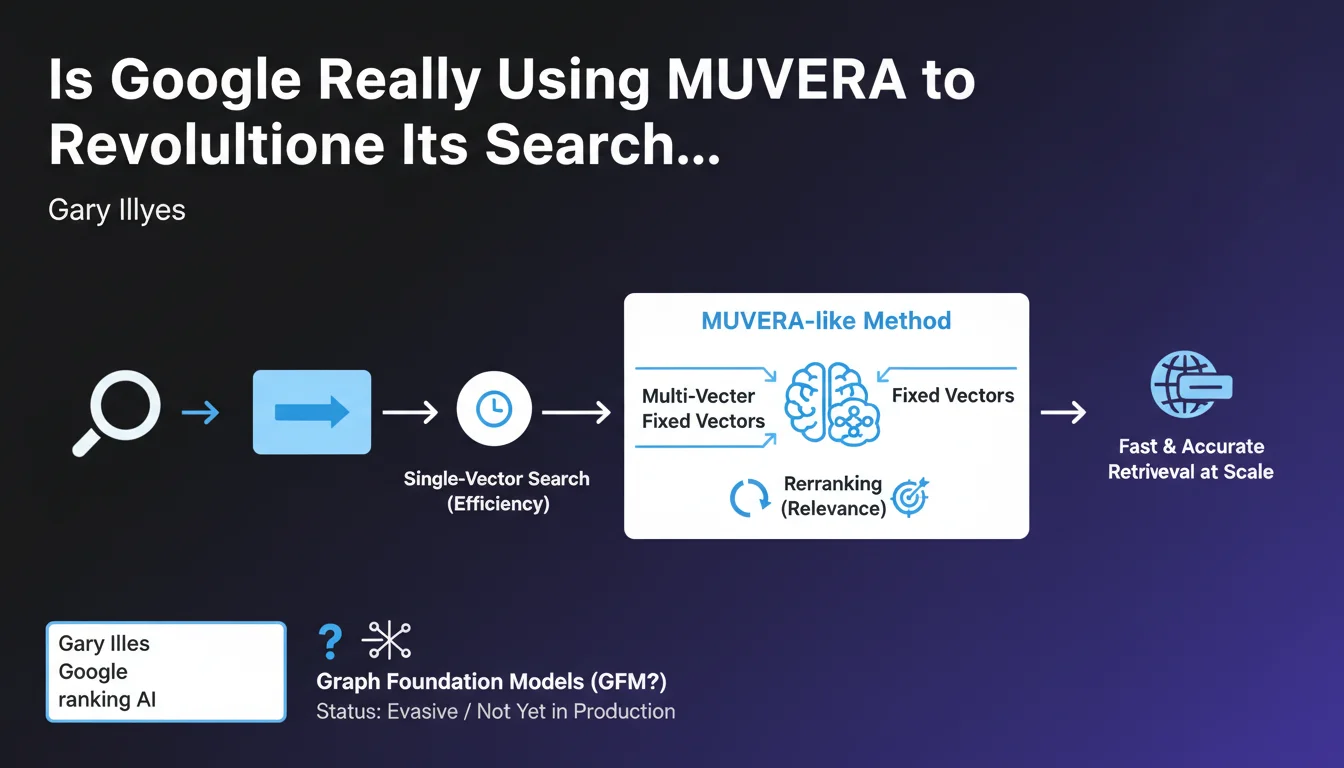
MUVERA combines two complementary approaches to improve result relevance. First, a single-vector search system enables rapid processing of billions of pages. Then, multi-vector reranking refines the final ranking by analyzing relevance in a more nuanced way.
This confirmation provides valuable insight into Google's technical architecture. The search engine no longer simply uses classic signals, but compressed vector representations that capture the deep semantics of content.
- Multi-vector search: Google analyzes content across multiple semantic dimensions simultaneously
- Fixed-vector compression: enables large-scale processing without sacrificing precision
- Intelligent reranking: results are reorganized after initial selection to maximize relevance
- Graph Foundation Models: their use in production remains unconfirmed according to Gary Illyes
SEO Expert opinion
This statement confirms the shift toward semantic machine learning that we've been observing for several years. The practices that currently work (in-depth content, clear semantic structure, well-defined entities) are perfectly explained by this vector architecture.
The vagueness maintained around Graph Foundation Models is interesting. Either Google is still testing them, or the company prefers to remain discreet about this technological component. In both cases, this suggests that relationships between entities and concepts will become even more important soon.
Sites currently struggling with SEO despite good content might suffer from a lack of semantic clarity. MUVERA likely penalizes ambiguous or poorly structured content, because the vector system needs clear signals to create accurate representations.
Practical impact and recommendations
- Structure your content around clear entities: each page must have a perfectly identifiable main topic with explicit named entities
- Develop semantic depth: cover sub-topics and related concepts to enrich the vector representation of your pages
- Optimize thematic interconnections: create coherent semantic silos where pages mutually reinforce each other through their conceptual proximity
- Avoid semantic ambiguity: clarify context from the introduction, use precise terms rather than approximate synonyms
- Abandon single-keyword optimization: MUVERA analyzes multidimensional vectors, not isolated words. Think complete semantic fields.
- Strengthen topical authority signals: multi-vector reranking likely rewards demonstrated expertise in a specific domain
- Test inter-page semantic consistency: verify that your related content presents strong, non-contradictory thematic logic
- Monitor ranking fluctuations: MUVERA may cause fluctuations for pages at the boundary of multiple semantic fields
In summary: the adoption of MUVERA-type methods confirms that Google now prioritizes deep semantic understanding over surface optimization. Your strategy must evolve toward vectorially coherent content architecture.
Implementing these advanced semantic optimizations requires sharp technical expertise and a holistic strategic vision of your content ecosystem. If your team lacks resources or experience in these dimensions, support from an SEO agency specializing in semantic architecture can prove decisive in effectively structuring your migration to these new relevance standards.
💬 Comments (0)
Be the first to comment.