
Official statement
Other statements from this video 10 ▾
- □ Les snippets sont-ils vraiment le levier SEO le plus sous-estimé pour booster votre CTR ?
- □ Faut-il vraiment répéter ses mots-clés dans les titres pour ranker ?
- □ Pourquoi Google insiste-t-il autant sur l'unicité des balises title ?
- □ Comment Google génère-t-il vraiment les snippets de vos pages dans les résultats de recherche ?
- □ Google peut-il vraiment ignorer vos balises title et meta description ?
- □ La meta description doit-elle vraiment être un argumentaire commercial ?
- □ Faut-il vraiment oublier la limite de 155 caractères pour les meta descriptions ?
- □ Faut-il vraiment rédiger les meta descriptions comme des phrases complètes ?
- □ Faut-il vraiment rédiger une meta description unique pour chaque page ?
- □ Comment optimiser techniquement les balises title et meta description pour maximiser leur impact SEO ?
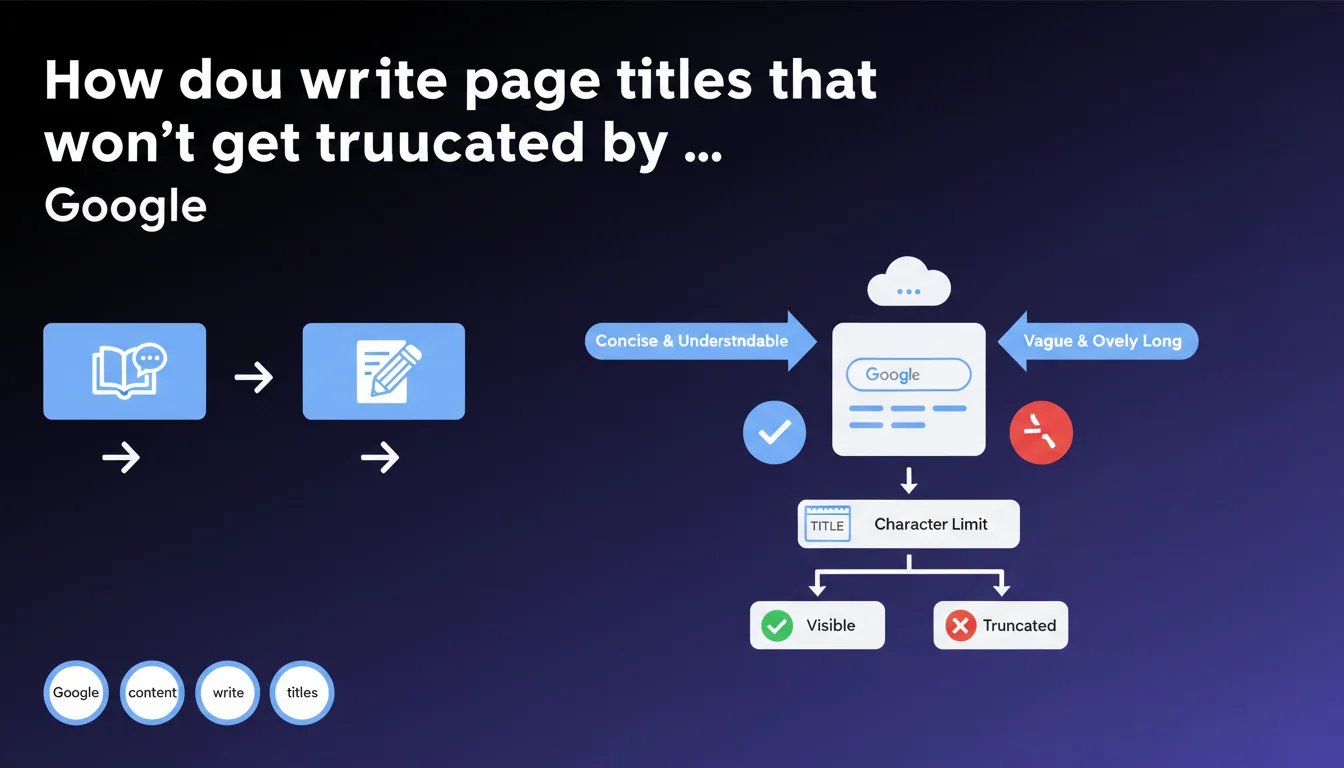
Google reminds us that an effective title must be concise, understandable, and clearly communicate the page's content. Titles that are too long risk being cut off in SERPs, and vague wording hurts click-through rates. The stakes: maximize visibility and appeal without exceeding display limits.
What you need to understand
Why does Google insist on concise titles?
Google displays approximately 600 pixels of width for a title in desktop search results, which corresponds to roughly 50-60 characters. Beyond that, the title gets cut off with ellipsis.
A truncated title loses clarity and impact. The user no longer understands the offer, hesitates, and may choose a competitor whose title is complete. CTR drops mechanically.
What does "understandable" mean to Google?
An understandable title gets straight to the point. It doesn't drown the message in jargon, hollow superlatives, or keywords piled up without logic.
Google values titles that accurately reflect the page's content. If the algorithm detects a mismatch between the title and the content, it may automatically rewrite it by pulling from the H1, the beginning of the text, or internal link anchors.
What are the pitfalls of vague titles?
Generic phrases like "Welcome to our website" or "Home - Company" provide no indication of the content. They are invisible in SERP competition.
A vague title doesn't stand out, doesn't appeal to anyone, and doesn't address any search intent. It might as well not exist.
- Prioritize titles that precisely describe the offer or topic covered
- Respect the 50-60 character limit to avoid truncation
- Avoid repeated keywords or hollow wording
- Match the title with the H1 and actual page content
- Anticipate that Google may rewrite a title deemed inadequate
SEO Expert opinion
Is this statement consistent with real-world observations?
Yes, but with a caveat: Google massively rewrites titles. According to several studies, between 60% and 70% of titles displayed in SERPs don't exactly match the original <title> tag.
Google pulls from H1s, anchor texts, meta tags, or even page content to reword. Practically speaking, even a "perfect" title can be modified if the algorithm believes another element is more relevant to the query.
In what cases doesn't this rule fully apply?
On brand or navigation queries, a long title including the company name + description can be truncated without negative impact. The user recognizes the brand and clicks anyway.
For highly specific niche pages, a descriptive 70-character title can outperform a short but vague title, even if truncated. Context always trumps the general rule. [To verify]: Google doesn't communicate an official pixel or character threshold; the 50-60 character estimate is empirical.
What nuances should be applied to this recommendation?
"Conciseness" doesn't mean "minimalism." A 15-character title isn't necessarily better than a well-constructed 55-character title.
The goal is to optimize the information-to-space ratio. Every word must justify its presence. If an adjective or verb adds nothing to understanding, it pollutes.
Practical impact and recommendations
What should you concretely do to optimize your titles?
First step: audit existing titles with a crawler (Screaming Frog, Oncrawl, Botify). Identify those exceeding 60 characters, duplicates, empty or generic ones.
Second step: compare your <title> tags with titles actually displayed in SERPs. If Google is massively rewriting them, that's a signal of mismatch between your titles and algorithm expectations.
What errors should you absolutely avoid?
Don't repeat the main keyword multiple times in the same title. Google understands synonyms and variants; there's no need to over-optimize.
Avoid fixed structures like "Keyword | Brand Name" on all pages. Vary formulations based on page type (product sheet, blog article, service page).
- Limit titles to 50-60 characters to avoid truncation
- Place important keywords at the beginning of the title
- Match the title with the H1 and page content
- Avoid vague or generic wording
- Check Search Console for titles rewritten by Google
- Test multiple variants with A/B testing if traffic allows
- Don't duplicate titles across multiple pages
How can you verify that your site complies?
Use Search Console to list indexed pages and verify displayed titles. Compare them with your actual <title> tags.
Test your titles with a SERP simulator (like Mangools or Portent) to visualize the final rendering. Anticipate cutoffs and adjust accordingly.
❓ Frequently Asked Questions
Quelle est la longueur idéale d'un titre pour Google ?
Google peut-il réécrire mes titres même s'ils sont optimisés ?
Faut-il répéter le mot-clé principal plusieurs fois dans le titre ?
Comment savoir si mes titres sont trop longs ?
Un titre court est-il toujours meilleur qu'un titre long ?
🎥 From the same video 10
Other SEO insights extracted from this same Google Search Central video · published on 24/02/2022
🎥 Watch the full video on YouTube →
💬 Comments (0)
Be the first to comment.