
Official statement
Other statements from this video 13 ▾
- □ Faut-il vraiment craindre son prestataire SEO ?
- □ Quelles questions un prestataire SEO doit-il vraiment poser avant d'intervenir ?
- □ Pourquoi votre prestataire SEO doit-il comprendre votre business avant de toucher à votre site ?
- □ Pourquoi personne ne peut garantir votre classement sur Google ?
- □ Que risque vraiment un site qui enfreint les directives Google ?
- □ Comment vérifier qu'un prestataire SEO livre vraiment des résultats durables ?
- □ Faut-il vraiment intégrer le SEO à la stratégie business plutôt que de le traiter comme un canal d'acquisition ?
- □ Faut-il donner un accès complet à la Search Console à son prestataire SEO ?
- □ Faut-il vraiment confier l'audit SEO de son site à un prestataire externe ?
- □ Faut-il vraiment optimiser pour l'utilisateur plutôt que pour Google ?
- □ Comment estimer l'investissement SEO et l'impact business d'un audit ?
- □ Comment prioriser les optimisations SEO pour maximiser le ROI avec un minimum de ressources ?
- □ Faut-il vraiment définir des objectifs précis avant de piloter une stratégie SEO ?
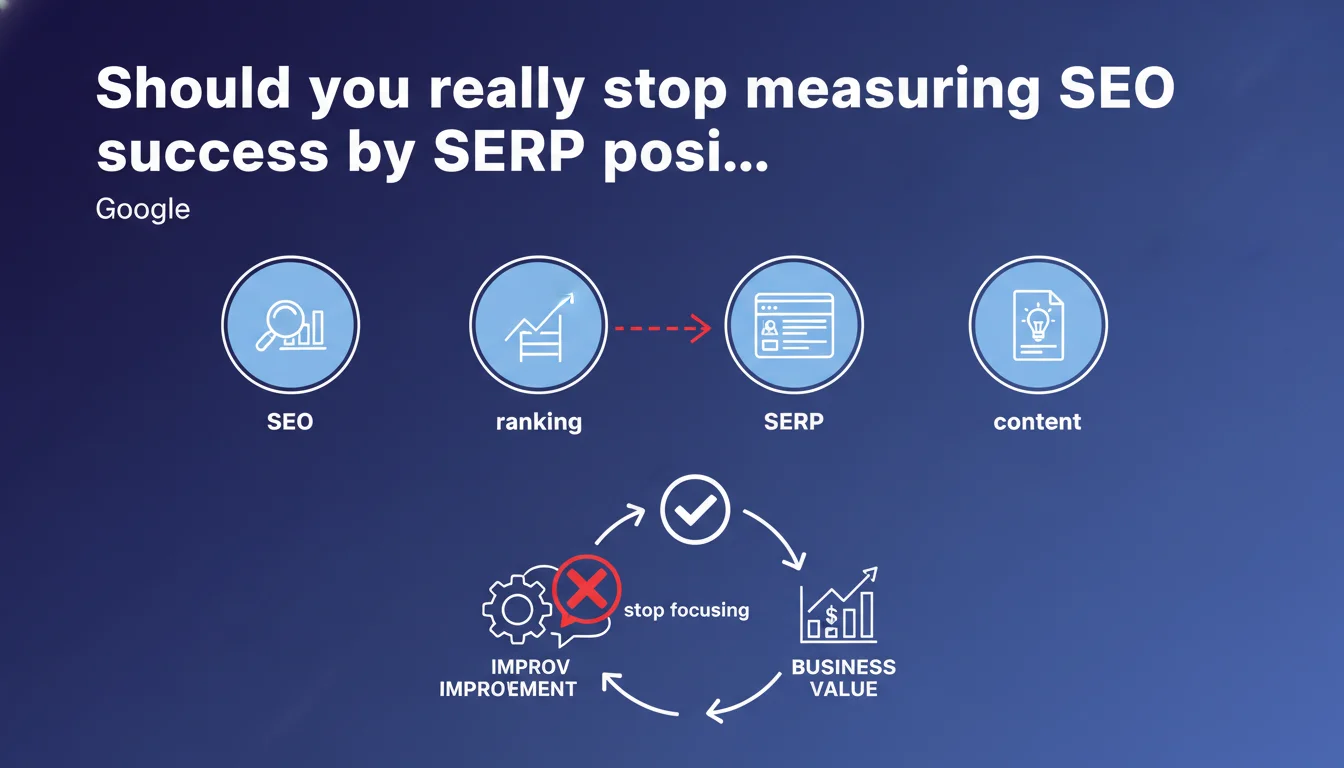
Google states that a good SEO provider must prioritize the business value delivered by content rather than simple rankings in search results. The message is clear: positions are just an intermediate indicator, not an end goal. The real objective remains conversion, engagement, and measurable ROI.
What you need to understand
Does Google say that positions no longer matter at all?
No. Google does not deny the importance of positions, but refocuses the debate on what comes next: traffic quality and conversion. A site ranking first for an off-topic or poorly targeted query brings no tangible business value.
What Google is implicitly criticizing is the unhealthy obsession with rankings disconnected from business objectives. A provider who sells only positioning without questioning keyword relevance or the site's conversion ability misses the essential point.
What is the distinction between "ranking" and "business value"?
A ranking is a visibility indicator. Business value encompasses click-through rate, time on page, conversions, average order value, customer retention. All metrics that positioning alone cannot capture.
Google emphasizes this distinction because its business model depends on user satisfaction. If well-ranked sites disappoint users, Google loses credibility. Hence this reminder: optimize for the end user, not just the algorithm.
How does "displayed content" bring value?
Displayed content refers to what the user sees in snippets, rich results, enhanced extracts. A compelling title, persuasive meta description, properly implemented structured data: all of this influences actual click-through rate.
Google implies that a site ranking #3 can generate more qualified traffic than a #1 site with a mediocre snippet. This is a field reality that every experienced SEO knows, but few clients understand without guidance.
- Ranking alone guarantees neither clicks nor conversions
- Content relevance to search intent takes priority
- Optimized snippets (title, meta, rich results) directly influence CTR
- Business value is measured in ROI, not raw positions
- A good provider educates the client on these nuances
SEO Expert opinion
Is this statement consistent with practices observed in the field?
Yes and no. On paper, Google is right: measuring only positions is reductive. In reality, it is often the client themselves who demands position reports — because it is tangible, easy to understand, and they can compare with competitors.
The problem is that Google asks providers to educate clients without providing clear tools to measure this famous "business value." Google Analytics provides conversions, but linking a conversion precisely to a specific SEO improvement remains complex without an advanced analytics stack. [To verify] whether Google considers its own tools sufficient to track this value.
What nuances should be added to this statement?
Google oversimplifies. Business value depends on the sector, sales cycle, and business model. For an e-commerce site, ROI is direct. For a B2B site with a long sales cycle, "value" might be a completed form whose final conversion takes 6 months.
Second nuance: positions remain a reliable visibility proxy. Telling a client "you're on page 3 but your content brings value" is a difficult narrative to maintain. Positions are not everything, but they remain a structuring KPI for 90% of clients.
In what cases does this logic not really apply?
For pure content sites (media, blogs), business value is often directly correlated with raw traffic. More top-3 positions = more page views = more ad revenue. In this model, neglecting positions in favor of vague "value" would be counterproductive.
Same for brands in acquisition phase: if you launch a product and nobody finds you, business value is zero. You must first gain visibility (thus positions) before you can optimize conversion.
Practical impact and recommendations
What should you do concretely to align SEO with business value?
Start by qualifying your keywords by their conversion potential, not just search volume. A keyword with 500 searches/month and 10% conversion rate beats a keyword with 5000 searches and 0.5% conversion.
Next, optimize your snippets: compelling titles, action-oriented meta descriptions, structured data to earn rich results. A good snippet can double your CTR at equal position.
Finally, implement rigorous analytics tracking: Google Analytics 4 with custom events, conversion-focused dashboards, multi-touch attribution if the sales cycle justifies it. Without measurement, proving value is impossible.
What mistakes should you avoid when overhauling an SEO strategy focused on business?
Classic mistake: abandoning position tracking under the pretense that "Google says it doesn't matter." Google says it is not sufficient, not that it is useless. Keep your position dashboards, but supplement them with CTR, assisted conversions, SEO revenue.
Another trap: trying to measure "business value" without defining what that means for the client. A qualified lead? A direct sale? A newsletter subscription? Without a precise definition, you will be flying blind.
How can you verify that your SEO provider applies this logic?
Ask them about business objectives before even discussing positions. If they start with "we'll get you ranked top 3 for this keyword" without questioning your conversion funnel, that is a bad sign.
Request ROI-oriented performance reports: qualified organic traffic, conversion rate by landing page, SEO attribution on sales. A good provider must talk revenue, not just impressions and clicks.
- Qualify keywords by their real conversion potential
- Optimize snippets (titles, meta, rich results) to maximize CTR
- Implement conversion-oriented analytics tracking (GA4, custom events)
- Clearly define what "business value" means in your context
- Do not abandon position tracking, but contextualize it
- Measure SEO ROI through multi-touch attribution if complex sales cycle
- Train internal teams to read business-oriented reports, not just position reports
❓ Frequently Asked Questions
Google dit-il que les positions ne comptent plus ?
Comment mesurer concrètement la valeur business du SEO ?
Faut-il arrêter de suivre les positions dans les rapports SEO ?
Un site peut-il réussir en SEO sans être systématiquement premier ?
Quel est le principal piège à éviter avec cette approche ?
🎥 From the same video 13
Other SEO insights extracted from this same Google Search Central video · published on 24/02/2022
🎥 Watch the full video on YouTube →
💬 Comments (0)
Be the first to comment.