
Official statement
Other statements from this video 13 ▾
- □ Faut-il vraiment arrêter de mesurer le succès SEO aux positions dans les SERP ?
- □ Quelles questions un prestataire SEO doit-il vraiment poser avant d'intervenir ?
- □ Pourquoi votre prestataire SEO doit-il comprendre votre business avant de toucher à votre site ?
- □ Pourquoi personne ne peut garantir votre classement sur Google ?
- □ Que risque vraiment un site qui enfreint les directives Google ?
- □ Comment vérifier qu'un prestataire SEO livre vraiment des résultats durables ?
- □ Faut-il vraiment intégrer le SEO à la stratégie business plutôt que de le traiter comme un canal d'acquisition ?
- □ Faut-il donner un accès complet à la Search Console à son prestataire SEO ?
- □ Faut-il vraiment confier l'audit SEO de son site à un prestataire externe ?
- □ Faut-il vraiment optimiser pour l'utilisateur plutôt que pour Google ?
- □ Comment estimer l'investissement SEO et l'impact business d'un audit ?
- □ Comment prioriser les optimisations SEO pour maximiser le ROI avec un minimum de ressources ?
- □ Faut-il vraiment définir des objectifs précis avant de piloter une stratégie SEO ?
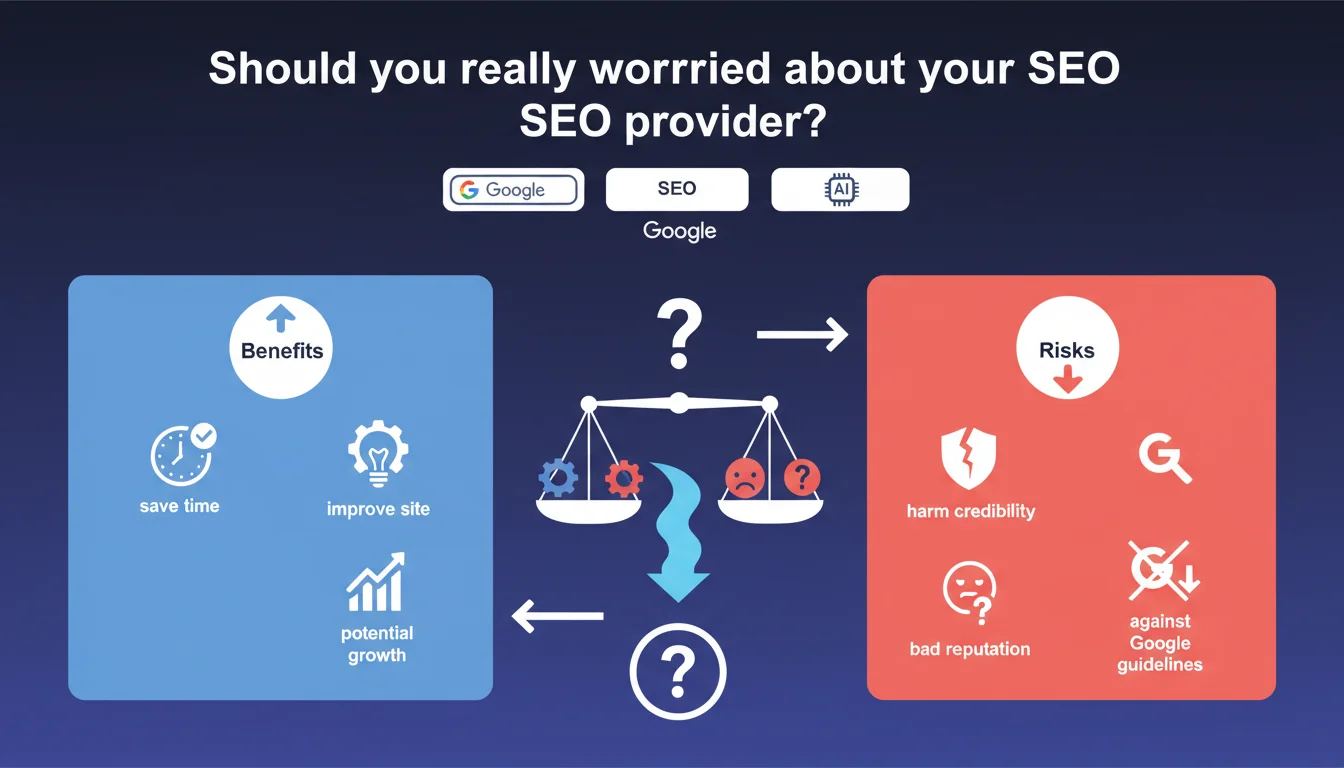
Google reminds us that an incompetent SEO provider can permanently damage a site's credibility and its operator's reputation. The main risk: recommendations that violate guidelines and expose you to penalties. The issue goes beyond technical concerns—it's also about reputation.
What you need to understand
Why is Google issuing this reminder about SEO providers?
This statement is part of a warning campaign that Google has been repeating for years. The stated objective: protect site owners from excessive promises and risky techniques.
Concretely, Google is pointing fingers at providers who recommend practices that violate the Search Essentials — formerly known as Webmaster Guidelines. This includes cloaking, massive link buying, keyword stuffing, or generating low-quality automated content.
What does Google mean by "harming a site's and operator's credibility"?
The message goes beyond a simple algorithmic penalty. Google is pointing to a reputational risk: a penalized site loses visibility, but also the trust of its users and business partners.
An incompetent provider can trigger a manual action, a sharp drop in organic traffic, or even partial deindexation. The damage can take months to repair—and some sites never fully recover.
How do you identify an "unqualified" SEO provider?
Google doesn't provide precise criteria, which leaves room for broad interpretation. In practice, red flags include: guarantees of ranking #1, abnormally low rates, lack of transparent reporting, or reliance on opaque techniques.
A good provider documents their recommendations, justifies their strategic choices, and aligns their practices with the Search Essentials. They refuse risky shortcuts and prioritize a sustainable approach.
- Main risk: recommendations that violate Google's guidelines
- Consequences: algorithmic penalties, manual actions, loss of credibility
- Reputational impact: effects on user and partner trust
- Red flags: unrealistic guarantees, lack of transparency, opaque techniques
- Solution: audit recommendations, demand documentation, verify alignment with Search Essentials
SEO Expert opinion
Is there something more behind this warning?
Let's be honest: this type of statement also serves Google's interests. By demonizing certain practices, the search engine strengthens its control over the SEO ecosystem and discourages webmasters from exploring gray areas.
The problem is that Google remains deliberately vague on certain criteria. What exactly is "bad advice"? The line between legitimate optimization and manipulation varies depending on interpretation—and Google reserves the right to move it as it sees fit. [To verify]: no quantitative thresholds are provided to distinguish an acceptable practice from a risky one.
Are "good" providers really immune to penalties?
No. Even when meticulously following the Search Essentials, a site can experience a visibility drop after an algorithm update. Google adjusts its criteria constantly, and what worked yesterday can become problematic tomorrow.
Manual actions, in theory, target clear violations. But we regularly see false positives—sites penalized unfairly, which must then argue through Search Console to get relief. The process is lengthy, opaque, and rarely documented publicly.
Should you avoid all risk in SEO then?
This is where it gets tricky. A 100% "safe" SEO strategy according to Google can turn out to be completely ineffective against more aggressive competitors. Certain ultra-competitive sectors require testing techniques in the gray zone—which doesn't mean black hat, but simply outside the scope explicitly validated by Google.
Expertise consists precisely in evaluating the risk/benefit ratio depending on context: industry, competition level, client tolerance for fluctuations. A good provider knows when to push forward and when to hold back—and they document their choices so the client can decide with full knowledge of the facts.
Practical impact and recommendations
How do you audit your current provider's recommendations?
First step: demand detailed reporting of all actions taken. If your provider refuses to document their interventions, that's an immediate red flag.
Second point: verify compliance with Search Essentials. Review the recommendations and cross-reference them with Google's explicit prohibitions. Any technique that relies on concealment, link manipulation, or automated content generation deserves careful scrutiny.
What technical checks should you prioritize?
Consult Search Console to detect any manual actions. Verify the absence of cloaking by comparing server-side and client-side rendering. Inspect your incoming link profile using third-party tools—a sudden spike in low-quality backlinks is a risk indicator.
Also analyze the quality of added content: if it looks like massively generated text with no added value, you're probably in dangerous territory. The Helpful Content updates specifically target this type of practice.
What should you do if risky practices have already been implemented?
Stop dubious actions immediately. Document everything that was done—you'll need it for a potential reconsideration request if a manual action is triggered.
Then correct methodically: remove or disavow toxic links, clean up low-quality content, eliminate any concealment techniques. The process can take weeks or even months depending on the extent of the damage.
- Demand transparent, documented reporting of all SEO actions
- Cross-reference recommendations with Google's Search Essentials
- Regularly check Search Console for manual actions
- Audit your incoming link profile with third-party tools (Ahrefs, Majestic, Semrush)
- Analyze the quality and origin of recently published content
- Compare server-side and client-side rendering to detect possible cloaking
- Document all doubtful practices identified before correction
- Clean up systematically: disavow toxic links, remove spam content
❓ Frequently Asked Questions
Quels sont les principaux risques concrets d'un prestataire SEO non qualifié ?
Comment vérifier qu'un prestataire SEO respecte les Search Essentials ?
Un site peut-il être pénalisé même en respectant les directives Google ?
Que faire si mon prestataire actuel a déjà appliqué des techniques risquées ?
Existe-t-il une liste officielle des pratiques SEO autorisées par Google ?
🎥 From the same video 13
Other SEO insights extracted from this same Google Search Central video · published on 24/02/2022
🎥 Watch the full video on YouTube →
💬 Comments (0)
Be the first to comment.