
Official statement
Other statements from this video 13 ▾
- □ Faut-il vraiment craindre son prestataire SEO ?
- □ Faut-il vraiment arrêter de mesurer le succès SEO aux positions dans les SERP ?
- □ Quelles questions un prestataire SEO doit-il vraiment poser avant d'intervenir ?
- □ Pourquoi votre prestataire SEO doit-il comprendre votre business avant de toucher à votre site ?
- □ Pourquoi personne ne peut garantir votre classement sur Google ?
- □ Que risque vraiment un site qui enfreint les directives Google ?
- □ Comment vérifier qu'un prestataire SEO livre vraiment des résultats durables ?
- □ Faut-il donner un accès complet à la Search Console à son prestataire SEO ?
- □ Faut-il vraiment confier l'audit SEO de son site à un prestataire externe ?
- □ Faut-il vraiment optimiser pour l'utilisateur plutôt que pour Google ?
- □ Comment estimer l'investissement SEO et l'impact business d'un audit ?
- □ Comment prioriser les optimisations SEO pour maximiser le ROI avec un minimum de ressources ?
- □ Faut-il vraiment définir des objectifs précis avant de piloter une stratégie SEO ?
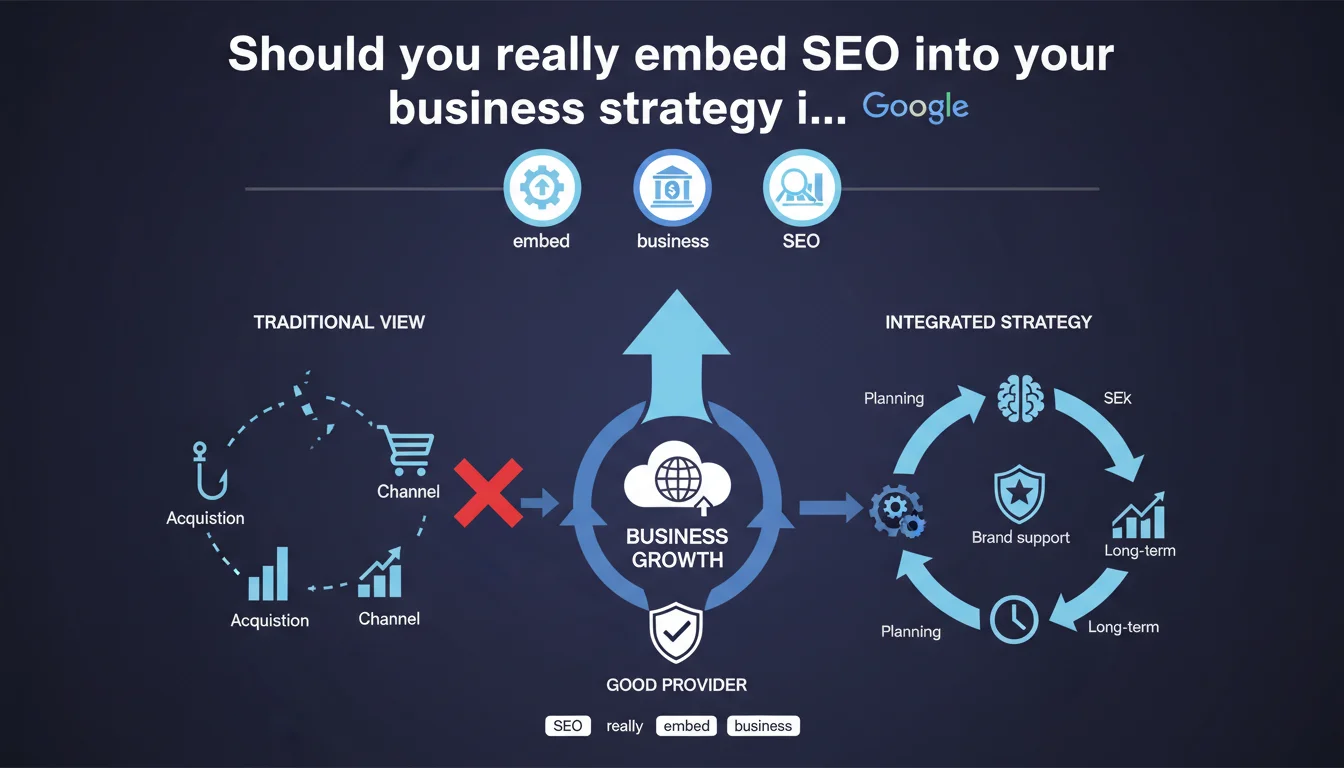
Google is clear: a competent SEO provider doesn't stop at driving traffic—they weave SEO into your daily business operations. The focus must be on long-term vision and brand support, not just tactical quick wins. In other words, SEO needs to become a strategic pillar, not merely a marketing lever.
What you need to understand
What does it really mean to integrate SEO as an integral part of business operations?
Google is talking about a cultural and operational transformation here. The idea isn't just to optimize a few pages or fix some title tags. It's about infusing your entire value chain with SEO logic: product development, content creation, technical architecture, customer relationships.
Concretely? This means that business decisions must factor in SEO constraints and opportunities from the start. Launching a new service without thinking about its SERP positioning is leaving money on the table. Building a new feature without considering crawlability or indexation risks creating invisible silos for Google.
Why emphasize long-term planning?
SEO is a marathon, not a sprint. Meaningful results rarely appear before 6 to 12 months, sometimes longer depending on sector competitiveness. Google wants to discourage short-term approaches that chase quick gains through borderline tactics or over-optimization that eventually backfire.
Long-term planning also means building durable SEO assets: topical authority, coherent semantic linking, natural link profile. These elements take time to develop but offer resilience against algorithm updates.
What's the connection between SEO and brand support?
Google explicitly mentions branding, which is significant. The engine increasingly recognizes brand signals: branded searches, high click-through rates on branded results, unlinked brand mentions across the web, consistent multi-channel presence.
A good provider doesn't just optimize for generic keywords. They help strengthen your brand's visibility and credibility in its ecosystem. This involves strategic content marketing, digital PR relationships, expert positioning—elements that feed both SEO and brand image.
- Operational integration: SEO must influence product, tech, and content decisions from design phase
- Marathon vision: prioritize durable assets (authority, linking, natural links) over ephemeral quick wins
- Branding and SEO: brand signals count more and more in algorithms
- Strategic provider: goes beyond tactical execution to advise leadership on SEO business implications
SEO Expert opinion
Is this statement consistent with real-world practices?
Yes, and it reflects a reality observable for several years. Sites that perform sustainably are those where SEO isn't siloed but permeates the entire organization. Leading e-commerce pure players dominating their sectors have SEO teams involved from product roadmap inception, not called in at the end to "optimize" a project already locked in.
However, this ideal vision clashes with reality: many companies still treat SEO as tactical cost center, not strategic leverage. They want measurable quarterly results, not 18-month investments. Google is preaching good practice that only a minority of mature organizations truly implement.
What nuances should we add to this directive?
Beware of using this recommendation as an excuse to never deliver concrete results. Some providers hide behind "long-term" to justify months without tangible gains. A good professional must balance tactical quick wins with strategic building.
Also, integrating SEO into operations heavily depends on your organization's maturity and size. A startup in launch phase can't structure SEO like a CAC 40 group. You must adapt ambition to organizational reality. [To verify]: Google provides no criteria to evaluate whether this integration succeeds or not.
When doesn't this rule fully apply?
For short-lifecycle sites (one-off events, temporary campaigns), investing in deep SEO integration makes no sense. Similarly, some business models rely on paid or social channels where SEO remains marginal—forcing strategic integration would backfire.
Finally, in highly regulated sectors (healthcare, finance), legal and validation constraints can slow or limit SEO optimizations. Integration must then factor in trade-offs that go beyond the SEO lens alone.
Practical impact and recommendations
What should you do concretely to integrate SEO into business strategy?
First step: involve SEO teams upstream in strategic projects. This means including them in product committees, campaign launch meetings, technical architecture decisions. SEO shouldn't be consulted after the fact to "fix" projects designed without it.
Next, train non-SEO decision-makers on SEO implications. A CMO who understands the impact of URL structure changes or domain mergers makes better decisions. Internal education is a powerful lever for anchoring SEO in company culture.
Finally, establish SEO KPIs that speak to business: organic share of voice on strategic queries, SEO-attributable revenue, organic customer acquisition cost compared to paid. Move beyond pure technical reporting (rankings, crawls) to show real business impact.
What mistakes should you avoid in this strategic integration?
Don't confuse strategic integration with bureaucratization. Adding SEO validation layers to every micro-decision slows your organization without adding value. The goal is to streamline, not rigidify.
Another trap: wanting to do everything in-house out of principle. Some SEO expertise (deep technical audits, advanced semantic analysis, white-hat link building) requires specialized skills and dedicated time. Underestimating this complexity leads to surface-level optimizations that won't deliver expected results.
How do you verify your SEO integration is working?
Ask yourself these questions: do product launches systematically include an SEO thinking phase before development? Do content teams have an editorial framework fed by semantic research? Are technical choices (frameworks, CMS, CDN) validated from a crawl and indexation standpoint?
If you answer no to several of these, your SEO probably remains on the periphery, not at the core. Successful integration is measured by process fluidity, not by having an "SEO Manager" on the org chart.
- Involve SEO in the design phase of all projects (product, content, tech)
- Train non-SEO decision-makers on organic search implications
- Create SEO KPIs tied to business outcomes (revenue, CAC, share of voice)
- Avoid over-validation bureaucracy that slows without adding value
- Regularly audit how SEO considerations are integrated into existing processes
- Don't hesitate to leverage external expertise for complex technical subjects
❓ Frequently Asked Questions
Combien de temps faut-il pour observer les résultats d'une stratégie SEO intégrée ?
Le SEO intégré est-il compatible avec une approche Agile ou Lean ?
Faut-il recruter en interne ou externaliser pour une approche stratégique du SEO ?
Comment convaincre la direction d'investir dans le SEO long terme ?
Le branding améliore-t-il vraiment le SEO de manière mesurable ?
🎥 From the same video 13
Other SEO insights extracted from this same Google Search Central video · published on 24/02/2022
🎥 Watch the full video on YouTube →
💬 Comments (0)
Be the first to comment.