
Official statement
Other statements from this video 13 ▾
- □ Faut-il vraiment craindre son prestataire SEO ?
- □ Faut-il vraiment arrêter de mesurer le succès SEO aux positions dans les SERP ?
- □ Quelles questions un prestataire SEO doit-il vraiment poser avant d'intervenir ?
- □ Pourquoi votre prestataire SEO doit-il comprendre votre business avant de toucher à votre site ?
- □ Pourquoi personne ne peut garantir votre classement sur Google ?
- □ Que risque vraiment un site qui enfreint les directives Google ?
- □ Comment vérifier qu'un prestataire SEO livre vraiment des résultats durables ?
- □ Faut-il vraiment intégrer le SEO à la stratégie business plutôt que de le traiter comme un canal d'acquisition ?
- □ Faut-il donner un accès complet à la Search Console à son prestataire SEO ?
- □ Faut-il vraiment optimiser pour l'utilisateur plutôt que pour Google ?
- □ Comment estimer l'investissement SEO et l'impact business d'un audit ?
- □ Comment prioriser les optimisations SEO pour maximiser le ROI avec un minimum de ressources ?
- □ Faut-il vraiment définir des objectifs précis avant de piloter une stratégie SEO ?
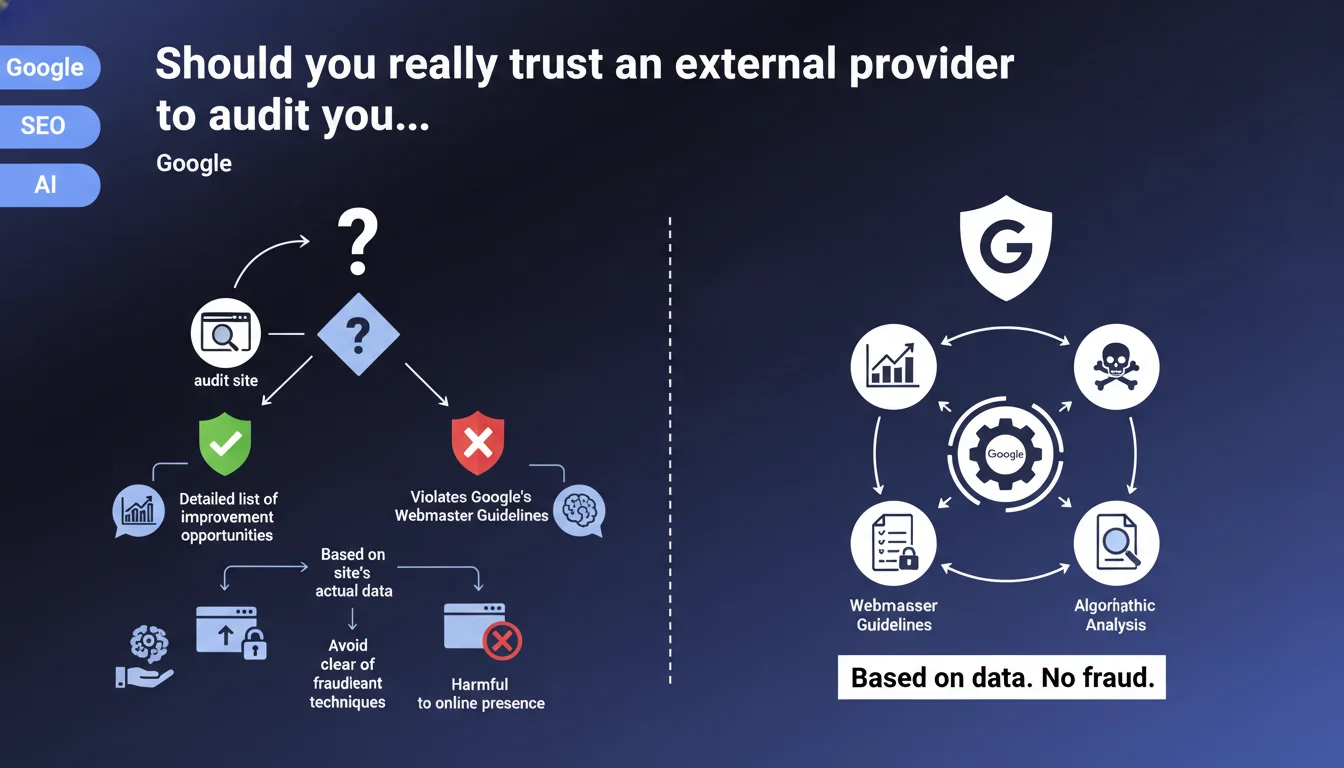
Google emphasizes that an SEO audit must be grounded in real website data, not generic templates. Recommendations should enhance your online presence without relying on fraudulent techniques. The goal: avoid superficial audits that propose pointless or counterproductive actions.
What you need to understand
What does a "data-driven" audit mean according to Google?
Google demands that every SEO recommendation be backed by concrete metrics: crawl data, user behavior, technical performance, analytics. Generic audits that propose the same 50 points to every client without prior analysis are out.
A data-driven audit identifies site-specific priorities: if your crawl budget is healthy, there's no point wasting time optimizing robots.txt. If your Core Web Vitals are already excellent, focus your efforts elsewhere.
Why does Google insist on guideline compliance?
Because some audits still recommend outdated or risky techniques: link networks, hidden content, keyword stuffing. Google wants service providers to guide clients toward sustainable practices.
The underlying idea? A solid audit should never harm your online presence. If a recommendation exposes your site to a penalty or degrades user experience, it has no place in a professional audit.
What are the essential takeaways?
- Data before assumptions: every recommendation must be justified by measurable metrics.
- No copy-paste audits: an audit should be customized based on context, industry, and competition.
- Respect the guidelines: fraudulent techniques must be eliminated entirely.
- Measurable impact: proposals should aim for concrete improvement, not just checking boxes.
- Clear prioritization: identify what has the most impact, don't bury the client under 200 micro-optimizations.
SEO Expert opinion
Is this statement consistent with real-world practices?
Yes and no. Google is right to call out generic low-cost audits that flood the market — those generated by automated tools with zero human analysis. These 100-page reports often serve only to impress the client.
But the reality is that even "data-driven" audits must make strategic bets. Some optimizations — like overhauling information architecture — rely as much on experience as on raw metrics. The data shows a problem; expertise explains why and how to solve it.
What nuances should we add?
Not all sites have access to the same data volumes. A site with 10,000 pages and 500k visitors/month provides a solid foundation for statistical analysis. A 50-page site with 2,000 visits? The data is more fragile — you need to cross-reference with industry benchmarks and qualitative analysis.
Another point: some Google recommendations remain intentionally vague. "Improve user experience" or "create quality content" are hollow mantras without concrete methodology. [To verify] whether Google will ever provide a precise evaluation framework for these subjective criteria.
In what cases does this rule not fully apply?
For new sites without a track record, the audit necessarily relies on predictive analyses: competitive study, anticipated user behavior, crawl modeling. Data will come after launch.
Similarly, some industries require preventive optimizations before problems even appear in metrics. In e-commerce with strong seasonality, you prepare category pages before traffic peaks, not after detecting a crawl collapse.
Practical impact and recommendations
What should you do concretely before commissioning an audit?
Ask the provider what data they'll analyze and how. A serious audit starts by collecting: server logs, Search Console data, analytics, performance metrics, internal link mapping. Without access to this data, delivering a reliable diagnosis is impossible.
Demand concrete examples of previous audits (anonymized). Verify that recommendations are ranked by priority — impact vs. effort — and that each proposal explains the "why" before the "how."
What mistakes should you avoid when implementing an audit?
Don't try to implement everything at once. A good audit contains dozens of recommendations — some critical, others minor. Start with high-impact quick wins, then tackle structural projects.
Another pitfall: blindly following recommendations without contextualizing them. If the audit suggests infinite scroll but your B2B audience prefers classic pagination, adapt. Your site's data trumps general trends.
How do you verify your site stays compliant with Google's guidelines?
- Regularly audit your incoming backlinks: disavow toxic links identified via Search Console.
- Verify that your content provides genuine added value, not just rewording existing sources.
- Check that your key pages are indexable and crawlable (no accidental noindex, properly configured robots.txt).
- Test the mobile experience with Google tools (Mobile-Friendly Test, PageSpeed Insights) and fix blocking issues.
- Monitor Core Web Vitals in Search Console and analyze problem pages.
- Document every significant SEO change to isolate impacts if traffic fluctuates.
❓ Frequently Asked Questions
Un audit SEO automatisé par outil suffit-il selon Google ?
Faut-il refaire un audit SEO régulièrement ?
Quelles données sont indispensables pour un audit basé sur les faits ?
Google sanctionne-t-il un site qui applique de mauvaises recommandations d'audit ?
Comment distinguer un bon audit d'un rapport générique ?
🎥 From the same video 13
Other SEO insights extracted from this same Google Search Central video · published on 24/02/2022
🎥 Watch the full video on YouTube →
💬 Comments (0)
Be the first to comment.