
Official statement
Other statements from this video 13 ▾
- □ Should you really be worried about your SEO provider?
- □ Should you really stop measuring SEO success by SERP positions?
- □ Why should your SEO provider understand your business before optimizing your website?
- □ Why can't anyone guarantee your Google rankings?
- □ What are the real consequences when a website violates Google's guidelines?
- □ How can you verify that an SEO provider truly delivers sustainable, long-term results?
- □ Should you really embed SEO into your business strategy instead of treating it as just another acquisition channel?
- □ Should you grant your SEO provider complete Search Console access?
- □ Should you really trust an external provider to audit your site's SEO performance?
- □ Should you really optimize for users instead of Google?
- □ How can you accurately estimate SEO investment and measure real business impact from an audit?
- □ How should you prioritize SEO optimizations to maximize ROI while minimizing resource investment?
- □ Should you really define precise objectives before launching an SEO strategy?
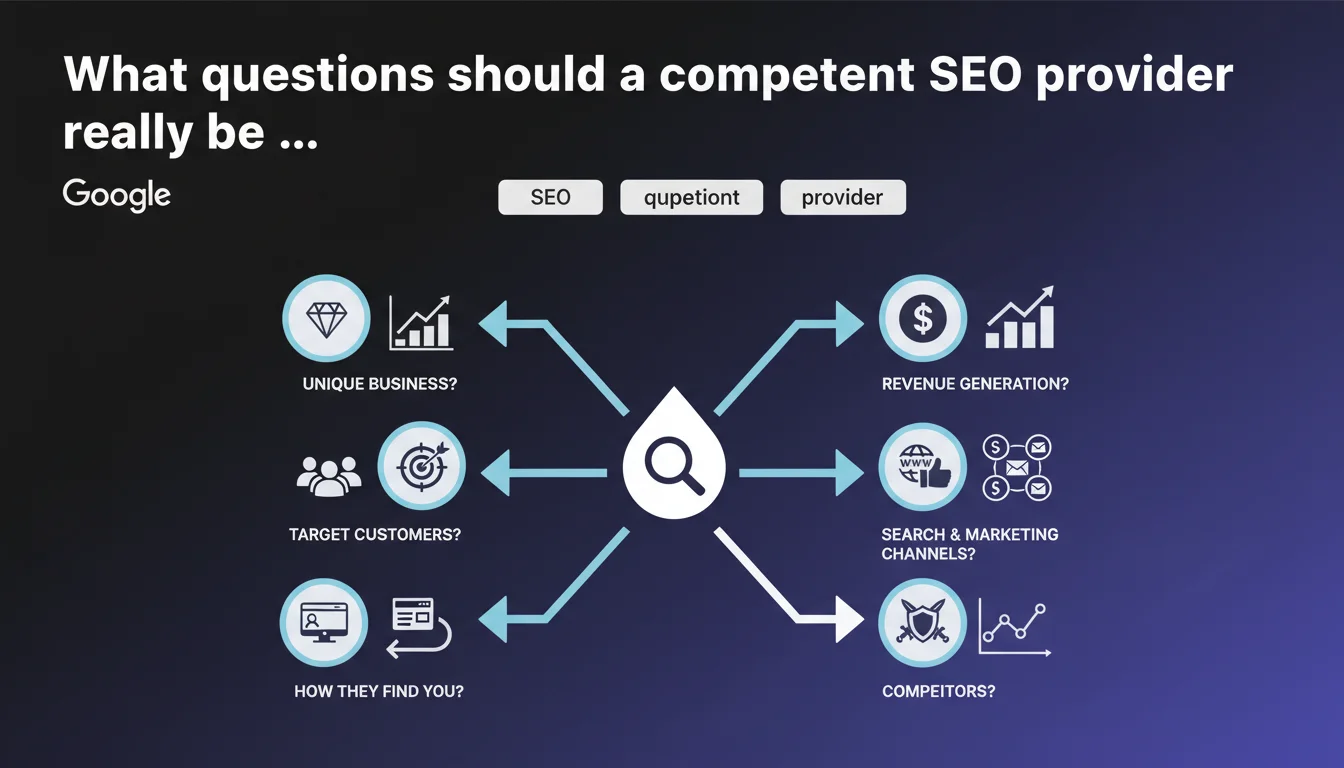
Google lists the questions a skilled SEO provider should ask: what makes your business unique, who are your target customers, where your traffic comes from, how you generate revenue, how you use search results and marketing channels, and who your competitors are. This checklist aims to distinguish serious consultants from those applying one-size-fits-all recipes without understanding business context.
What you need to understand
Why does Google publish a list of questions to evaluate an SEO provider?
Google is trying to protect businesses from SEO charlatans who sell miracle results without ever asking a single question about the business. This list acts as a filter: a consultant who arrives with a standard audit without trying to understand your business model is a red flag.
The underlying message is clear — SEO is not an isolated technical discipline. It fits into a broader marketing strategy and must align with real business objectives, not just vanity metrics.
Are these questions truly discriminating?
Yes and no. A provider who asks these questions shows they're trying to personalize their strategy. But let's flip the question: how many clients can precisely answer "how do your customers find your site" or "how do you use search results"?
Real-world reality — many companies have zero visibility into this data. The good provider doesn't just ask the question; they help build the answer through analytics audits, customer surveys, and deep competitive analysis.
What are the limitations of this approach?
This checklist assumes every SEO project starts from scratch with a complete brief. In practice, some missions are hyper-targeted: resolving a penalty, migrating a site, optimizing technical structure. In these cases, some questions become secondary.
Moreover, Google remains vague about what to do after asking these questions. No concrete methodology, no framework to translate answers into SEO actions. It's a guardrail, not an instruction manual.
- A serious provider must understand the business model before touching the site
- Questions must lead to personalized actions, not generic reports
- Certain specific SEO missions can bypass this extensive discovery phase
- Google provides no methodology for leveraging these answers — it's up to the consultant to structure what comes next
SEO Expert opinion
Does this statement align with what we observe in the real world?
Completely. The SEO providers who fail most spectacularly are those who apply a universal recipe without ever digging into business context. Classic example: aggressively optimizing for high-volume keywords but low purchase intent, because "it drives traffic" — when the client sells an ultra-specialized product with a long sales cycle.
Conversely, consultants who truly perform spend 30 to 40% of their time on the discovery phase before even touching Search Console. They map customer journeys, analyze sales conversations, identify buying signals. SEO becomes an acquisition lever, not an end in itself.
What nuances should we add to this list of questions?
First nuance: these questions aren't magic. Anyone can read them and recite them during a sales meeting. What matters is the depth of listening and ability to follow up on answers. A junior consultant can ask "who are your competitors?", but only an expert will know how to challenge the answer by identifying SERP competitors invisible to the client.
Second nuance — some questions are more critical than others depending on the industry. For an e-commerce site, "how do you generate revenue" is central. For a media site funded by advertising, "how do you use search results and other marketing channels" becomes the priority.
What's missing from this list to make it truly operational?
Let's be honest — this list overlooks major dimensions. Nothing about technical constraints (stack, CMS, available dev team), nothing about realistic budget to achieve objectives, nothing about precise success KPIs expected by the client.
It also doesn't mention previous SEO attempts — a critical point nonetheless. A site may carry unresolved manual penalties, broken redirect chains, a history of toxic links. Ignoring this history is hitting a wall. [To verify] in the field: how many providers really dig into SEO history before signing on?
Practical impact and recommendations
What should you do concretely if you're looking for an SEO provider?
Use this list as a reverse evaluation grid. During your first exchanges with a consultant, note whether they spontaneously ask these questions or jump straight into your site with an automated audit tool.
If the provider asks none of these questions but promises measurable results in 3 months, run. If they ask all of them but never dig deeper into the answers, be suspicious too — they may just be checking boxes to reassure.
What mistakes should SEO providers avoid?
Don't turn this checklist into an administrative questionnaire emailed out for completion. These questions should fuel a live conversation, not a Google Forms survey. The client should feel you're seeking to understand, not collecting info to fill a sales proposal template.
Another classic mistake: ask the questions but fail to adapt your strategy to the answers. If the client says "80% of our customers find us through referrals", and you still propose a purely top-of-funnel SEO strategy, you've understood nothing. SEO must complement existing channels, not ignore them.
How do you verify the provider is actually using this information?
Ask to see how they translate your answers into concrete strategic priorities. A good consultant should be able to say: "You told me 60% of your customers compare 3 to 4 solutions before buying, so we'll focus on comparative pages and mid-funnel reassurance content."
If the final proposal looks like every other SEO audit you've seen — title tag optimization, internal linking, page speed — with no obvious connection to your business context, the discovery exercise was a sham.
- Verify the provider asks these questions spontaneously, not because you mention them
- Observe if they dig deeper with follow-up questions or just check boxes
- Demand a proposal that explicitly links answers to SEO recommendations
- Request examples of similar projects where they adapted strategy to business context
- Refuse any engagement with a provider who promises results without understanding your business
❓ Frequently Asked Questions
Un prestataire qui ne pose pas ces questions est-il forcément mauvais ?
Dois-je connaître toutes les réponses avant de contacter un prestataire SEO ?
Comment savoir si le prestataire exploite vraiment mes réponses ?
Ces questions suffisent-elles à évaluer la compétence d'un prestataire ?
🎥 From the same video 13
Other SEO insights extracted from this same Google Search Central video · published on 24/02/2022
🎥 Watch the full video on YouTube →
💬 Comments (0)
Be the first to comment.