
Official statement
Other statements from this video 12 ▾
- □ Should you really duplicate product data between your website and Merchant Center?
- □ Why does Google trust Merchant Center feeds over regular crawling for your product data?
- □ Can Merchant Center really boost the crawl of your product listings?
- □ Does Googlebot actually crawl your site's internal search engine to discover content?
- □ Should you use Google's URL inspection tool or the site: operator to verify indexation?
- □ Does Google really require both structured data AND Merchant Center feeds to display product prices correctly?
- □ Could price discrepancies between your website and Merchant Center really be killing your product visibility?
- □ Should you increase Google Merchant Center feed processing frequency to boost your e-commerce visibility?
- □ Can automatic updates in Merchant Center fix your product data without manual intervention?
- □ Does Google really have total control over when rich results appear in search?
- □ Are Search Console and Merchant Center errors quietly killing your shopping visibility?
- □ Why aren't product structured data alone enough to appear in the Shopping tab?
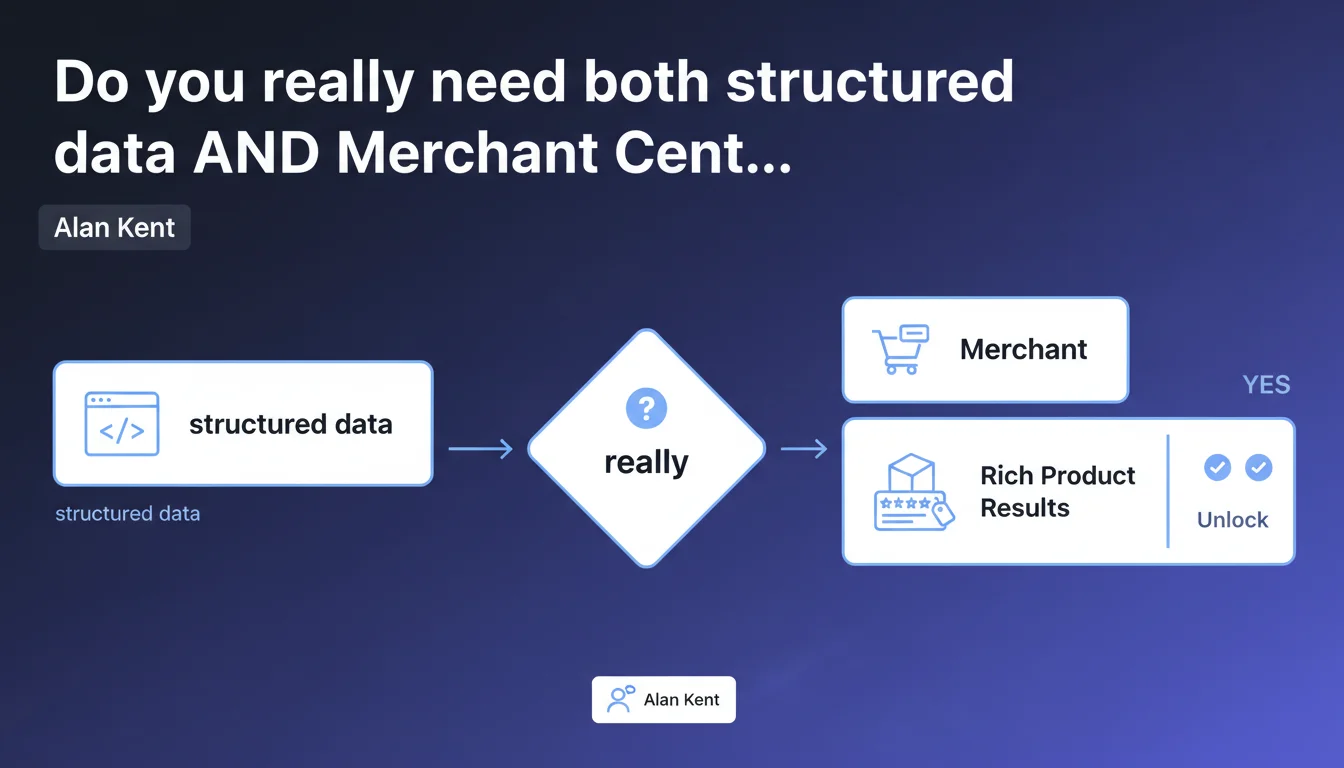
Google officially recommends providing both Product structured data on your pages AND a Merchant Center feed to maximize your chances of getting rich product results in search. This dual requirement isn't just a suggestion: it's the optimal combination to secure those valuable visual formats that boost CTR. Using only one of the two simply isn't enough anymore.
What you need to understand
Why does Google enforce this dual data feed approach?
Google consolidates its information sources to display rich results that are reliable and complete. Product structured data embedded in your HTML pages allows the engine to directly understand the context and content of each product.
The Merchant Center feed, on the other hand, centralizes inventory with real-time updated information: availability, pricing, promotions. This intentional redundancy ensures consistency and reduces display errors that would harm user experience.
What's the difference between structured data and a Merchant Center feed?
Structured data (JSON-LD, microdata) lives in the HTML code of your product pages. Google crawls it at its regular crawl rate. It enriches the semantic understanding of the page.
The Merchant Center feed is an XML/CSV file hosted separately and fetched daily (or more frequently) by Google. It contains precise commercial metadata: GTIN, MPN, categories, stock levels. This feed powers Google Shopping and other services.
- Structured data: semantic context and on-page validation
- Merchant Center feed: dynamic inventory and catalog consistency
- Combination of both: maximized chances of eligibility for rich results
- Either one alone can work, but Google explicitly recommends the dual approach
Does this recommendation apply to all e-commerce sites?
In theory, yes. Any site selling physical or digital products has good reason to leverage both channels. However, the technical complexity varies enormously depending on catalog size and your technology stack.
Small sites can get by with a simple plugin or module for structured data, while Merchant Center requires minimal infrastructure to generate and maintain a feed. Larger players benefit greatly from industrializing this dual presence.
SEO Expert opinion
Is this statement consistent with real-world observations?
Yes, and it's even a long-standing finding. E-commerce sites that combine Product structured data + an active Merchant Center feed statistically obtain more rich results — and especially more stable ones over time.
However, Google remains vague about the exact weight of each signal. We observe that Merchant Center alone can trigger rich snippets via Google Shopping, but without structured data on the page, eligibility for other enriched formats (aggregated reviews, availability) becomes unpredictable. [To verify]: Google publishes no precise correlation rate between dual data feeding and enriched display rates.
What nuances should be added to this rule?
First, not all rich results require Merchant Center. A site publishing recipes, events, or articles can stick to Recipe, Event, or Article structured data without ever touching Merchant Center.
Second, Merchant Center imposes commercial constraints: clear return policy, HTTPS mandatory, compliance with Google Shopping rules. If your model doesn't fit (marketplace, gray market dropshipping), you risk suspensions that also impact organic enriched display.
In what cases is this dual approach unnecessary?
If you don't sell anything online (pure brochure site), Merchant Center has no value. Similarly, B2B sites without public catalogs or displayed pricing can stick to Organization and BreadcrumbList structured data.
For affiliate sites that redirect to third-party merchants, Merchant Center is often inaccessible or pointless — Google prefers to index the final merchant. Better to focus on clean Product structured data with links to external offers.
Practical impact and recommendations
What should you do concretely to maximize your rich product results?
Start by implementing clean Product structured data on each product page: name, image, description, offers (price, availability, priceCurrency). Validate with Google's Rich Results Test.
Next, create a Google Merchant Center account and set up a product feed. If your CMS or e-commerce platform offers a native plugin (Shopify, WooCommerce, PrestaShop), use it. Otherwise, generate an automated XML/CSV feed that updates daily.
Ensure strict consistency between the two sources: identical prices, same currency, same availability. Any discrepancy triggers warnings in Merchant Center and can block enriched display.
What mistakes should you absolutely avoid?
- Never leave critical errors in Merchant Center — Google penalizes quickly
- Don't forget mandatory fields: GTIN, MPN, brand depending on product category
- Avoid price or stock gaps between feed and HTML page (classic promo mistake)
- Don't duplicate products in the feed with different IDs
- Don't ignore structured data validation warnings in Search Console
How can you verify that your site is compliant and optimized?
Use the Rich Results Test on each product page template. Inspect errors and warnings, fix them before rolling out at scale.
In Merchant Center, monitor the Diagnostics tab: zero critical errors is the bare minimum. Warnings should be addressed quickly.
In Search Console, check the Rich Results report in the Product section: Google flags eligible pages and detected issues there. If your volume of pages with rich results stalls or drops, dig deeper.
❓ Frequently Asked Questions
Peut-on obtenir des résultats enrichis produits avec seulement des données structurées, sans Merchant Center ?
Merchant Center est-il réservé aux sites qui font de la publicité Google Shopping ?
Que se passe-t-il si mes prix diffèrent entre le flux Merchant Center et les données structurées ?
Faut-il des GTIN ou MPN pour tous les produits dans Merchant Center ?
Les marketplaces doivent-elles créer un flux Merchant Center par vendeur tiers ?
🎥 From the same video 12
Other SEO insights extracted from this same Google Search Central video · published on 29/08/2022
🎥 Watch the full video on YouTube →
💬 Comments (0)
Be the first to comment.