
Official statement
Other statements from this video 12 ▾
- □ Why does Google trust Merchant Center feeds over regular crawling for your product data?
- □ Can Merchant Center really boost the crawl of your product listings?
- □ Does Googlebot actually crawl your site's internal search engine to discover content?
- □ Should you use Google's URL inspection tool or the site: operator to verify indexation?
- □ Does Google really require both structured data AND Merchant Center feeds to display product prices correctly?
- □ Could price discrepancies between your website and Merchant Center really be killing your product visibility?
- □ Should you increase Google Merchant Center feed processing frequency to boost your e-commerce visibility?
- □ Can automatic updates in Merchant Center fix your product data without manual intervention?
- □ Do you really need both structured data AND Merchant Center feed to unlock rich product results?
- □ Does Google really have total control over when rich results appear in search?
- □ Are Search Console and Merchant Center errors quietly killing your shopping visibility?
- □ Why aren't product structured data alone enough to appear in the Shopping tab?
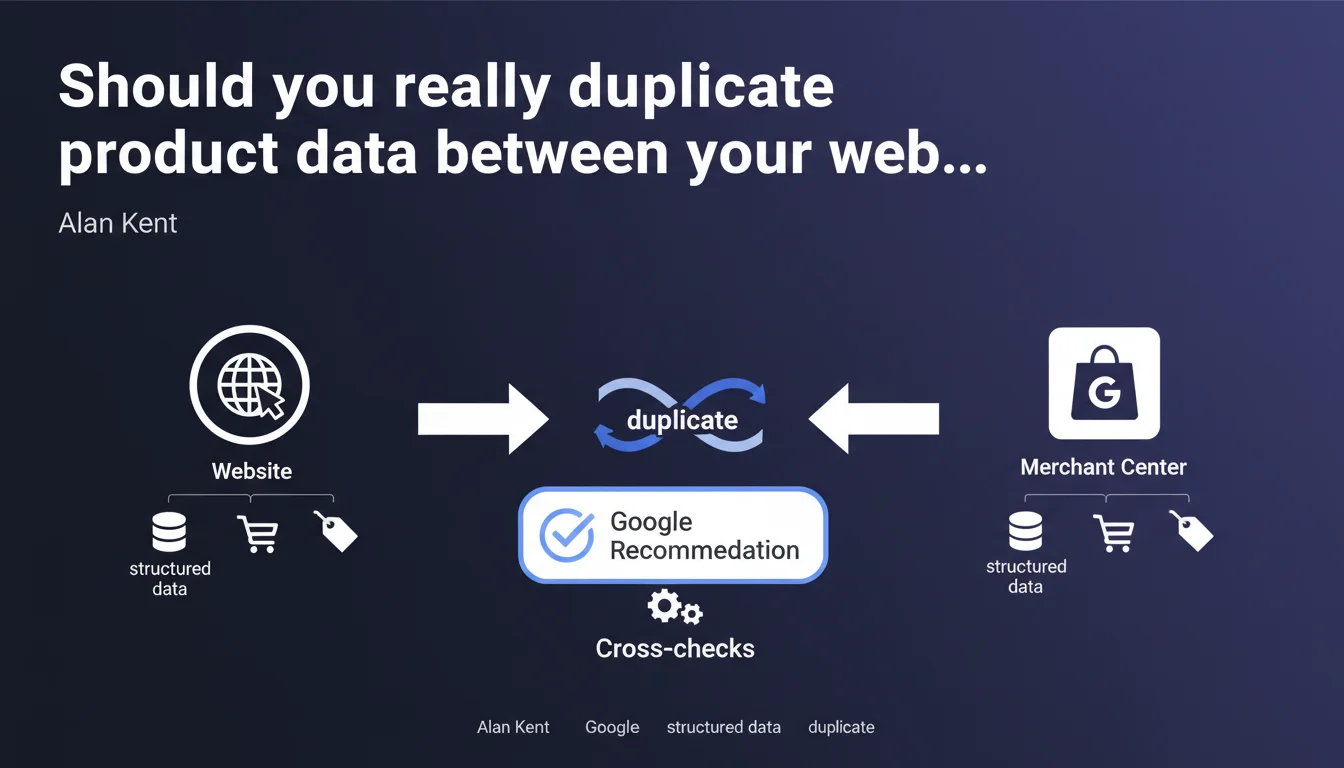
Google officially recommends providing both Product structured data on pages and a Merchant Center feed. The search engine can cross-reference these two sources to validate information consistency. This redundancy has become a de facto requirement for e-commerce sites seeking maximum visibility.
What you need to understand
Why does Google require this dual data entry?
Google leverages two distinct channels to ingest product data: traditional site crawling (with Schema.org Product markup) and Merchant Center feeds sent directly via API or XML/CSV files. Each channel has its limitations — crawling may miss real-time updates, feeds can diverge from actual site content.
By cross-referencing both sources, Google can detect inconsistencies: different prices between page and feed, conflicting availability, truncated descriptions. This cross-validation reduces errors in Shopping and product rich snippets. Alan Kent confirms this practice is no longer optional but recommended by default.
Is this cross-checking performed systematically?
Google doesn't specify the exact frequency or algorithm for this validation. We know it occurs at least during Merchant Center quality audits and likely before displaying product rich snippets in organic search results.
Sites that provide only a single channel (feed-only or markup-only) risk visibility penalties: article disapprovals in Shopping, non-display of prices/reviews in natural results, or even Merchant Center account suspension in case of repeated discrepancies.
Which elements are subject to this dual requirement?
- Price and availability: must match exactly between page and feed to avoid disapprovals
- Title and description: divergences tolerated to some extent but Google prioritizes the feed version for Shopping
- Images: main image URL must be consistent, quality verified on crawled site
- GTIN/MPN/Brand: critical product identifiers for clustering, must be present in both channels
- Customer reviews: Review markup on site plus Google Customer Reviews feed if available
SEO Expert opinion
Is this requirement realistic for all catalogs?
Let's be honest: maintaining two synchronized systems represents a non-negligible technical burden, especially for catalogs with thousands of references and frequent variations. Sync errors are commonplace — a price updated in the CMS that doesn't immediately flow into the exported feed, stock depletion managed in the ERP but not reflected in the markup.
Google provides no numerical tolerance for acceptable discrepancies. [To verify] whether a propagation delay of a few hours between site update and feed update is tolerated, or if Google expects strict consistency at the moment of crawl.
Are sites without Merchant Center feeds penalized in organic search?
Alan Kent's statement explicitly concerns the optimal combination to maximize visibility. It doesn't say that the absence of a Merchant Center feed demotes a site in standard organic results — that would contradict the stated principles of separation between paid/Shopping and organic.
In practice, we observe that e-commerce sites with active Merchant Center feeds more easily obtain complete product rich snippets (price, availability, reviews) in organic search results. Correlation or causation? Hard to prove, but the correlation is strong.
Is markup alone no longer sufficient for product rich snippets?
Officially, Google maintains that valid Schema.org Product markup is theoretically sufficient to obtain rich snippets. In practice, field reports show that sites with Merchant Center feeds have a higher display rate and shorter update latency.
This recommendation from Alan Kent confirms what we've observed over recent months: Google is pushing toward a mandatory hybrid model for e-commerce, where the feed becomes the primary source of truth and markup serves as secondary validation — or vice versa in some cases. The exact logic remains opaque.
Practical impact and recommendations
What needs to be implemented concretely?
The first step is to audit what you have: do you already have an active Merchant Center feed? Is your Schema.org Product markup deployed on all product pages? If either is missing, that's the absolute priority before any advanced optimization.
Next, you must guarantee real-time synchronization between the two sources. Ideally, a single product database feeds both HTML rendering (with JSON-LD markup) and the XML/CSV feed exported to Merchant Center. Artisanal solutions with manual daily exports multiply the risk of discrepancies.
How do you detect and correct inconsistencies between feed and site?
Merchant Center provides a diagnostic report that flags discrepancies detected between feed and crawled pages. Check it at minimum weekly. The most frequent errors: different prices, invalid destination URL, GTIN missing on page while present in feed.
For markup, use Google's Rich Results Testing Tool to verify that all required properties are present and match the visible page content. A price displayed as 99€ in HTML but 89€ in JSON-LD will be flagged as inconsistent.
- Verify that Merchant Center feed is active and free of blocking errors
- Deploy Schema.org Product markup on 100% of product pages
- Automate feed generation from the same database as the site
- Control consistency of price/availability/GTIN between both channels
- Set up automatic alerts if discrepancies are detected by Merchant Center
- Test a sample of products with the Rich Results Testing Tool
- Document the update pipeline to identify friction points
Which errors should you absolutely avoid?
Never use dummy or placeholder data in either channel to "fill" mandatory fields. Google detects these patterns and can suspend the Merchant Center account or deindex rich snippets.
Also avoid intentional divergences — for example a lower price in the feed to attract the Shopping click then a higher actual price on site. This is an explicit violation of Merchant Center rules and grounds for permanent banning.
❓ Frequently Asked Questions
Peut-on se passer du flux Merchant Center si le balisage Product est parfait ?
Quelle fréquence de mise à jour pour le flux Merchant Center ?
Les variations produits (taille, couleur) doivent-elles être dans le flux et le balisage ?
Google pénalise-t-il les petits écarts de prix dus aux arrondis ?
Faut-il un flux Merchant Center pour un site non marchand avec balisage Product ?
🎥 From the same video 12
Other SEO insights extracted from this same Google Search Central video · published on 29/08/2022
🎥 Watch the full video on YouTube →
💬 Comments (0)
Be the first to comment.