
Official statement
Other statements from this video 12 ▾
- □ Should you really duplicate product data between your website and Merchant Center?
- □ Why does Google trust Merchant Center feeds over regular crawling for your product data?
- □ Can Merchant Center really boost the crawl of your product listings?
- □ Does Googlebot actually crawl your site's internal search engine to discover content?
- □ Should you use Google's URL inspection tool or the site: operator to verify indexation?
- □ Does Google really require both structured data AND Merchant Center feeds to display product prices correctly?
- □ Could price discrepancies between your website and Merchant Center really be killing your product visibility?
- □ Should you increase Google Merchant Center feed processing frequency to boost your e-commerce visibility?
- □ Can automatic updates in Merchant Center fix your product data without manual intervention?
- □ Do you really need both structured data AND Merchant Center feed to unlock rich product results?
- □ Are Search Console and Merchant Center errors quietly killing your shopping visibility?
- □ Why aren't product structured data alone enough to appear in the Shopping tab?
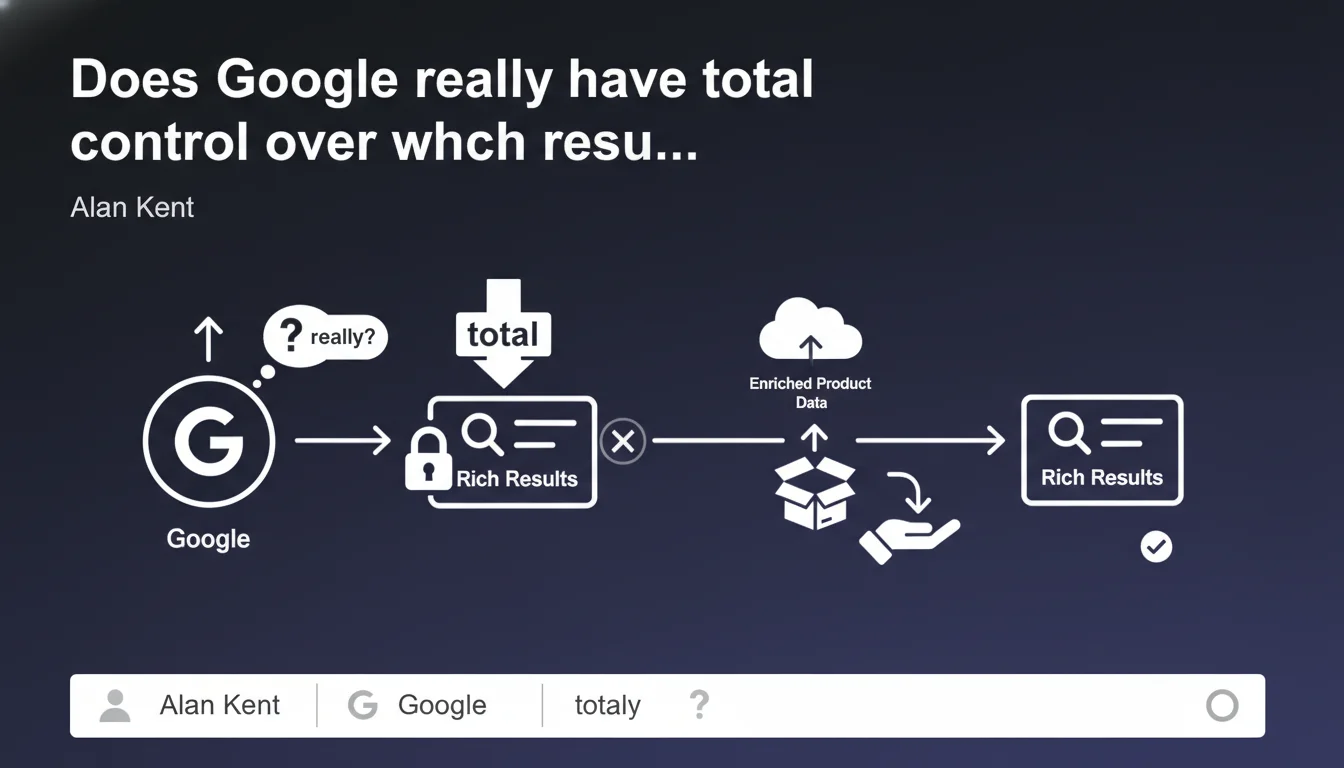
Google claims to control the display of rich results but conditions their appearance on the presence of structured data. In other words: without valid schema markup, no rich results — but even with it, there's no guarantee of display. The search engine reserves the right to filter according to criteria it doesn't detail.
What you need to understand
What does "at Google's discretion" really mean?
This vague phrasing masks a more complex reality. Google never guarantees the display of a rich result, even when structured data is technically perfect. The search engine applies filters — content quality, relevance, data consistency — without publishing the exact thresholds.
Discretion operates at multiple levels: choice of format (carousel, card, FAQ), display frequency, position in the SERP. In practice? You can have impeccable Schema.org markup and never see your star ratings display for certain queries. Frustrating, but logical from Google's perspective since it wants to avoid spam.
Why does Google emphasize "enriched product data"?
The term "enriched product data" refers here to Schema.org markup (Product, Review, Article, Recipe, etc.). Without these tags, Google cannot extract the structured information necessary to create a rich result. This is the absolute technical prerequisite.
But watch out — and this is where it gets sticky — the presence of Schema is not enough. Google first validates technical compliance, then evaluates quality and consistency. A site can pass the validation test in Search Console and never obtain rich results in production.
What are the implicit criteria behind this "discretion"?
Google doesn't publish a transparent evaluation grid, but real-world observations reveal several quality filters: domain authority, content freshness, review consistency (no obvious manipulation), keyword density in structured fields.
- Schema.org markup is necessary but not sufficient to obtain rich results
- Google applies undocumented quality filters that can block display even with valid markup
- The choice of format and display frequency remains opaque and variable depending on queries
- Rich results can appear then disappear without technical changes on your part
- Certain types of rich results are reserved for specific verticals (recipes, products, events)
SEO Expert opinion
Is this statement consistent with what we observe in the field?
Yes, and that's precisely the problem. SEOs have observed for years that perfect markup guarantees nothing. E-commerce sites with hundreds of authentic reviews and impeccable Product Schema see their star ratings disappear overnight with no apparent reason.
What's critically missing from this statement is transparency about filter criteria. Alan Kent implicitly acknowledges that Google plays an active curatorial role, but without providing the rules of the game. [To verify]: Are there domain authority thresholds for certain types of rich results? Field observations suggest yes, but Google never confirms this officially.
What nuances should we add to this statement?
The phrasing "require that Google has enriched product data" is misleading. It suggests that providing the data is sufficient — which is false. The real workflow is: structured data → technical validation → quality filters → contextual display decision per query.
Another rarely mentioned point: some rich results are reserved for partners or specific verticals. Recipes, for example, appear more easily on established cooking sites than on generalist blogs, even with identical markup. Google denies any form of whitelist, but observed patterns suggest otherwise. [To verify]
In what cases does this rule not apply?
There are exceptions where Google generates rich results without explicit markup: featured snippets extracted from standard HTML content, knowledge panels built from external sources (Wikidata, third-party databases), PAA (People Also Ask) that aggregates answer fragments.
These formats partially escape the logic "no Schema = no rich result". But they remain just as opaque in terms of eligibility criteria. Let's be honest: Google wants complete control over display, with or without your collaboration.
Practical impact and recommendations
What should you do concretely to maximize your chances?
First step: implement clean and comprehensive Schema.org markup for all eligible content types (products, articles, FAQs, recipes, events). Use JSON-LD preferably, as it's Google's recommended format and easiest to maintain.
Second step — often overlooked — ensure consistency between markup and visible content. Google penalizes discrepancies (different price in Schema versus HTML, aggregated rating inconsistent with displayed reviews). This consistency is a critical trust signal.
Third step: monitor continuously. Rich results can disappear following an algorithm update, a content modification, or a Google policy change. Search Console is your best ally to detect validation errors and display drops.
What mistakes should you absolutely avoid?
Never manipulate structured data to artificially inflate ratings, fabricate reviews, or display misleading prices. Google detects these patterns and may blacklist your site from rich results — sometimes permanently.
Also avoid unnecessary or out-of-context markup. Adding a Recipe Schema to a non-recipe page, or marking up content invisible to the user, triggers manual penalties. The principle: if the user doesn't see it, don't mark it up.
- Implement JSON-LD for all eligible content (products, articles, FAQs, recipes)
- Validate markup with the rich results testing tool AND the Search Console report
- Verify strict consistency between structured data and visible content
- Never invent or manipulate data (reviews, prices, availability)
- Monitor actual display in SERPs, not just technical validation
- Document display fluctuations to identify algorithmic patterns
- Test different Schema formats for the same content (Article vs BlogPosting, Product vs Offer)
How do you measure the real impact of your rich results?
CTR is the primary KPI. Search Console gives you click-through rate by rich result type. Compare pages with active rich results versus pages without — the gap can reach 20-30% additional CTR on some verticals. But watch out for false positives: a CTR drop may also signal that Google is displaying your rich results less frequently.
Beyond metrics, qualitative analysis matters. Which queries trigger your rich results? Does it align with your keyword strategy? Sometimes Google displays your stars on low-volume queries but ignores your strategic pages. Adjusting content and markup accordingly can unlock significant gains.
Rich results remain a powerful but unpredictable SEO lever. Structured markup is your entry ticket, not your display guarantee. Invest in careful implementation, monitor rigorously, and accept that Google has the final say. This complexity — technical, editorial, strategic — often makes it wise to work with an SEO agency specialized in auditing your markup, interpreting Search Console signals, and adjusting your content strategy to maximize your chances of appearing in volatile SERP environments.
❓ Frequently Asked Questions
Le balisage Schema.org garantit-il l'affichage de résultats enrichis ?
Pourquoi mes résultats enrichis apparaissent puis disparaissent ?
Tous les types de Schema ont-ils la même chance d'affichage ?
Peut-on être pénalisé pour un mauvais balisage Schema ?
Comment savoir si mon Schema est correctement implémenté ?
🎥 From the same video 12
Other SEO insights extracted from this same Google Search Central video · published on 29/08/2022
🎥 Watch the full video on YouTube →
💬 Comments (0)
Be the first to comment.