
Official statement
Other statements from this video 13 ▾
- □ Peut-on gérer plusieurs sites web sans pénalité SEO ?
- □ Tirets vs underscores dans les URLs : quel impact réel sur votre SEO ?
- □ Le noindex follow garantit-il vraiment l'exploration des liens par Google ?
- □ Pourquoi Google ignore-t-il les fragments d'URL avec # en SEO ?
- □ Les erreurs 503 brèves impactent-elles vraiment le crawl de votre site ?
- □ Pourquoi noindex est-il plus efficace que robots.txt pour masquer un site de Google ?
- □ Changer d'hébergeur web impacte-t-il réellement votre référencement naturel ?
- □ Faut-il vraiment limiter l'API d'indexation aux offres d'emploi et événements ?
- □ Faut-il vraiment bannir le texte intégré directement dans les images ?
- □ Les menus burger dupliqués dans le DOM nuisent-ils au référencement ?
- □ Les erreurs 404 externes nuisent-elles vraiment au classement Google ?
- □ Faut-il vraiment un sitemap.xml pour bien ranker sur Google ?
- □ Faut-il vraiment abandonner les URLs mobiles séparées (m-dot) pour le SEO ?
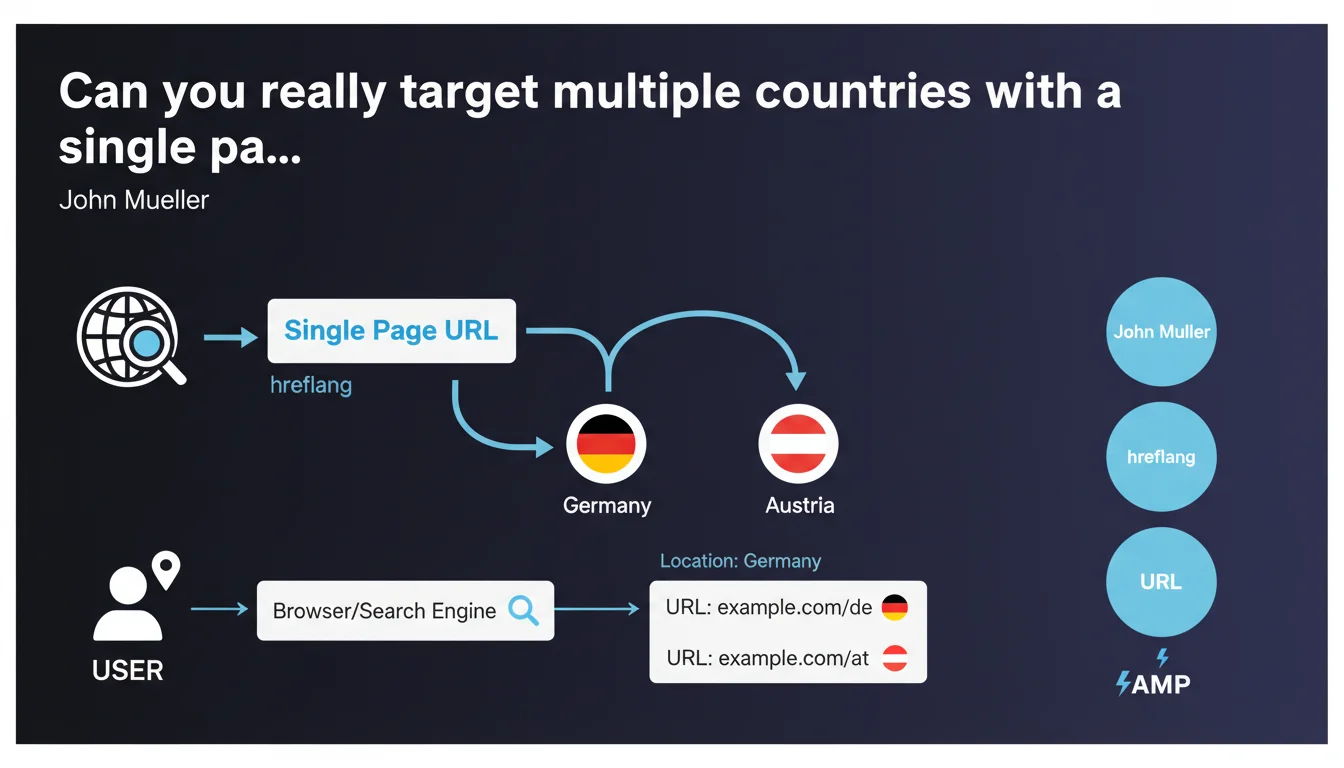
Google confirms that a single page can have multiple hreflang tags pointing to it. In practice, a unique German URL can target both Germany and Austria without duplicating content. Hreflang serves to adjust the displayed URL according to the user's language and location.
What you need to understand
Does hreflang really allow geographical redundancy?
The answer is yes, and it's a point often misunderstood. A single page can be declared as a valid variant for multiple regions sharing the same language. There's no need to create a separate Austrian version if your German content works for both markets.
This flexibility solves a recurring headache: should you duplicate identical content for each country? No. Hreflang allows you to signal "this page works for users in Germany AND Austria", without multiplying near-identical content.
What does "replacing the displayed URLs" in the SERPs mean?
Google adjusts the URL displayed in search results based on the detected location and language of the user. If you declare hreflang="de-DE" and hreflang="de-AT" for the same page, an Austrian user will see the URL annotated for Austria — even though technically, it's the same resource.
This isn't a server-side redirect. It's Google choosing which variant to present in the SERPs. The user lands on the most relevant page according to their geographical context.
In which cases is this strategy really useful?
Typically for multi-country, single-language sites: German for DE/AT/CH, English for UK/US/AU/CA, Spanish for ES/MX/AR. Rather than creating separate versions with near-identical content, you target multiple regions with a single URL.
- A page can have multiple hreflang tags designating it as a variant for different countries
- Google displays the most relevant URL based on the user's location in the SERPs
- No obligation to duplicate identical content for each geographical market
- Hreflang functions as a geographical and language targeting signal, not as a redirect
SEO Expert opinion
Does this statement match real-world observations?
Yes, and it clarifies a frequent confusion. Many still think one URL = one single language/region pair in hreflang. Wrong. Successful implementations commonly use this multi-country approach to avoid duplicate content and simplify maintenance.
Be careful though: this flexibility doesn't exempt you from strategic thinking. If your products, prices, or regulations differ between Germany and Austria, a single page becomes problematic — hreflang or not.
What nuances should be added to this recommendation?
Google doesn't say "systematically use this approach". It says "it's possible". Important distinction. If your content varies by country — currencies, inventory, specific legal notices — you must create distinct pages and link them via hreflang.
Another pitfall: bidirectional consistency. If page A declares "I'm valid for DE and AT", it must also declare its variants in other languages. Hreflang annotation remains a reciprocal system: each page must point to all its variants, including itself.
[To verify] — Mueller's statement doesn't specify how Google arbitrates if multiple pages claim the same language/region combination. In practice, the first coherent signal detected takes priority, but conflicting cases can generate erratic displays.
In which cases does this rule NOT apply?
If your content is genuinely different by country, don't use this trick. Typical example: e-commerce with country-specific product catalogs, variable prices, national terms and conditions. Create distinct pages instead.
Practical impact and recommendations
How do you implement multiple hreflang tags for a page in practice?
Three methods available: HTML tags <link rel="alternate" hreflang="x" href="y"> in the <head>, HTTP Link headers, or XML sitemap. Choose one method and stick with it — mixing approaches creates conflicts.
Concrete example for a German page targeting DE and AT:
<link rel="alternate" hreflang="de-DE" href="https://example.com/de/page" />
<link rel="alternate" hreflang="de-AT" href="https://example.com/de/page" />
<link rel="alternate" hreflang="x-default" href="https://example.com/de/page" />
Notice that the URL is identical for de-DE and de-AT. That's the principle. Also add your other language variants (en-GB, fr-FR, etc.).
What mistakes should you absolutely avoid?
Mistake #1: forgetting reciprocity. If your German page declares its French and English variants, these must also point back to the German version. Otherwise, Google ignores everything.
Mistake #2: using invalid language/region codes. hreflang="de" alone is valid (language without region), but hreflang="AT" (region without language) is not. Respect ISO 639-1 for language, ISO 3166-1 Alpha 2 for country.
Mistake #3: targeting too broadly without justification. If your content mentions German specificities (hours, phone numbers, legislation), don't declare it valid for Austria "because it's also in German". Shared language is not enough if the context differs.
- Verify that your content is truly relevant for all countries targeted by your hreflang tags
- Implement annotations in a completely bidirectional manner: each page must list all its variants, including itself
- Use a single implementation method (HTML, HTTP header, or sitemap) to avoid conflicts
- Test your annotations with Search Console and tools like Hreflang Checker
- Document your hreflang strategy: which countries share which URL, and why
- Monitor hreflang error reports in Search Console — Google flags inconsistencies
❓ Frequently Asked Questions
Peut-on utiliser hreflang="de" sans préciser de pays pour cibler tous les germanophones ?
Faut-il créer une page distincte pour chaque pays même si le contenu est identique ?
Que se passe-t-il si deux pages différentes revendiquent le même couple langue/région en hreflang ?
Le x-default est-il obligatoire quand on utilise plusieurs hreflang pour une page ?
Hreflang influence-t-il le classement ou seulement l'affichage dans les SERP ?
🎥 From the same video 13
Other SEO insights extracted from this same Google Search Central video · published on 18/04/2024
🎥 Watch the full video on YouTube →
💬 Comments (0)
Be the first to comment.