
Official statement
Other statements from this video 13 ▾
- □ Peut-on gérer plusieurs sites web sans pénalité SEO ?
- □ Tirets vs underscores dans les URLs : quel impact réel sur votre SEO ?
- □ Le noindex follow garantit-il vraiment l'exploration des liens par Google ?
- □ Pourquoi Google ignore-t-il les fragments d'URL avec # en SEO ?
- □ Les erreurs 503 brèves impactent-elles vraiment le crawl de votre site ?
- □ Pourquoi noindex est-il plus efficace que robots.txt pour masquer un site de Google ?
- □ Changer d'hébergeur web impacte-t-il réellement votre référencement naturel ?
- □ Faut-il vraiment limiter l'API d'indexation aux offres d'emploi et événements ?
- □ Faut-il vraiment bannir le texte intégré directement dans les images ?
- □ Peut-on vraiment cibler plusieurs pays avec une seule page grâce à hreflang ?
- □ Les erreurs 404 externes nuisent-elles vraiment au classement Google ?
- □ Faut-il vraiment un sitemap.xml pour bien ranker sur Google ?
- □ Faut-il vraiment abandonner les URLs mobiles séparées (m-dot) pour le SEO ?
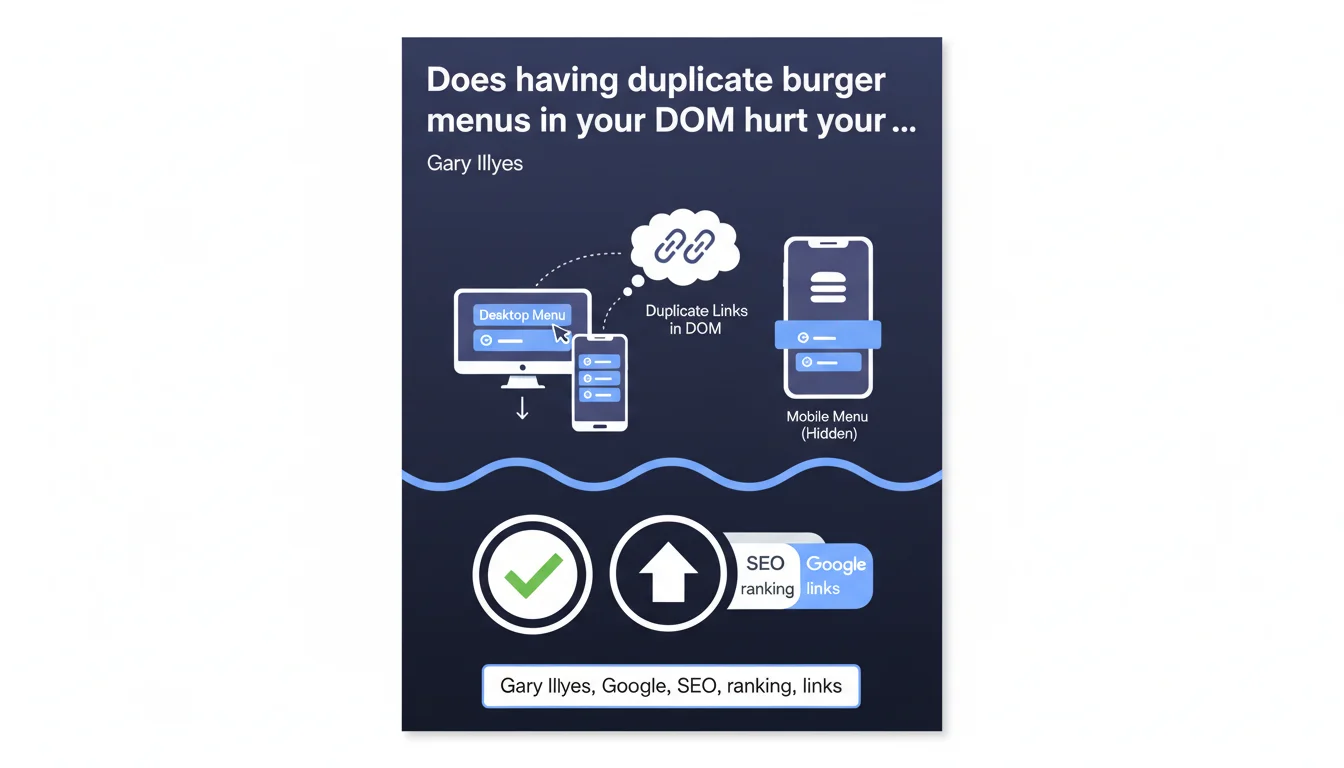
Google confirms that having duplicate links in the DOM (mobile burger menu + desktop menu) triggers no penalty whatsoever. The Mountain View teams consider this practice a common technical pattern in responsive design, not an attempt at manipulation.
What you need to understand
Why is this question even being asked in the first place?
Responsive design often requires creating two versions of the same menu — one for desktop, another for mobile in burger form. Technically, this means the same URLs end up appearing twice in the DOM (Document Object Model). Some SEO professionals worried that Google might see this as a form of internal link stuffing.
This concern didn't come out of nowhere. We know Google penalizes flagrant manipulation — hidden text, cloaking, unnecessary links without value. Systematic duplication of dozens of links could seem suspicious.
What exactly does Gary Illyes say?
Gary is crystal clear: no penalty is applied for this practice. Even if your source code contains two instances of the same menu with identical anchors and URLs, Google doesn't consider it problematic.
He doesn't specify how the algorithm handles these duplicates in terms of crawl budget or internal PageRank calculation, but the message is unambiguous — you won't be penalized for following modern web development standards.
What use cases does this cover?
We're talking about all situations where a menu is hidden via CSS (display:none, transform, etc.) depending on screen size. Duplicated main navigation in burger form, repeated footer, sidebar that disappears on mobile — all these patterns are covered by this statement.
- Standard desktop menu + identical mobile burger menu in HTML
- Navigation links in footer duplicated for responsive UX reasons
- Sidebar with internal links hidden on small screens but present in the DOM
- Rich mega-menus full of links hidden/displayed based on viewport
SEO Expert opinion
Is this statement consistent with what we observe in the field?
Yes, and has been for a long time. No site has ever been penalized for having a standard burger menu. Thousands of e-commerce sites run with this architecture and have experienced no crawl or ranking issues specifically related to it.
What's interesting is that Gary takes the time to clarify this publicly. It suggests the question comes up often, probably due to overly cautious SEO advice or myths circulating in the community.
What nuances should we still keep in mind despite this?
Be careful — no penalty doesn't mean no impact. Google doesn't penalize, but that doesn't mean the crawler treats these duplicate links exactly like unique links.
If your burger menu contains 80 links and your desktop menu also contains 80, you potentially have 160 links in the DOM. Google will crawl them, but the internal PageRank distribution and URL prioritization in crawling could be affected. [Needs verification] — Google doesn't document precisely how juice is distributed in this case.
Another point: this tolerance applies to legitimate menus. If you duplicate 300 links in an invisible footer then 300 more in a burger, hoping to artificially boost your internal linking, you're outside the scope of a standard UX pattern. Other algorithmic filters could apply there.
Should you duplicate without thinking twice?
No. Just because Google tolerates duplication doesn't make it a good default practice. Fewer links in the DOM is often clearer for the crawler and ensures better internal juice distribution.
If you can avoid duplication — for example by using a single menu in the DOM and transforming it visually via CSS/JS depending on viewport — that's preferable. But if your tech stack or project constraints impose two menus, you now know this won't cost you a penalty.
Practical impact and recommendations
What should you actually do on your current projects?
If you have a burger menu + desktop menu in the DOM and everything works fine with crawling and indexation, don't touch anything. You're not in violation, you're not at risk.
However, if you're launching a new project or redesigning your site, take the opportunity to think about HTML architecture. A single menu manipulated via CSS/JS is technically more elegant and avoids any ambiguity for bots.
What mistakes should you avoid to stay compliant?
Avoid duplicating entire content blocks under the pretext that the menu is tolerated. Gary's statement specifically concerns navigation menus, not any arbitrary duplicated element in the DOM.
Don't hide rich text content solely to stuff it with keywords thinking Google will ignore it like a menu. The context of use matters: a menu is a recognized UX pattern, hidden text without valid UX reason remains suspicious.
- Verify that your duplicate menus are properly hidden via CSS (
display:none,transform,visibility:hidden), not via JavaScript after full load (risk of confusion for Googlebot) - Test your pages with Mobile-Friendly Test and via the URL inspection tool to see what Google actually crawls
- Control consistency of anchors and URLs between the two menu versions — variations could signal a maintenance issue
- Monitor your index coverage reports: if important pages are only crawled via the desktop menu, that's a warning sign
- Audit total internal link volume per page — beyond 150-200 links (all menus combined), you're entering territory where crawl budget could be less optimal
❓ Frequently Asked Questions
Est-ce que Google compte les liens dupliqués deux fois pour le PageRank interne ?
Si mon menu burger contient plus de liens que mon menu desktop, est-ce un problème ?
Puis-je dupliquer d'autres éléments que le menu de la même manière ?
Dois-je utiliser des attributs HTML spécifiques pour signaler la duplication à Google ?
Un menu burger avec des liens en nofollow change-t-il quelque chose ?
🎥 From the same video 13
Other SEO insights extracted from this same Google Search Central video · published on 18/04/2024
🎥 Watch the full video on YouTube →
💬 Comments (0)
Be the first to comment.