
Official statement
Other statements from this video 13 ▾
- □ Peut-on gérer plusieurs sites web sans pénalité SEO ?
- □ Tirets vs underscores dans les URLs : quel impact réel sur votre SEO ?
- □ Le noindex follow garantit-il vraiment l'exploration des liens par Google ?
- □ Les erreurs 503 brèves impactent-elles vraiment le crawl de votre site ?
- □ Pourquoi noindex est-il plus efficace que robots.txt pour masquer un site de Google ?
- □ Changer d'hébergeur web impacte-t-il réellement votre référencement naturel ?
- □ Faut-il vraiment limiter l'API d'indexation aux offres d'emploi et événements ?
- □ Faut-il vraiment bannir le texte intégré directement dans les images ?
- □ Les menus burger dupliqués dans le DOM nuisent-ils au référencement ?
- □ Peut-on vraiment cibler plusieurs pays avec une seule page grâce à hreflang ?
- □ Les erreurs 404 externes nuisent-elles vraiment au classement Google ?
- □ Faut-il vraiment un sitemap.xml pour bien ranker sur Google ?
- □ Faut-il vraiment abandonner les URLs mobiles séparées (m-dot) pour le SEO ?
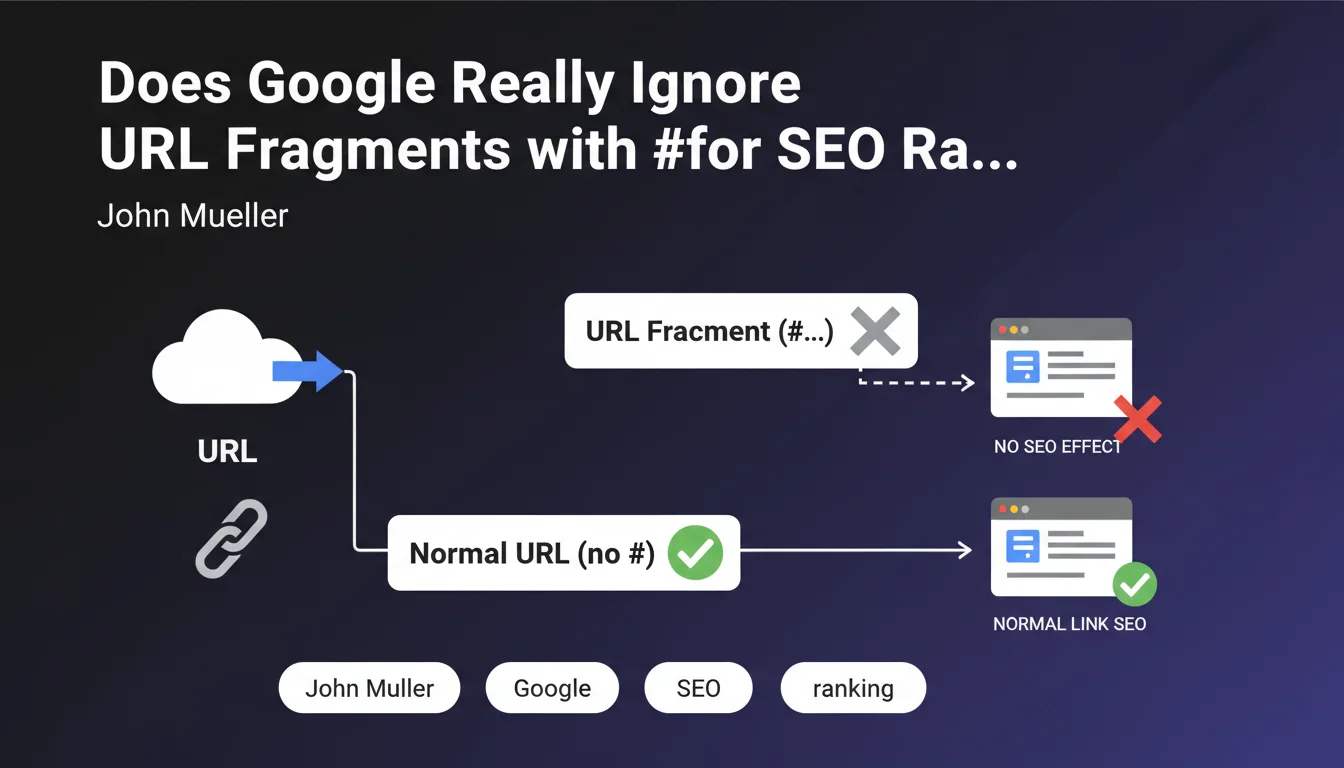
Google completely ignores URL fragments (everything after the # symbol) for search engine optimization. Whether you're using classic anchors or text fragments, these elements have zero SEO impact — a link pointing to #section-x passes exactly the same authority as a link to the page without the fragment.
What you need to understand
URL fragments are those portions of a web address that follow the hash symbol (#), historically used to point to a specific section of a page. With the arrival of text fragments (scroll-to-text-fragment), some practitioners wondered whether these new features could influence search rankings.
Mueller's statement is crystal clear: no special treatment, no bonuses, no differentiation. The fragment is simply and purely ignored by Google's algorithms.
Have URL fragments ever played a role in SEO?
No, never. Since the dawn of the Web, fragments have served exclusively for client-side internal navigation. The browser interprets them, not the server — and certainly not the crawlers.
Some analysis tools may display URLs with fragments in their reports, creating the illusion of a distinction. But on the indexing side, Google treats example.com/page and example.com/page#section as a single identical resource.
What's the difference between classic anchors and text fragments?
A classic anchor (#intro, #conclusion) points to an HTML element identified by an id attribute. A text fragment (introduced via the #:~:text= syntax) allows you to highlight a specific passage without prior markup.
From an SEO standpoint? No difference whatsoever. Both are ignored. A link to a text fragment doesn't carry more weight than a standard link — it's just better UX for the user who arrives exactly where they need to be.
Can Google still see what happens after the #?
No. Fragments are never sent to the server during an HTTP request. When you click on example.com/page#section, the server only receives example.com/page. The browser handles the scroll locally.
Googlebot behaves exactly the same way: it crawls the page without the fragment, indexes it, and ignores everything after the hash. It's technically impossible to base a ranking criterion on data that's never received.
- URL fragments (#section, #:~:text=) are completely ignored by Google in terms of SEO
- A link with a fragment passes the same authority as a link without a fragment to the same page
- Fragments serve only to improve user navigation, not search rankings
- This rule applies equally to classic anchors and new text fragments
- Googlebot never receives fragments — they remain entirely client-side
SEO Expert opinion
Is this statement consistent with real-world observations?
Yes, and it always has been. No credible test has ever demonstrated an SEO impact from fragments. Technical audits show that Google systematically consolidates URLs with fragments toward the canonical version without a fragment.
I've seen cases where sites generated thousands of variants with different anchors — the result? A single SEO signal for the root URL. No dilution, no bonus. Just unnecessary noise in the logs.
Are there exceptions or edge cases to watch out for?
There aren't really any exceptions, but two points warrant attention. First point: Single Page Applications (SPAs) that use fragments to simulate different URLs (#/product/123). Technically, it's a single page for Google — unless you implement server-side rendering or a pushState system.
Second point: some CMS tools or tracking systems automatically add fragments to mark events. If you see thousands of variants in Search Console, it's often a reporting artifact, not an actual indexing problem.
Will text fragments evolve into an SEO signal?
Honestly? Unlikely in the near term. Google has clearly positioned this feature as a UX tool, not a ranking lever. Adopting it for SEO would require a complete overhaul of crawl architecture.
[To verify]: Some argue that Google could one day use text fragments to better understand the relevance of link anchors. Technically feasible via JavaScript rendering, but Mueller has never suggested it's in the pipeline.
Practical impact and recommendations
What should you concretely do with URL fragments?
First, clean up your reports. If you see URLs with fragments in Search Console or your analysis tools, it's often a configuration issue. Configure your tools to group these variants under the canonical URL.
Next, use fragments for what they are: a way to improve navigation. Create anchors to key sections of your long-form content — it helps users and reduces bounce rates. But don't expect a direct SEO boost.
What mistakes should you absolutely avoid?
First mistake: believing that adding fragments to your internal links will distribute PageRank differently. It won't. <a href="/page#section1"> and <a href="/page#section2"> point to the same resource in Google's eyes. SEO juice doesn't split.
Second mistake: relying on text fragments to optimize your backlink anchors. Even if you share a link highlighting a specific passage, Google won't extract that information to refine its understanding of your content.
How can you verify that your site handles fragments properly?
Run a crawl with Screaming Frog or Sitebulb with JavaScript rendering enabled. See how many unique URLs come back with fragments. If the number is high, identify the source: tracking, CMS, external links?
Then check in Search Console that these variants aren't creating false impressions or confusion in your performance data. If they are, adjust your filters or fix URL generation at the source.
- Group URLs with fragments under their canonical version in your analysis tools
- Don't count on fragments to distribute internal PageRank differently
- Use anchors and text fragments only to improve UX
- Crawl your site to identify parasitic variants with fragments
- Clean up tracking systems that add unnecessary fragments
- Don't create distinct content accessible only via fragment (SPA without SSR)
- Document fragment usage in your internal linking strategy to avoid team misunderstandings
❓ Frequently Asked Questions
Un lien avec fragment (#section) transmet-il moins de PageRank qu'un lien normal ?
Les fragments de texte (#:~:text=) peuvent-ils améliorer le ranking d'une page ?
Si j'ai des milliers d'URL avec fragments dans Search Console, est-ce un problème ?
Dois-je supprimer tous les fragments de mes liens internes ?
Les SPA qui utilisent des fragments pour la navigation sont-elles pénalisées ?
🎥 From the same video 13
Other SEO insights extracted from this same Google Search Central video · published on 18/04/2024
🎥 Watch the full video on YouTube →
💬 Comments (0)
Be the first to comment.