
Official statement
Other statements from this video 13 ▾
- □ Peut-on gérer plusieurs sites web sans pénalité SEO ?
- □ Tirets vs underscores dans les URLs : quel impact réel sur votre SEO ?
- □ Le noindex follow garantit-il vraiment l'exploration des liens par Google ?
- □ Pourquoi Google ignore-t-il les fragments d'URL avec # en SEO ?
- □ Les erreurs 503 brèves impactent-elles vraiment le crawl de votre site ?
- □ Pourquoi noindex est-il plus efficace que robots.txt pour masquer un site de Google ?
- □ Changer d'hébergeur web impacte-t-il réellement votre référencement naturel ?
- □ Faut-il vraiment bannir le texte intégré directement dans les images ?
- □ Les menus burger dupliqués dans le DOM nuisent-ils au référencement ?
- □ Peut-on vraiment cibler plusieurs pays avec une seule page grâce à hreflang ?
- □ Les erreurs 404 externes nuisent-elles vraiment au classement Google ?
- □ Faut-il vraiment un sitemap.xml pour bien ranker sur Google ?
- □ Faut-il vraiment abandonner les URLs mobiles séparées (m-dot) pour le SEO ?
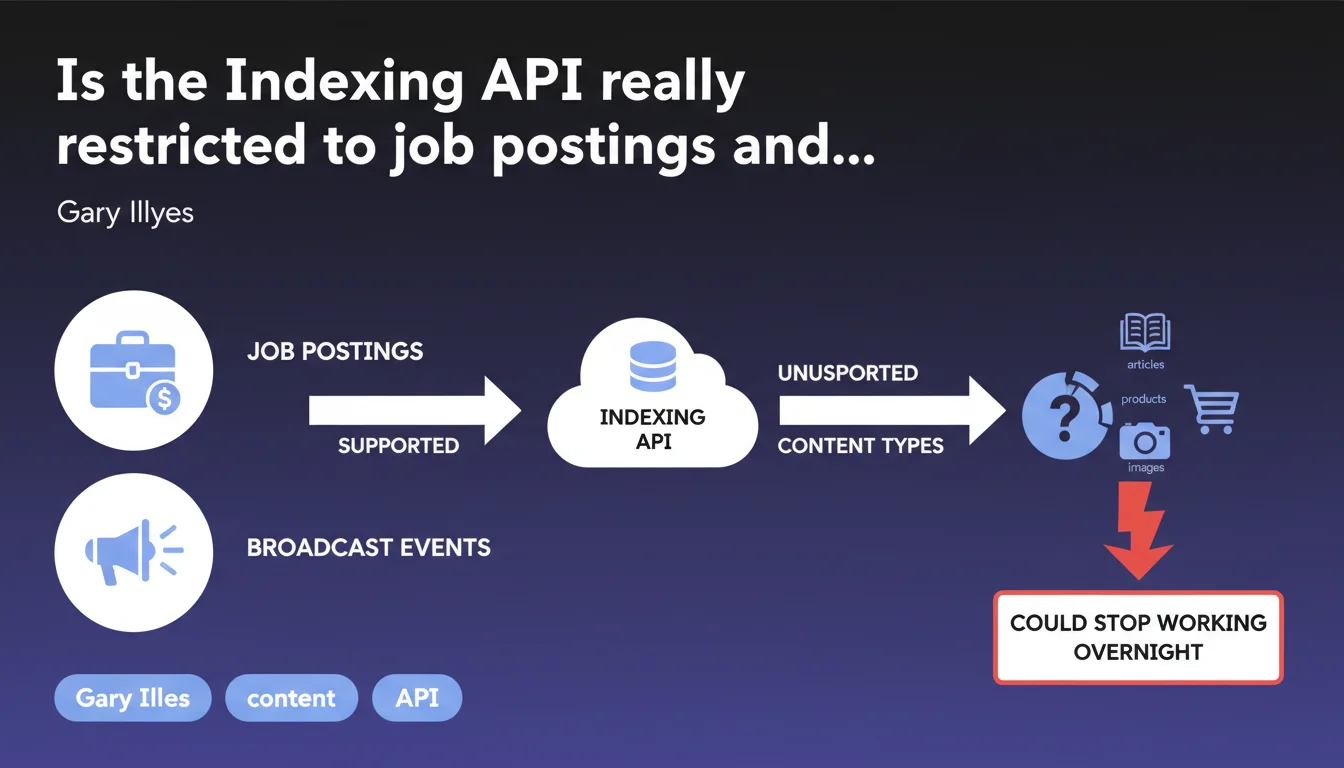
Google officially restricts the Indexing API to job postings and broadcast events. Using it for other content types might work today, but Google warns it can cut access without notice for non-compliant usage. A clear framework that puts an end to workarounds.
What you need to understand
Why does Google enforce strict boundaries on this API?
The Indexing API exists to signal time-sensitive content to Google: an event starting in two hours, a job opening that could be filled within 48 hours. This type of content requires near-immediate indexing, whereas standard crawling can take several days.
Gary Illyes's message is crystal clear — you can technically send any type of page through this API, but Google reserves the right to disable access without warning if you misuse the tool. No grace period, no warning email.
What distinguishes this API from standard crawling?
Classical crawling follows priorities set by the algorithm — site popularity, content freshness, allocated crawl budget. The Indexing API bypasses this queue for very specific use cases where timing is critical.
Google didn't design this infrastructure to index your blog articles or product sheets in bulk. The server resources mobilized to process these priority requests have a cost — hence the intentional restriction to verticals that justify this urgency.
What are the concrete risks for those who circumvent these limits?
The threat is explicit: your access can be revoked overnight. No gradual deprecation, no transition phase. If you've built your indexing strategy on non-compliant usage, you wake up one morning with a broken system.
The issue isn't technical so much as strategic — building operational dependency on officially unsupported usage exposes you to a risk few businesses can afford.
- The Indexing API targets exclusively job postings and broadcast events
- Usage for other content types may work temporarily but without any continuity guarantee
- Google can cut access immediately for unsupported verticals
- No SLA or compatibility commitment outside the official scope
- Standard crawling remains the recommended method for 99% of web content
SEO Expert opinion
Does this restriction truly reflect real-world practices?
Let's be honest — many sites have tested the Indexing API on out-of-scope content. News articles, product sheets, editorial pages... and it worked. The temptation was strong: why wait for natural crawling when you can force indexing in minutes?
The problem is that Google has apparently detected these workarounds and is deciding to enforce stricter rules. This statement is far from trivial — it likely signals a technical hardening coming soon. When Gary Illyes takes time to clarify publicly, it's rarely just for free education.
Do signals sent via the API actually impact rankings?
The question nobody asks: does bombarding Google with indexing requests via the API influence freshness or priority signals beyond simple discovery? [To be verified] — Google has never precisely documented the algorithmic treatment of URLs submitted via API versus those discovered by crawl.
Some observe faster indexing, others find that the API accelerates discovery but doesn't influence ranking. The correlation between indexing speed and SEO performance remains unclear, and this statement clarifies nothing on that front.
Can you really trust the stability of this boundary?
Google loves clear categories in theory, but reality is messier. Is a live webinar an "event broadcast"? Is a six-month internship an "job posting" in the strict sense? Gray areas exist, and Google provides no precise technical criteria to draw the line.
The risk: Google may apply this rule arbitrarily or inconsistently. What passes today could be blocked tomorrow, with no recourse or explanation. This regulatory uncertainty should alone be enough to discourage any critical dependency on the API outside documented use cases.
Practical impact and recommendations
What should you do if you're currently using the API out of scope?
First reflex: audit immediately all feeds sending requests to the Indexing API. Identify precisely what content types are flowing through it. If it's not strictly job postings or broadcast events, you're in red territory.
Next, assess criticality — does your business model depend on this accelerated indexing? If yes, you have a dependency problem you need to solve before Google decides for you. If it's peripheral, simply cut the feed and revert to standard crawling.
How do you optimize indexing without relying on the API?
Natural crawling remains the reference indexing channel for 99% of sites. Optimize your crawl budget, improve site architecture, accelerate server response times — these levers work, they're stable, and Google isn't going to break them overnight.
For urgent content outside API scope, combine multiple methods: frequently updated XML sitemaps, reinforced internal linking to new pages, social signals to accelerate discovery. Less flashy than the API, but far more resilient.
What mistakes must you absolutely avoid?
Never ever build operational dependency on undocumented usage of a Google tool. History is clear: APIs change, features disappear, policies tighten. What works today can be disabled tomorrow without compensation.
Second common mistake: believing that fast indexing compensates for poor architecture. If your site crawls badly, the API doesn't fix anything fundamentally — it just masks the symptom. You end up with a house of cards that collapses the moment Google closes the tap.
- Identify all current feeds using the Indexing API
- Verify strict compliance with the official scope (jobs + events)
- Migrate out-of-scope content to standard indexing methods
- Optimize crawl budget and architecture to reduce indexing delays
- Test your strategy's resilience by simulating complete API shutdown
- Document alternative processes and train teams on best practices
- Monitor actual indexing times post-migration to validate effectiveness
❓ Frequently Asked Questions
Peut-on utiliser l'API d'indexation pour des articles de presse urgents ?
Que se passe-t-il si Google détecte un usage non conforme de l'API ?
L'indexation via l'API améliore-t-elle le ranking des pages ?
Comment savoir si mon contenu entre dans la catégorie 'événement diffusé' ?
Quelle alternative pour indexer rapidement du contenu sensible au facteur temps ?
🎥 From the same video 13
Other SEO insights extracted from this same Google Search Central video · published on 18/04/2024
🎥 Watch the full video on YouTube →
💬 Comments (0)
Be the first to comment.