
Official statement
What you need to understand
Google's Indexing API is a technical tool that allows you to instantly notify the search engine about the addition or update of web pages. Unlike the traditional XML sitemap, it promises almost immediate indexing.
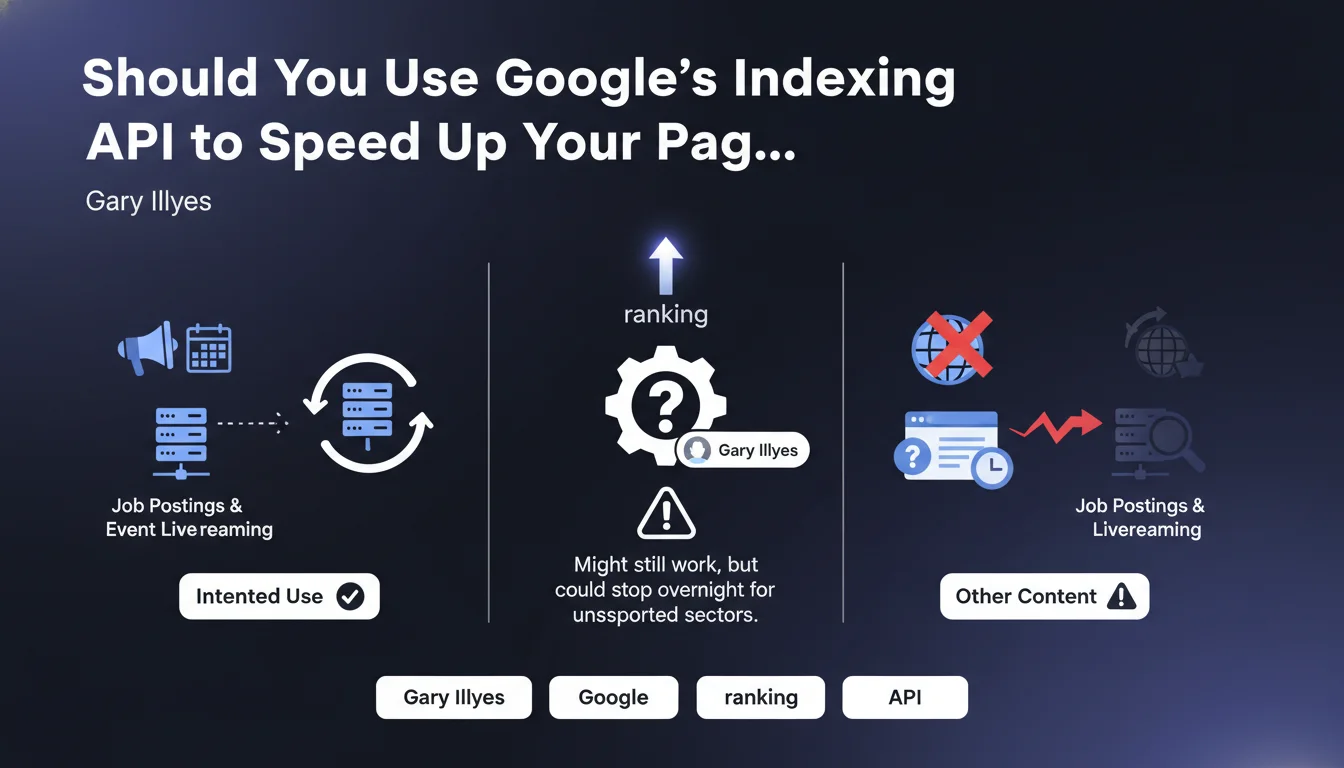
However, Google officially restricts its use to two specific use cases: job postings (JobPosting) and online events (livestream markup). Any other use constitutes a violation of the terms of use intended by Google.
Gary Illyes warns against using this API for other sectors such as real estate, e-commerce, or news sites. The main risk: a sudden service interruption without notice, leaving affected sites without their accelerated indexing method.
- The API is reserved for job postings and live events only
- Its misuse may work temporarily but without guarantee
- Google can disable access at any time for non-compliant uses
- The API has been associated with indexing spam and low-quality content
- No warning will be given before a potential shutdown
SEO Expert opinion
This warning from Gary Illyes is perfectly consistent with field observations. Many SEO professionals have indeed used this API to accelerate the indexing of e-commerce, real estate, or media sites, with initially positive results.
The important nuance here concerns the benefit/risk ratio. While the API still technically works for other sectors, basing your entire indexing strategy on a misused tool represents a major vulnerability. The mention of the link with spam is not trivial: Google could drastically tighten its controls.
For job postings and live events, the use remains fully recommended as it complies with the guidelines. It's precisely for this short-lived content that the API provides genuine legitimate added value.
Practical impact and recommendations
- Immediately audit your current use of the Indexing API and identify whether you're using it outside of job postings and events
- Gradually stop the misuse of the API for other types of content (real estate, e-commerce, news)
- Strengthen your classic indexing strategy: optimize your XML sitemaps, improve internal linking, increase crawl frequency
- Prioritize content quality over indexing speed: valuable pages get indexed naturally faster
- Use Search Console to manually submit truly strategic URLs (launches, premium content)
- Document a plan B for indexing to anticipate a potential sudden API access shutdown
- If you manage job postings or events, continue using the API in accordance with official guidelines
- Monitor indexing times after the transition to adjust your strategy if necessary
Bringing your indexing strategy into compliance and optimizing alternative methods require in-depth technical expertise and a thorough understanding of Google's crawling mechanisms. These adjustments often touch on site architecture, technical performance, and overall content strategy.
For large sites or critical projects, specialized support helps secure this transition without losing visibility. An experienced SEO agency can precisely audit your situation, identify the most effective indexing levers for your sector, and implement a robust and sustainable strategy tailored to your specific challenges.
💬 Comments (0)
Be the first to comment.