
Official statement
What you need to understand
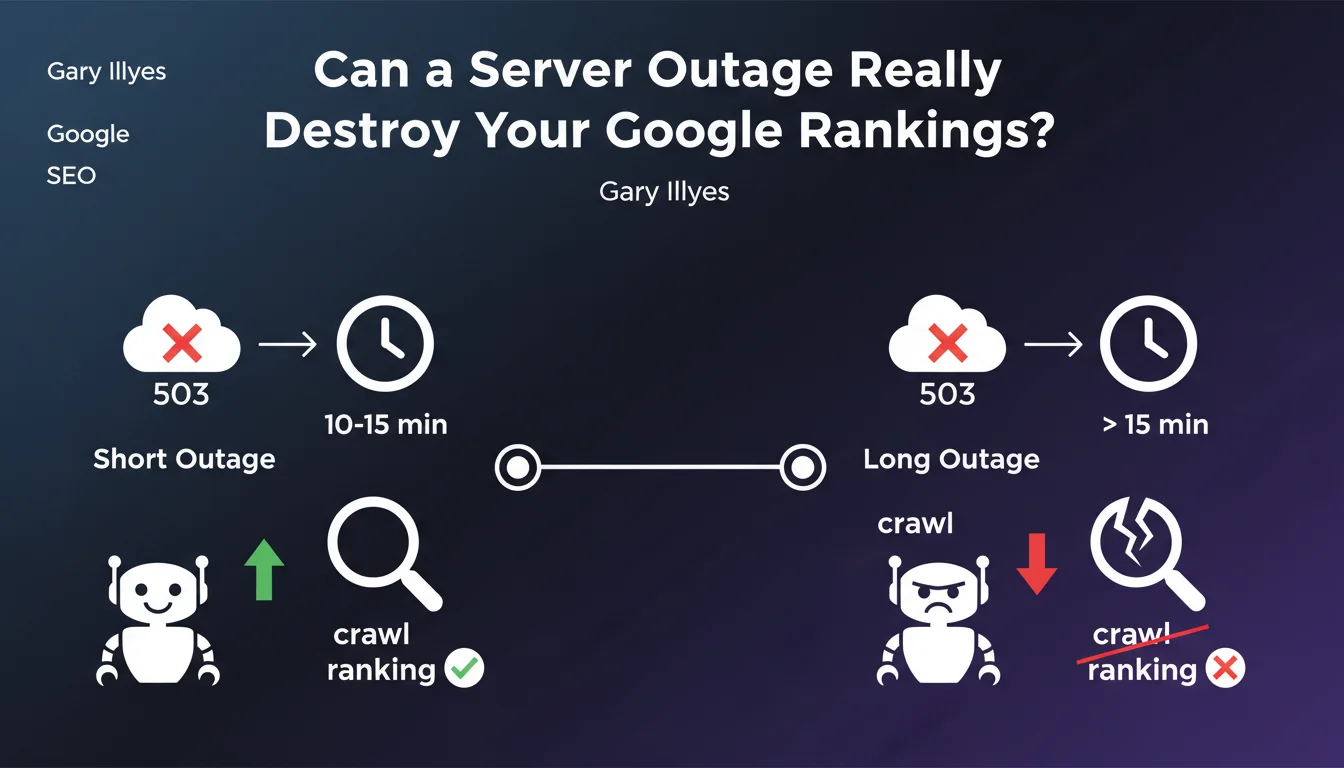
Google has clarified its position regarding the impact of temporary website unavailability on organic search rankings. When a server returns an HTTP 503 code (Service Unavailable), which indicates a momentary interruption, the search engine shows a certain degree of tolerance.
Specifically, short interruptions of a few minutes do not affect the crawl rate or rankings. Google understands that maintenance, updates, and technical incidents are part of a website's normal lifecycle. However, the situation changes dramatically when the unavailability extends.
The critical threshold is around 10 to 15 minutes. Beyond this duration, Google's robots begin to slow down their crawling frequency, which can have cascading consequences on indexing and, ultimately, on the positioning of pages in search results.
- Short-duration 503 codes (less than 10 minutes) are tolerated without penalty
- Beyond 10-15 minutes, the crawl budget is negatively impacted
- Extended unavailability can affect indexing and rankings
- Google differentiates between isolated outages and recurring availability problems
SEO Expert opinion
This statement is perfectly consistent with field observations over several years. In my practice, I have indeed observed that short-term scheduled maintenance, even on high-visibility sites, generates no measurable impact on SEO performance. Google has clearly optimized its algorithms to distinguish between isolated maintenance and a structural reliability problem.
However, an important nuance must be made regarding news sites and time-sensitive content. For these, even a 10-minute unavailability during a traffic spike or when publishing breaking news content can cause a critical indexing window to be missed. The damage is not so much a demotion as it is a definitively lost traffic opportunity.
Another crucial point rarely mentioned: the type of pages affected matters enormously. An unavailability affecting only deep, infrequently crawled pages will have a negligible impact, while the inaccessibility of the homepage or main hubs, even briefly, can disrupt the discovery of new content.
Practical impact and recommendations
- Optimize your maintenance windows: Schedule them during low-traffic hours and strictly limit them to less than 10 minutes. Use real-time monitoring to ensure you respect this threshold.
- Configure HTTP 503 codes correctly: Ensure your server returns a 503 code (not 404 or 500) during maintenance, with a Retry-After header to indicate the estimated duration of the interruption.
- Implement proactive monitoring: Use uptime monitoring tools (Pingdom, UptimeRobot, StatusCake) with immediate alerts to respond within 10 minutes in case of an unplanned incident.
- Document your maintenance in Search Console: Although not officially confirmed, informing Google via Search Console of scheduled maintenance can facilitate contextual understanding by the algorithms.
- Favor zero-downtime deployments: Invest in architectures that enable zero-downtime deployment (blue-green deployment, rolling updates) to completely eliminate risks.
- Test your recovery plan: Ensure you can quickly restore your site in case of problems during an update. Rollback time must be less than 10 minutes.
- Absolutely avoid: Extended maintenance without a 503 code, repeated outages even if short, unavailability during crawl peaks identified in Search Console.
- Analyze your logs after each incident: Check whether Googlebot attempted to crawl during the unavailability and monitor variations in crawl frequency in the following days.
💬 Comments (0)
Be the first to comment.