
Official statement
Other statements from this video 15 ▾
- □ Les fluctuations de classement sont-elles vraiment normales ou cachent-elles un problème technique ?
- □ Google utilise-t-il vraiment un seul index mondial pour tous les pays ?
- □ Faut-il encore se fier aux résultats de la requête site: pour diagnostiquer l'indexation ?
- □ L'engagement utilisateur influence-t-il réellement le classement Google ?
- □ Pourquoi les pages à fort trafic pèsent-elles plus dans le score Core Web Vitals ?
- □ Google segmente-t-il vraiment les sites par type de template pour évaluer la Page Experience ?
- □ Pourquoi la structure en arbre de votre maillage interne compte-t-elle vraiment pour Google ?
- □ La distance depuis la homepage influence-t-elle vraiment la vitesse d'indexation ?
- □ Pourquoi la structure d'URL n'a-t-elle aucune importance pour Google ?
- □ Pourquoi les positions Search Console ne reflètent-elles pas la réalité du classement ?
- □ Google distingue-t-il vraiment 'edit video' et 'video editor' comme des intentions différentes ?
- □ Le balisage FAQ doit-il obligatoirement figurer sur la page indexée pour générer un rich snippet ?
- □ Les liens en footer ont-ils la même valeur SEO que les liens dans le contenu ?
- □ L'indexation mobile-first a-t-elle un impact sur vos classements Google ?
- □ Faut-il vraiment qu'un robots.txt inexistant retourne un 404 pour éviter de bloquer Googlebot ?
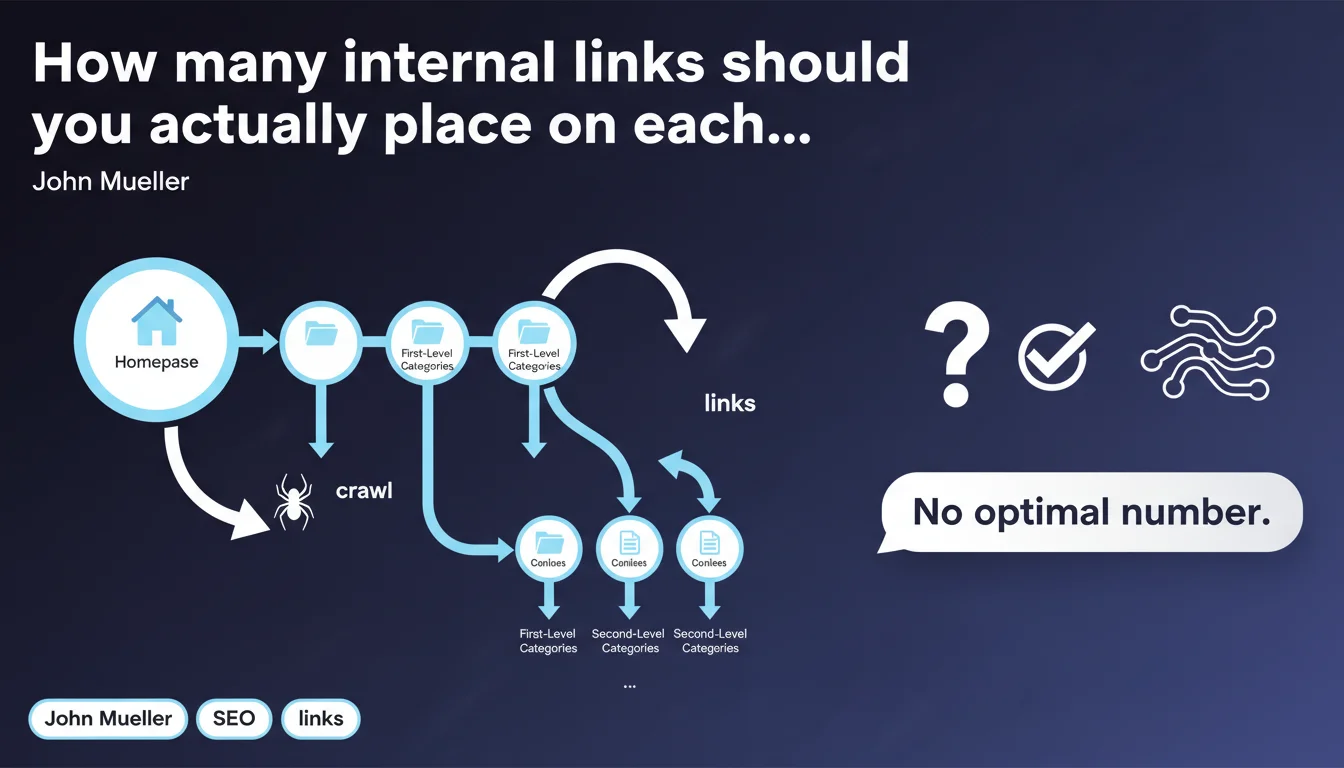
Google states there is no optimal number of internal links per page. What really matters: the clarity of your site architecture during crawling. Bots must instantly identify the hierarchy (homepage, primary categories, subcategories) without any ambiguity.
What you need to understand
Why does Google refuse to give an ideal number of links?
The answer comes down to one simple logic: every site has a different architecture. An e-commerce site with 50,000 products will never have the same structure as a 200-article blog. Imposing a universal number would mean ignoring this fundamental diversity.
What Mueller emphasizes is that Google prioritizes structural understanding over mechanical counting. The algorithms seek to map your site: where is the homepage, what are the main sections, how are the sub-levels organized. This hierarchical logic takes precedence over any quantitative consideration.
What does a "clear and visible" structure mean to Google?
Clear architecture means that each page finds its logical place in the information hierarchy. The homepage points to major categories. These categories point to their subcategories or content. No bizarre shortcuts, no chaotic links that blur the hierarchy.
Concretely, if your homepage links to 200 items all at the same depth level, Google will struggle to distinguish what really matters. Conversely, 15 carefully chosen links to your strategic pillars send a perfectly intelligible signal.
Does this statement contradict older recommendations?
For a long time, a rule circulated: no more than 100 links per page. This limit dated from an era when Google only crawled the first 100 links on a URL. This technical constraint disappeared years ago.
Mueller confirms here what many were already observing in the field. Sites with 150, 200 or even 300 links (think e-commerce megamenus) are not penalized as long as the structure remains coherent. It's the architectural logic that counts, not the raw count.
- No optimal numerical threshold: Google refuses any universal figure
- Priority given to hierarchy: bots must identify structural levels
- End of the 100-link rule: this technical limit no longer exists
- Clarity over quantity: logical architecture beats mathematical ratios
SEO Expert opinion
Is this statement really operational for a practitioner?
Let's be honest: Mueller's answer remains deliberately evasive. Saying "there's no optimal number" doesn't help anyone make concrete decisions. An SEO facing a category page with 180 links will legitimately wonder if that's too much or acceptable.
The problem is that Google systematically passes the ball back to "common sense" and "structural clarity" without ever providing tangible metrics. [To verify]: no official data specifies at what point links become "confusing" for algorithms. This imprecision leaves a frustratingly large margin for interpretation.
Do on-the-ground observations confirm this position?
In practice, the best-performing sites generally maintain visual and semantic consistency. Pages with 300 chaotic links (bloated footer, crazed sidebar, buried content) underperform — not because of the number, but because the hierarchy becomes unreadable.
Conversely, major e-commerce sites display 150-200 links per page (megamenus, filters, product grids) without apparent issues. The difference? These links follow an obvious structural logic: main navigation → categories → products. Google digests this architecture without a hitch.
And that's where it gets sticky: how do you objectively measure this "clarity"? Traditional SEO tools provide no reliable metric. We're reduced to manual analysis or time-consuming A/B tests.
What gray areas does Mueller not mention?
First point: the distinction between HTML links and JavaScript links. Google now crawls JavaScript, but with what real efficiency in different contexts? Mueller says nothing about this. Will a site with 80 HTML links + 150 JS links be crawled the same as a 100% HTML site? Mystery.
Second blind spot: the impact of link positioning on the page. Does a link at the top of a page pass more weight than a footer link? The statement remains silent on this dimension, yet it's crucial for internal PageRank distribution.
Practical impact and recommendations
What should you actually do on your existing pages?
First step: audit your hierarchy. Spend 5 minutes, open your homepage, and ask yourself if a human (or a bot) immediately identifies the major sections. If your navigation mixes strategic categories, footer links, and temporary promotions at the same visual level, you have a problem.
Next, hunt down redundant and useless links. How many times do you link "Contact" or "Legal" from the same page? These duplicates add nothing and blur clarity. A single footer link is plenty for these utility pages.
How should you structure links on a large e-commerce site?
With a catalog of several thousand products, you can't avoid dense link pages. The key: segment visually and semantically. Your megamenu displays 60 categories? Group them by major themes with explicit titles.
Product filters (color, size, price) should follow a faceted logic, not a chaotic accumulation. Google must understand that these links refine a parent category, not that they create 150 independent silos.
And let's be practical: don't link everything from everywhere. Your flagship products deserve links from the homepage; your niche products can wait to be discovered via categories. This hierarchy signals to Google what really matters.
What mistakes should you absolutely avoid?
The classic error: the bloated footer. These blocks of 100 links to valueless pages (terms, various policies, old archives) pollute every page on your site. Google crawls it all, dilutes its budget, and struggles to identify your real priorities.
Another trap: excessive contextual links. Some CMS automatically add 20 "similar articles" links at the bottom of each piece of content. If these suggestions lack semantic relevance, they muddy the structure more than they help.
- Map your current information architecture and identify level inconsistencies
- Eliminate redundant links (same destinations linked 3-4 times per page)
- Group links visually into coherent semantic blocks
- Prioritize homepage links to strategic content (the 80/20 rule)
- Clean up bloated footers full of utility links with no SEO value
- Verify that e-commerce filters/facets don't create confusing parallel structures
- Test crawl with Screaming Frog to spot orphaned or overly deep pages
❓ Frequently Asked Questions
Peut-on dépasser 100 liens internes par page sans risque ?
Comment savoir si ma structure de liens est assez claire pour Google ?
Les liens footer comptent-ils autant que les liens dans le contenu principal ?
Faut-il limiter les liens 'articles similaires' en bas de page ?
Le maillage interne impacte-t-il vraiment le positionnement ?
🎥 From the same video 15
Other SEO insights extracted from this same Google Search Central video · published on 14/03/2022
🎥 Watch the full video on YouTube →
💬 Comments (0)
Be the first to comment.