
Official statement
Other statements from this video 15 ▾
- □ Les fluctuations de classement sont-elles vraiment normales ou cachent-elles un problème technique ?
- □ Google utilise-t-il vraiment un seul index mondial pour tous les pays ?
- □ Faut-il encore se fier aux résultats de la requête site: pour diagnostiquer l'indexation ?
- □ L'engagement utilisateur influence-t-il réellement le classement Google ?
- □ Pourquoi les pages à fort trafic pèsent-elles plus dans le score Core Web Vitals ?
- □ Google segmente-t-il vraiment les sites par type de template pour évaluer la Page Experience ?
- □ Combien de liens internes faut-il placer par page pour optimiser son SEO ?
- □ Pourquoi la structure en arbre de votre maillage interne compte-t-elle vraiment pour Google ?
- □ La distance depuis la homepage influence-t-elle vraiment la vitesse d'indexation ?
- □ Pourquoi la structure d'URL n'a-t-elle aucune importance pour Google ?
- □ Pourquoi les positions Search Console ne reflètent-elles pas la réalité du classement ?
- □ Google distingue-t-il vraiment 'edit video' et 'video editor' comme des intentions différentes ?
- □ Les liens en footer ont-ils la même valeur SEO que les liens dans le contenu ?
- □ L'indexation mobile-first a-t-elle un impact sur vos classements Google ?
- □ Faut-il vraiment qu'un robots.txt inexistant retourne un 404 pour éviter de bloquer Googlebot ?
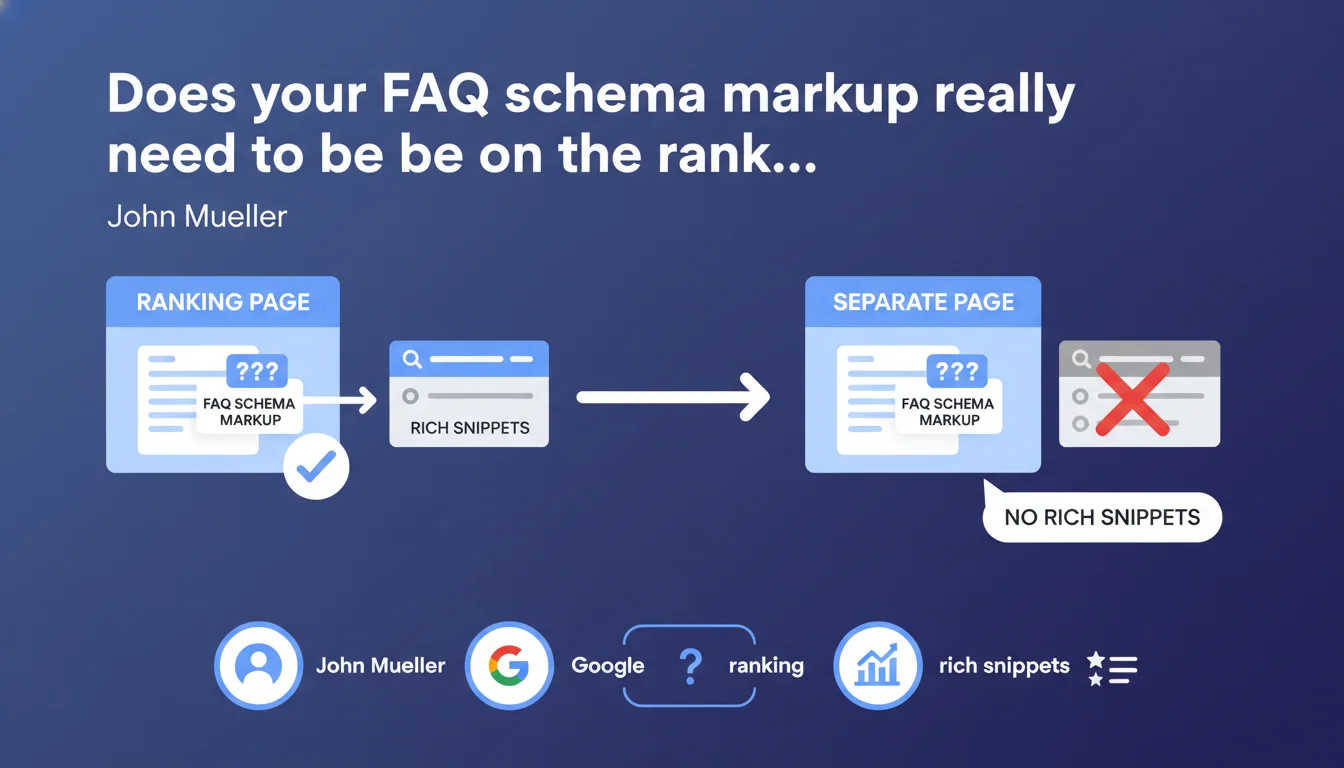
Google only displays FAQ rich snippets if the Schema markup is present on the page that actually appears in search results. Placing FAQ Schema on a separate unindexed page or a different page than the one ranking makes it impossible for these enhancements to display. This is a technical constraint that's often overlooked during multi-page architecture planning.
What you need to understand
Why does Google enforce this co-location constraint?
The logic is straightforward: Google associates Schema markup with the page that carries it. When the search engine crawls a URL, it analyzes the HTML code present on that specific URL. If your page A contains the FAQ Schema but it's page B that ranks, Google doesn't make the connection between the two.
This rule prevents manipulation where a site would place enriched markup on hidden pages to trick the algorithm. But it also creates real constraints for certain architectures — particularly sites that centralize their FAQs on dedicated pages rather than integrating them into ranking content.
What actually happens if the Schema is elsewhere?
Your markup will be technically valid in Search Console. No errors will be reported. But the rich snippet will never appear in the SERPs because the page generating the impression doesn't carry the necessary code.
It's a classic trap: you invest time structuring your data, you validate everything in the tools, and... nothing changes in the results. The problem isn't with the Schema itself, but with its location.
Which pages are considered "indexed" by Google?
An indexed page is a URL that Google has crawled, analyzed, and decided to store in its index. You can verify its status using the site:yoururl.com command or the URL inspection tool in Search Console.
Attention: a page can be technically accessible without being indexed (blocked by robots.txt, marked noindex, orphaned without internal links). If your FAQ Schema is on such a page, it will never be used — even if the content is relevant.
- The FAQ Schema must be on the page that ranks, not elsewhere
- An accessible page ≠ an indexed page — always verify indexation status
- FAQ rich snippets only display if Google finds the markup on the URL that generates the SERP impression
- Search Console won't flag this inconsistency as an error — it's up to you to verify the logic
SEO Expert opinion
Is this constraint really enforced strictly?
Yes, and it's one of the rare points where Google leaves no room for interpretation. Field observations consistently confirm this rule: FAQ Schema placed on page X never generates rich snippets for page Y, even if both pages cover the same topic.
Some SEOs hope that Google will "understand" the connection between two related pages. Let's be honest — Google doesn't do that work for you. The algorithm reads the code present on the URL that ranks, period.
What are the consequences for complex architectures?
Sites with silo architectures, centralized FAQs, or content distributed across multiple URLs face a dilemma. Either you duplicate the Schema on each relevant page, or you give up rich snippets on certain URLs.
And that's where it gets tricky: duplicating FAQ markup across 50 product pages is a technical and editorial undertaking. Centralizing FAQs on a dedicated page is cleaner architecturally, but you lose SERP enhancements on your priority pages. You have to choose.
Can you work around this limitation with technical tricks?
No. Neither iframes, asynchronous JavaScript, nor canonicalization change anything. Google reads the final HTML of the page generating the impression — that's where it must find the Schema.
Some have tried injecting Schema dynamically via GTM or a third-party script. It can work if JavaScript rendering is properly crawled, but you're adding a layer of complexity and risk for uncertain gains. You might as well place the markup directly in the source HTML.
Practical impact and recommendations
How do you verify that your FAQ Schema is on the right page?
First step: identify the URLs that actually rank for your target queries. Not the ones you'd like to see ranking — the ones appearing in the SERPs. Use Search Console or a tracking tool to retrieve this data.
Next, inspect the source code of each of these URLs. The FAQ Schema must be present in the HTML — either inline in the <head> or via a JSON-LD script. If you're using a CMS, verify that the template applied generates the markup on these specific pages.
What if your FAQs are centralized on a dedicated page?
You have three options. Option 1: Integrate questions and answers directly into the content of pages that rank, with the corresponding Schema. This is the most effective solution, but it requires editorial overhaul.
Option 2: Create FAQ blocks specific to each product or category page, with unique Schema per page. Less comprehensive than a centralized FAQ, but more targeted and actionable for Google.
Option 3: Accept that your central FAQ page won't generate rich snippets on other URLs. You can still make it rank itself on generic informational queries — but it won't boost your commercial pages.
What errors should you avoid during implementation?
- Never place FAQ Schema on a noindexed page or one blocked by robots.txt
- Verify that the markup is in the source HTML, not just injected client-side
- Don't duplicate the exact same FAQ Schema across 100 pages — Google may consider that spam
- Test each URL with Google's rich results testing tool
- Ensure the pages that rank are the ones carrying the Schema
❓ Frequently Asked Questions
Le Schema FAQ peut-il être placé sur une page en noindex ?
Si je duplique le même Schema FAQ sur plusieurs pages, est-ce pénalisant ?
Puis-je utiliser JavaScript pour injecter le Schema FAQ dynamiquement ?
Comment savoir si mon Schema FAQ est bien détecté par Google ?
Une page accessible en HTTPS mais non indexée peut-elle générer un rich snippet FAQ ?
🎥 From the same video 15
Other SEO insights extracted from this same Google Search Central video · published on 14/03/2022
🎥 Watch the full video on YouTube →
💬 Comments (0)
Be the first to comment.