
Official statement
Other statements from this video 15 ▾
- □ Les fluctuations de classement sont-elles vraiment normales ou cachent-elles un problème technique ?
- □ Google utilise-t-il vraiment un seul index mondial pour tous les pays ?
- □ Faut-il encore se fier aux résultats de la requête site: pour diagnostiquer l'indexation ?
- □ Pourquoi les pages à fort trafic pèsent-elles plus dans le score Core Web Vitals ?
- □ Google segmente-t-il vraiment les sites par type de template pour évaluer la Page Experience ?
- □ Combien de liens internes faut-il placer par page pour optimiser son SEO ?
- □ Pourquoi la structure en arbre de votre maillage interne compte-t-elle vraiment pour Google ?
- □ La distance depuis la homepage influence-t-elle vraiment la vitesse d'indexation ?
- □ Pourquoi la structure d'URL n'a-t-elle aucune importance pour Google ?
- □ Pourquoi les positions Search Console ne reflètent-elles pas la réalité du classement ?
- □ Google distingue-t-il vraiment 'edit video' et 'video editor' comme des intentions différentes ?
- □ Le balisage FAQ doit-il obligatoirement figurer sur la page indexée pour générer un rich snippet ?
- □ Les liens en footer ont-ils la même valeur SEO que les liens dans le contenu ?
- □ L'indexation mobile-first a-t-elle un impact sur vos classements Google ?
- □ Faut-il vraiment qu'un robots.txt inexistant retourne un 404 pour éviter de bloquer Googlebot ?
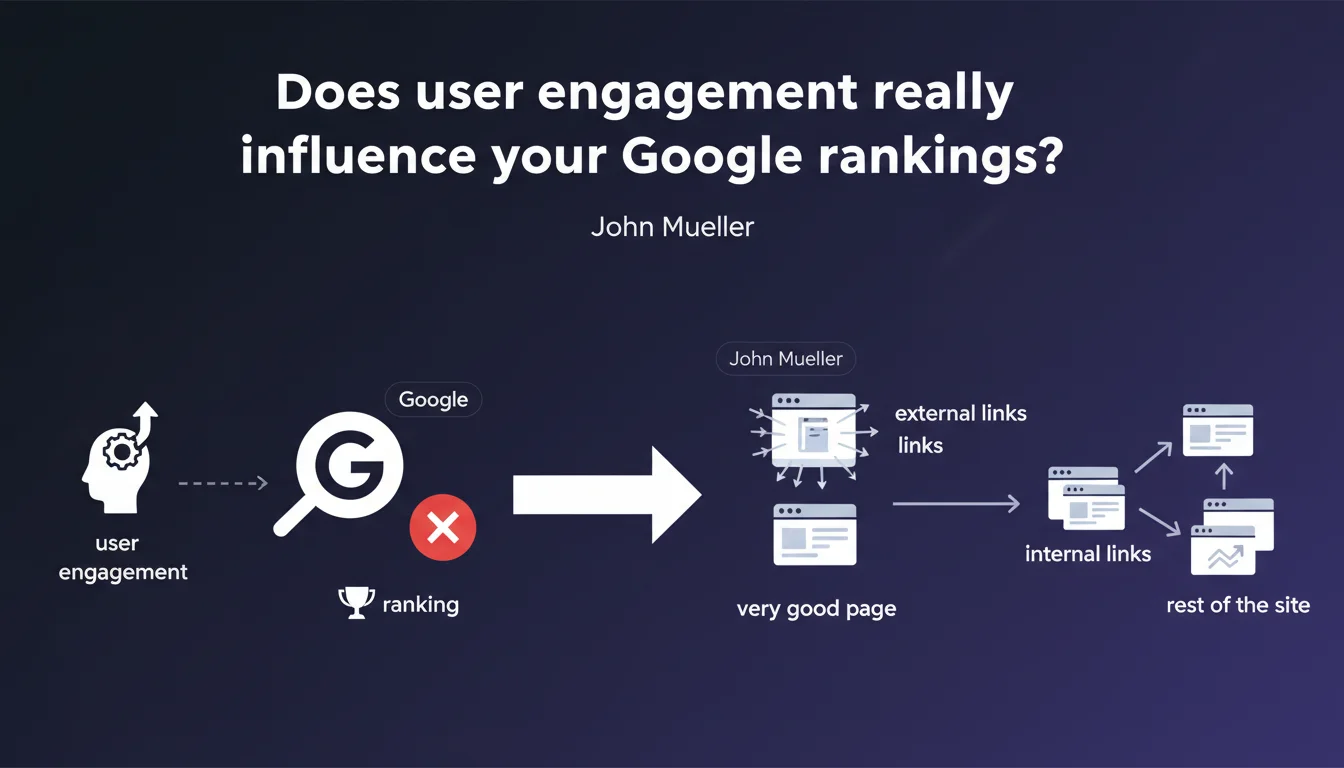
Google claims it doesn't use engagement as a direct ranking factor. However, quality signals from a high-performing page flow to other pages on the site through internal linking. A strong page nourishes the entire domain.
What you need to understand
What exactly does "engagement" mean in this statement?
Mueller is talking about behavioral metrics here: bounce rate, time on page, pages per session, click-through rate. Google claims these signals are not direct ranking criteria. Contrary to what many believe, high visit duration doesn't mechanically boost your positions.
The nuance — and it's critical — lies in signal transmission. A page that attracts quality backlinks becomes a hub. This authority ripples across the pages it links to internally.
How do signals actually transmit through internal linking?
Internal PageRank works like its external counterpart: a strong page distributes juice to the pages it points to. If your ultra-detailed guide collects 50 backlinks from authoritative sites, it becomes a relay to spread that authority to your commercial landing pages.
In practice? Your orphaned pages or weakly linked content languishes. Those benefiting from links from your flagship content climb the index. It's mechanical, measurable, exploitable.
- Direct engagement (CTR, dwell time) is not a ranking factor
- External backlinks remain the primary fuel for a page's authority
- Strategic internal linking redistributes that authority across the entire site
- An isolated page, however excellent, struggles to perform without internal links from strong pages
Why does Google emphasize this distinction?
Because confusion reigns. Many frantically optimize engagement signals — retention pop-ups, dwell time widgets — believing they can trick the algorithm. Mueller corrects the record: that's not where the battle is won.
The real challenge? Building content that attracts links, then orchestrating coherent internal linking. Everything else is cosmetic.
SEO Expert opinion
Is this statement consistent with real-world observations?
Yes and no. On paper, Google delivers a crystal-clear message: no direct engagement in the algorithm. But — and it's a big but — A/B tests regularly show that improving organic CTR from the SERPs generates ranking gains. Coincidence? Correlation without causality? [To verify]
Signal transmission through internal links, meanwhile, is observable in real time. Add a link from your star article to a struggling page: it climbs in 2-3 weeks. Remove it: it plummets again. Reproducible, documented.
What nuances should be added to this message?
Mueller talks about "signals" without naming them. What exactly transits through these internal links? PageRank, certainly. But also thematic signals, freshness, content depth — everything that constitutes a page's E-E-A-T.
Another point: Google says it doesn't use engagement as a factor, but nothing prevents these metrics from serving to refine models behind the scenes. RankBrain and similar systems train on behavioral data. Using them to rank and using them to learn are two different things.
In which cases does this rule not apply?
Ultra-specialized niche sites with few pages benefit less from internal transmission — for lack of volume. If you have 12 articles, however excellent, internal linking does what it can. The leverage effect is limited.
Conversely, on a 10,000-URL site, a poorly exploited hub page represents colossal waste. That's where strategic internal linking radically changes the game.
Practical impact and recommendations
What should you actually do to exploit this mechanism?
Identify your pages with high link equity. Use Ahrefs, Majestic, or Search Console to list URLs concentrating backlinks. These are your distribution relays.
Next, map the outbound links from these power pages. Do they point to your strategic content (conversion, pillar topics) or secondary pages that don't need them? Redirect the flow where it matters.
- Audit pages with the most external backlinks (referring domains, Trust Flow)
- Verify these pages distribute internal links to your priority URLs
- Remove unnecessary internal links from these hubs to weak or outdated pages
- Create pillar content capable of attracting natural backlinks
- Automate contextual linking via plugins or scripts to ensure consistency
- Monitor ranking evolution of newly linked pages from a strong hub
What mistakes should you avoid at all costs?
Don't turn your strong pages into link catalogs. Google detects footers packed with 50 links, bloated sidebars. Juice dilutes, effect cancels. Bet on parsimony: 5 to 10 well-placed contextual links beat 40 in the footer.
Another pitfall: believing good internal linking compensates for mediocre content. If your target pages are empty, duplicated, or off-topic, no internal link will save them. Content remains the foundation.
How can you verify your site leverages this logic?
Use a crawler (Screaming Frog, Oncrawl) to visualize internal PageRank flow. Identify orphaned pages — zero inbound links — and dead ends that accumulate links without redistributing.
Compare similar pages: do those receiving links from your performing hubs rank better? If not, your linking is poorly calibrated or your hubs aren't as strong as you think.
Engagement isn't a direct ranking lever, but your site's internal architecture is. Optimizing signal transmission through strategic linking requires fine-grained analysis: identifying high-equity pages, restructuring links, balancing flow. These optimizations, while critical, demand technical expertise and holistic site vision. If you lack time or resources for this deep audit, engaging a specialized SEO agency can help you fully exploit your existing content's potential without spreading yourself thin.
❓ Frequently Asked Questions
Google utilise-t-il le taux de rebond pour classer les pages ?
Le maillage interne peut-il remplacer les backlinks externes ?
Combien de liens internes une page forte doit-elle distribuer ?
Les pages sans backlinks externes peuvent-elles bien se classer ?
Faut-il supprimer les liens internes vers des pages faibles ?
🎥 From the same video 15
Other SEO insights extracted from this same Google Search Central video · published on 14/03/2022
🎥 Watch the full video on YouTube →
💬 Comments (0)
Be the first to comment.