
Official statement
What you need to understand
What exactly does this Google statement about engagement mean?
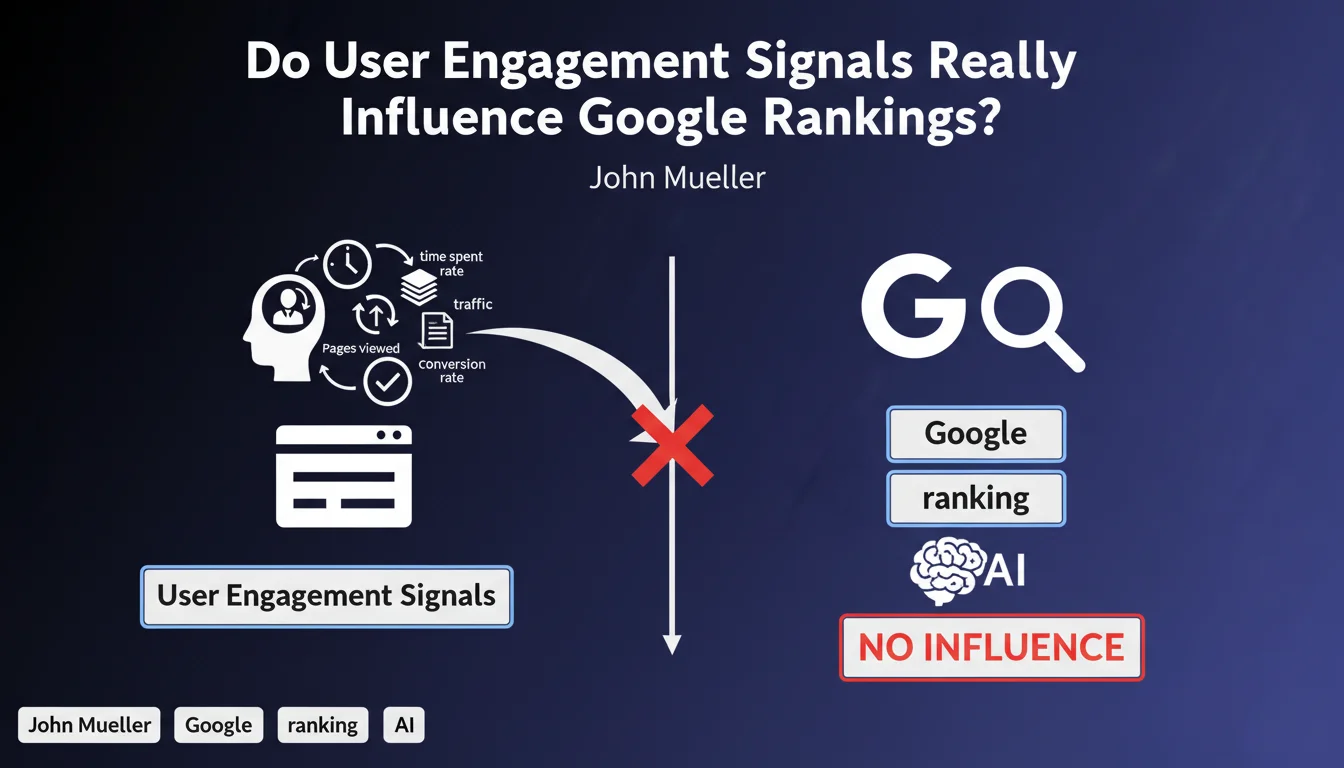
Google clearly states that user engagement metrics are not used as relevance criteria for ranking. This includes time spent on page, bounce rate, number of pages viewed, scroll depth, or even conversion rate.
This official position has been repeated by Google for years. The objective is to dispel a persistent myth in the SEO community that attributes direct ranking value to these behavioral signals.
Why does Google maintain this official position?
Google has its own quality indicators based on content, links, and technical user experience. Directly using behavioral analytics data would be too easily manipulated and would not necessarily reflect the real quality of a page.
Moreover, not all sites have Google Analytics installed. Relying on these metrics would create inequality in page evaluation. Google prefers to rely on its own signals collected via Chrome, Android, and the SERPs.
What are the gray areas in this statement?
The major problem lies in the vague definition of what Google means by engagement. John Mueller does not specify exactly which interactions are or are not taken into account.
- Clicks on search results and return to SERPs are signals that Google can observe directly
- Core Web Vitals indirectly measure certain forms of engagement (interaction, visual stability)
- Behavior in the SERPs (CTR, pogosticking) could influence ranking without being officially recognized
- The distinction between direct and indirect signals remains deliberately ambiguous
SEO Expert opinion
Is this statement consistent with what we observe in search results?
My 15 years of experience show a dissonance between the official statement and field observations. Pages that generate better behavioral signals do indeed tend to rank better, but correlation does not necessarily imply causation.
In reality, good content naturally generates engagement AND ranks well for other reasons (authority, semantic relevance, quality backlinks). Engagement is therefore a symptom of quality rather than a direct ranking factor.
What fundamental nuances should be brought to this official position?
Google is not saying that it totally ignores user behavior. It says it does not directly use classic engagement metrics as relevance factors. The nuance is crucial.
Google uses proprietary behavioral signals collected through its own channels: Chrome data, clicks in the SERPs, navigation patterns. These signals can influence ranking via systems like RankBrain or quality adjustments without being official "ranking factors."
In what contexts might this rule have exceptions?
For ambiguous or new queries, Google may rely more on behavioral signals to understand the real intent and adjust results. Machine learning requires interaction data to improve.
Google Discover and recommendation systems certainly use more direct engagement signals, as they do not operate on the same model as classic keyword-based search.
Practical impact and recommendations
What should you actually do as an SEO practitioner?
Don't waste your time artificially optimizing engagement metrics in Google Analytics. These numbers are useful for your business analysis, but do not directly serve your ranking.
Instead, focus on the real quality of user experience: fast and precise response to search intent, intuitive navigation, optimal loading times, naturally engaging content. If your content is excellent, engagement will naturally follow.
What critical mistakes should you absolutely avoid?
The most common mistake is to artificially manipulate metrics: forcing scroll, blocking access to content to increase time on page, unnecessarily multiplying pagination. These techniques degrade real user experience.
Another trap: completely ignoring behavioral signals on the grounds that Google says it does not use them. These metrics reveal real UX problems, content relevance issues, or misalignment with search intent that must absolutely be corrected.
How can you optimize your site taking this reality into account?
Adopt a holistic approach to quality. Work simultaneously on recognized technical factors (speed, mobile-first, HTTPS) and on real user satisfaction that is reflected in behaviors.
- Analyze pogosticking: if users quickly return to SERPs, improve the hook and immediate relevance
- Optimize response to search intent: your content must quickly and precisely answer the question asked
- Improve Core Web Vitals which are official factors and reflect the interaction experience
- Work on content structure: clear hierarchy, tables of contents, quick answers at the beginning of the page
- Monitor navigation patterns in your analytics to identify friction and abnormal exit points
- Regularly test your content with real users to validate relevance and clarity
- Create naturally engaging content that holds attention through its value, not through technical tricks
- Don't neglect indirect signals: a good CTR in the SERPs can result from convincing meta descriptions
In summary: Google claims not to directly use classic engagement metrics, but this does not mean that user behavior is unimportant. The real quality of the experience translates into signals that Google captures in other ways.
The winning strategy consists of creating authentically useful content that satisfies search intent, loads quickly, and offers smooth navigation. Positive engagement will naturally follow, as will good rankings.
These cross-optimizations between technical SEO, content, and UX can prove complex to orchestrate effectively. For a truly high-performing strategy that integrates all these aspects coherently, support from a specialized SEO agency often allows for significantly superior results thanks to in-depth expertise and a comprehensive strategic vision.
💬 Comments (0)
Be the first to comment.