
Official statement
What you need to understand
What is Google's official position on link placement?
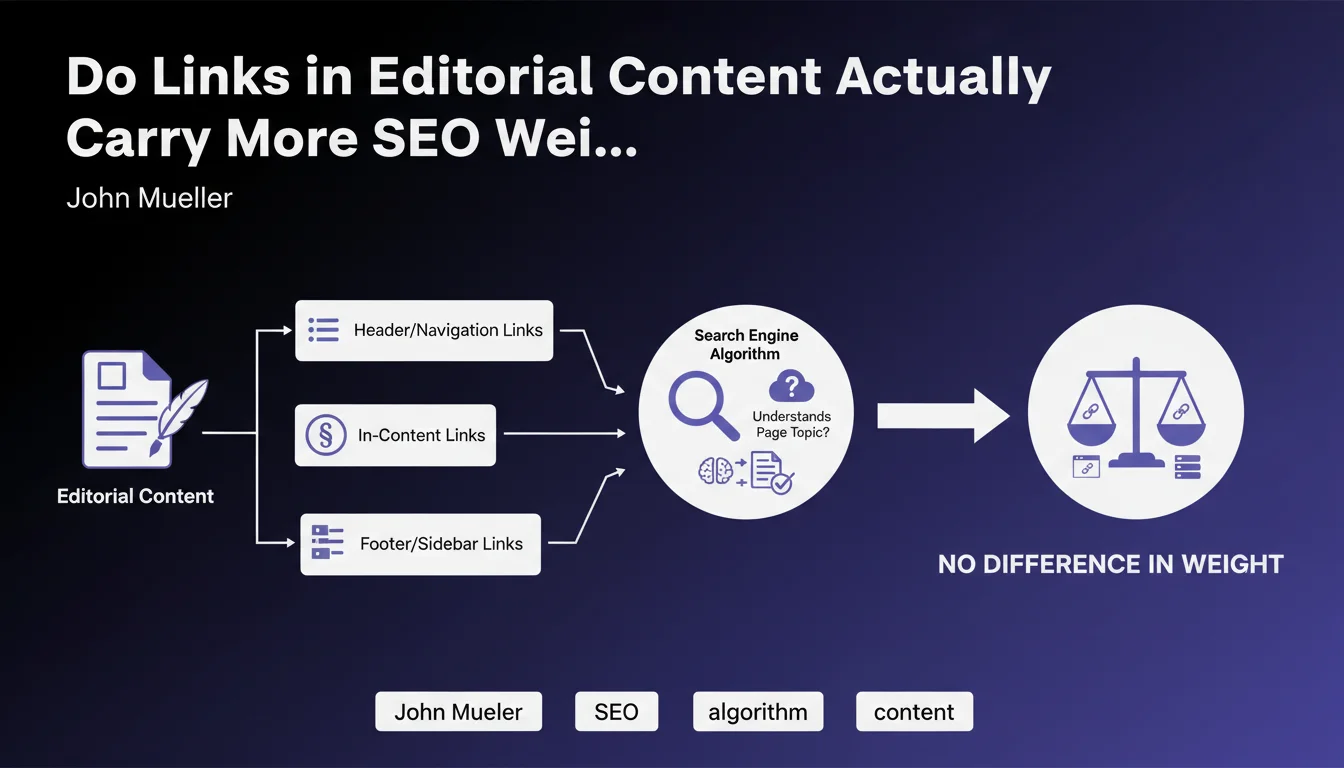
According to John Mueller, Google's team considers all outbound links from a page equally, whether they are positioned in the main editorial content or in peripheral zones like the header, footer, sidebar or navigation menu.
The algorithm does however pay particular attention to editorial content to understand the page's topic. But this analysis priority would not translate into a difference in weight assigned to links based on their placement.
Why does this statement seem contradictory to what we know about PageRank?
This assertion comes into apparent contradiction with the reasonable surfer theory, an evolution of traditional PageRank. This model specifically postulates that a link in the main content is more likely to be clicked than a footer link, and should therefore transmit more authority.
The patents filed by Google suggest that the algorithm effectively weights links based on their position, visibility and click probability. Mueller's statement therefore seems to simplify a more nuanced algorithmic reality.
What should we take away from this official statement?
- Google claims to treat all links in a technically equivalent manner during crawling
- Editorial content remains the priority for thematic understanding of the page
- This statement may be a simplification intended for non-expert webmasters
- The reasonable surfer theory suggests a more complex reality in practice
- Link placement likely remains a weighting factor in the actual algorithm
SEO Expert opinion
Is this statement consistent with field observations by SEO professionals?
My 15 years of SEO experience leads me to a clear conclusion: this Mueller statement does not reflect observed reality. Empirical testing consistently shows that a contextual link within content generates superior SEO results compared to a footer link.
Successful link building campaigns always prioritize editorial links for a simple reason: they work better. If all links truly had the same weight, this efficiency difference would not exist. Position within the page clearly influences authority transmission.
What nuances should be added to this official statement?
Google is probably referring to the technical processing of links during crawling: all are followed and indexed. But this does not mean they transmit the same PageRank value or the same thematic relevance.
The reasonable surfer concept, patented by Google, introduces weighting based on click probability. A link well integrated into a relevant paragraph, surrounded by semantically rich content, will naturally be valued more than a generic sidebar link.
How can we explain this apparent contradiction in Google's discourse?
Google often tends to simplify its explanations to avoid algorithmic manipulation. Revealing that content links have more weight would encourage webmasters to over-optimize this zone, creating unnatural link patterns.
This communication may also aim to discourage aggressive link building practices focused solely on placement. By stating that all links count, Google encourages a more natural and diversified approach to link networking.
Practical impact and recommendations
What should you actually do to optimize your link placement?
Despite the official discourse, continue to prioritize contextual links within your editorial content. Integrate them naturally into semantically rich paragraphs, consistent with the topic being covered.
For your internal linking, place your strategic links to important pages in the body text, with descriptive anchors. Reserve menus and footers for general navigation and secondary pages.
Regarding external link building, systematically seek editorial placements in the main content of partner pages. A partner site footer link will always have less impact than a contextual link in a relevant article.
What mistakes should you avoid in your linking strategy?
- Do not create isolated link zones disconnected from the main content
- Avoid over-optimization with too many links in the content (maintain naturalness)
- Do not completely neglect navigation links: they remain useful for site architecture
- Do not place all your important links only at the beginning or end of articles
- Avoid overly optimized anchors that seem artificial in context
- Do not ignore the semantic proximity between the link and surrounding content
How can you audit and improve link placement on your site?
Conduct an internal linking audit by identifying where your links to strategic pages are located. Use tools like Screaming Frog to extract link positions in the DOM and prioritize optimizations.
Analyze your performing pages to identify effective linking patterns. Observe how links are integrated into content and reproduce these best practices on pages to be optimized.
Verify that your priority pages receive contextual links from multiple pages on your site. The diversity of sources and quality of context matter as much as the quantity of links received.
💬 Comments (0)
Be the first to comment.