
Official statement
What you need to understand
Google has an active filtering mechanism that goes beyond simple indexation. A page can be technically indexed on Google's servers without appearing in search results accessible to users.
Martin Splitt reveals a crucial principle here: indexation doesn't guarantee visibility. Google uses behavioral signals to determine whether a page deserves to be maintained in active results or not.
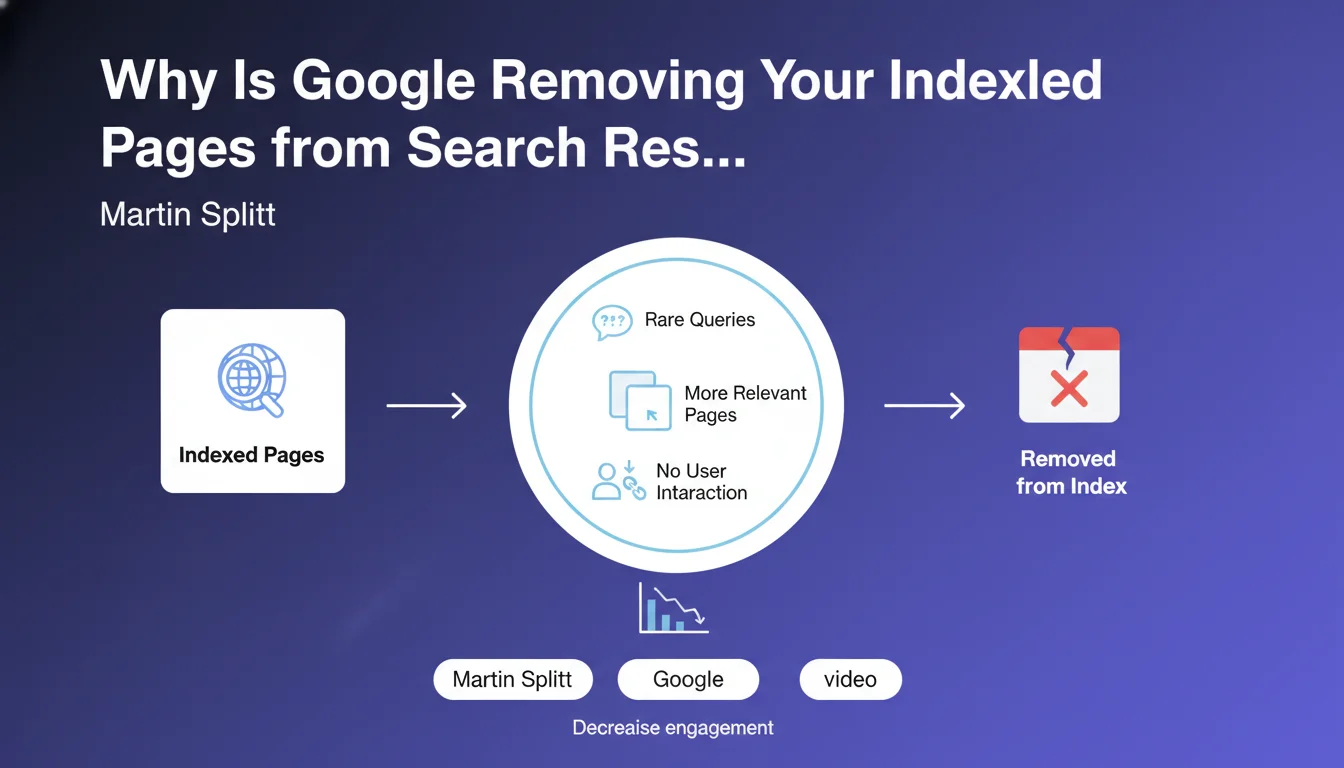
Three main factors explain this phenomenon according to this statement:
- Low query volume: the keywords targeted by your pages are too rare or specific
- Lack of comparative relevance: other content is deemed superior for the same queries
- Absence of user engagement: when your pages are displayed, users don't click or bounce quickly
The most concerning point: Google can actively remove content from the index if engagement signals remain consistently negative. This isn't a simple demotion, but an exclusion from search results.
SEO Expert opinion
This statement confirms what SEO professionals have been observing for several years with successive algorithmic updates. CTR (click-through rate) and engagement metrics have become indirect but powerful ranking factors.
However, be careful of an important nuance: correlation is not causation. Low engagement may be the consequence of poor positioning rather than its cause. Google likely tests your pages on low-volume queries before demoting them definitively.
The most revealing aspect is the explicit admission of active index removal. This means Google doesn't just demote: it can completely exclude pages deemed without value for users, thereby freeing up crawl and indexation resources.
Practical impact and recommendations
- Regularly audit your indexed pages via Google Search Console to identify those generating no impressions
- Analyze your pages' CTR: a rate below 2-3% for their current position indicates a perceived relevance problem
- Optimize your titles and meta descriptions to increase attractiveness in SERPs and improve click-through rate
- Review search intent: does your content truly match what users are looking for?
- Improve on-site engagement signals: reading time, scroll depth, interactions, internal linking to reduce bounce rate
- Consolidate low-traffic content: merge similar pages or redirect obsolete content to performing pages
- Target queries with minimal volume: avoid creating content on expressions with zero monthly searches
- Test different editorial approaches on your underperforming pages before voluntarily deindexing them
- Monitor progressive deindexation: set up alerts to quickly detect pages disappearing from the index
These optimizations require in-depth analysis of multiple behavioral, technical, and editorial signals. Implementing a comprehensive strategy to improve user engagement can prove complex, especially on medium to large-scale sites. To effectively structure this approach and prioritize high-impact actions, support from a specialized SEO agency provides access to proven methodology and advanced analysis tools adapted to your specific context.
💬 Comments (0)
Be the first to comment.