
Official statement
What you need to understand
What exactly is a widget link and why does Google treat it differently?
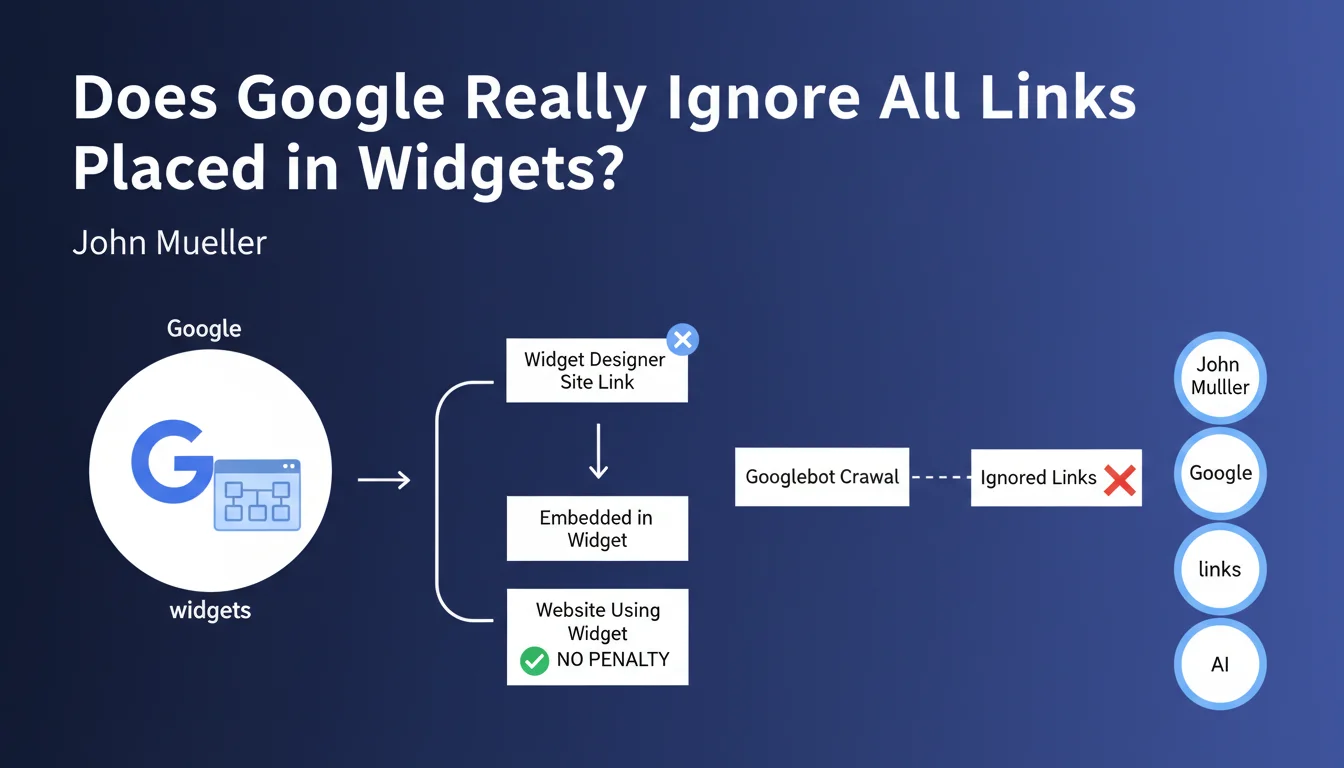
A widget link refers to a hyperlink embedded in a small application module (widget) distributed across multiple websites. Widget designers often add a link to their own site in the widget code, thus creating thousands of automatic backlinks.
Google considers these links as artificial and manipulative because they do not result from a natural editorial recommendation. The search engine has therefore decided to purely and simply ignore them in its ranking algorithm.
What is Google's official stance on these links?
John Mueller confirmed that Google does not take into account links integrated by default in widgets. This clarification is important because it addresses a common link acquisition practice.
Reassuring point: sites that use these widgets will not be penalized for it. Google makes the distinction between passive hosting of a widget and an active manipulation attempt.
Is this practice part of the official guidelines?
Indeed, the treatment of widget links has been part of Google's webmaster guidelines for several years. This statement therefore does not introduce a new rule but confirms an existing policy.
- Widget links are ignored by Google's algorithm
- No penalty is applied to sites hosting these widgets
- This rule has been part of the official best practices for a long time
- The distinction between editorial link and automatic link is fundamental
SEO Expert opinion
Is this statement consistent with practices observed in the field?
After 15 years of observation, I confirm that this Google position is perfectly consistent with the results observed. Sites that have massively distributed widgets with backlinks have never shown significant improvement in their domain authority.
Link profile analyses show that these widget backlinks do not provide any measurable SEO value. Google has clearly refined its detection of these automated patterns for many years.
What important nuances should be added to this rule?
The major nuance concerns the nature of the link. A widget can legitimately contain a link to its creator if it is marked with the rel="nofollow" or rel="sponsored" attribute. This practice then becomes compliant with the guidelines.
Another crucial point: a natural editorial link to the widget creator, placed in the page content (and not in the widget itself), retains all its SEO value. This is the difference between recommendation and automatic signature.
In which specific cases might this rule not apply?
This rule specifically targets standardized automatic links. A highly customized widget, uniquely integrated on a few partner sites with contextualized links, could escape this detection.
Premium WordPress plugins with links to their documentation or support also present a borderline case. If the link provides real user value and uses appropriate attributes, it falls outside the strictly manipulative framework.
Practical impact and recommendations
What should you do concretely if you distribute widgets?
If you are a widget designer, the first action is to systematically add the rel="nofollow" or rel="sponsored" attribute to all links integrated in your widgets. This practice brings you into compliance with Google guidelines.
Also clean up your existing widgets by deploying updates that modify the link attributes. Communicate transparently about this evolution to your users.
- Audit all your distributed widgets to identify links without appropriate attributes
- Systematically add rel="nofollow" or rel="sponsored" to signature links
- Offer automatic updates of your widgets to correct deployed versions
- Clearly document this practice in your terms of use
- Train your development teams on link best practices
What common mistakes should you absolutely avoid?
The most frequent error is to multiply widgets hoping to obtain free backlinks. This strategy is not only ineffective but can attract negative attention from Google if it is too systematic.
Another pitfall: modifying link attributes only on new deployments while neglecting the existing ones. The thousands of widgets already installed continue to create a suspicious pattern detectable by Google.
Also avoid considering that the absence of penalty means implicit validation. Google can evolve its position and harden its approach at any time if abuses multiply.
How can you verify the compliance of your current link strategy?
Use Google Search Console to analyze your backlink profile. Look for repetitive patterns that could indicate widget links. Export this data and identify links coming from similar footers or sidebars.
Perform a complete technical audit with tools like Screaming Frog or Ahrefs to map all your backlinks. Segment them by type and identify those that require the addition of nofollow attributes.
- Export and analyze your backlink profile from Search Console
- Identify repetitive patterns characteristic of widgets
- Verify the presence of appropriate rel attributes on your outgoing links
- Contact sites hosting your widgets to request modifications if necessary
- Set up monthly monitoring of your link profile
💬 Comments (0)
Be the first to comment.