
Official statement
Other statements from this video 15 ▾
- □ Does Google really use one global index for all countries?
- □ Should you still trust the site: operator to diagnose your indexation status?
- □ Does user engagement really influence your Google rankings?
- □ Why do high-traffic pages carry more weight in your Core Web Vitals score?
- □ Does Google really segment websites by template type when evaluating Page Experience?
- □ How many internal links should you actually place on each page to boost your SEO?
- □ Why does your internal linking tree structure really matter to Google?
- □ Does your homepage distance really impact how fast Google indexes your pages?
- □ Does Google really ignore your URL structure for SEO rankings?
- □ Why do Search Console positions fail to reflect your actual search rankings?
- □ Does Google really distinguish between 'edit video' and 'video editor' as different user intentions?
- □ Does your FAQ schema markup really need to be on the ranking page to generate rich snippets?
- □ Do footer links carry the same SEO weight as links in your main content?
- □ Is mobile-first indexing really impacting your Google rankings?
- □ Does Your Robots.txt Really Need to Return 404 or 200 to Keep Googlebot Happy?
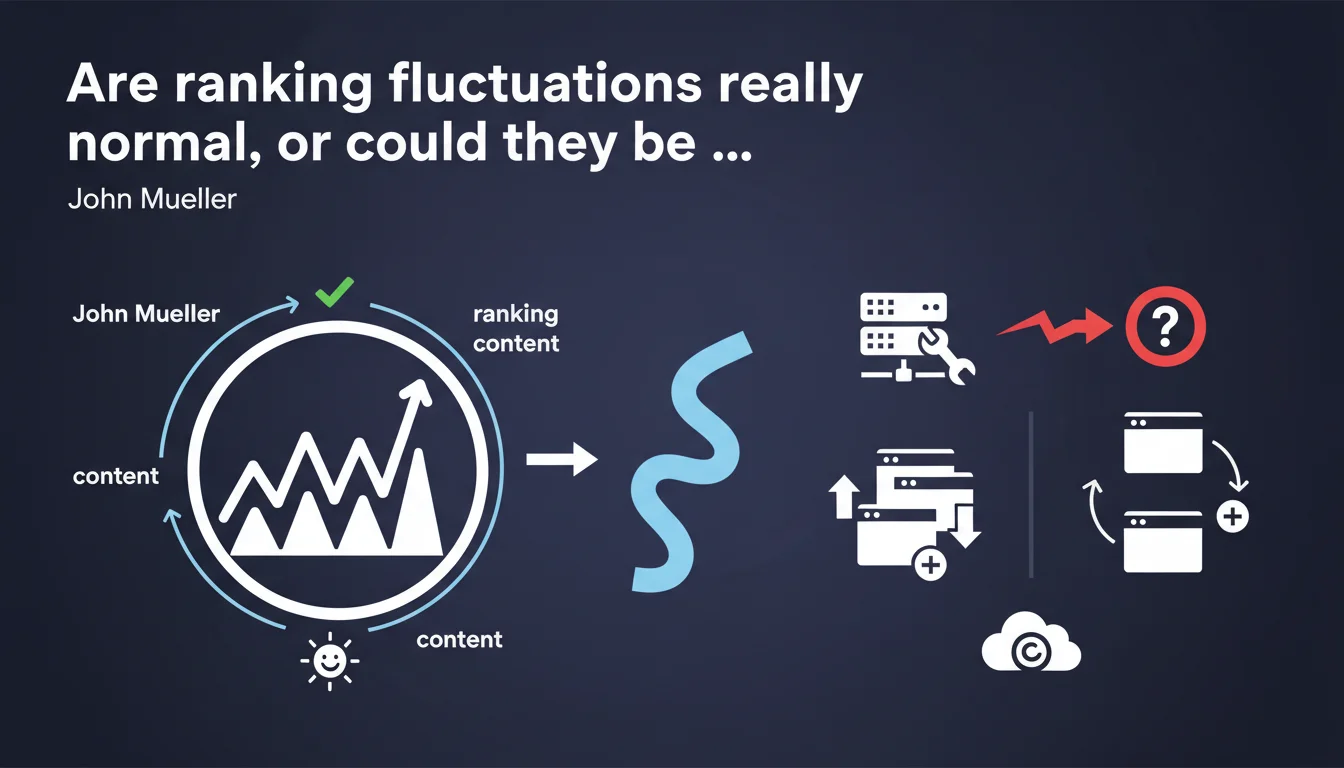
Google claims that ranking variations — pages that climb then drop, even temporarily disappearing from the index — are normal and don't necessarily signal a problem. This statement puts daily SERP panic into perspective, but raises the question: how do you tell the difference between normal fluctuation and a real issue?
What you need to understand
Why does Google normalize ranking fluctuations?
Google processes billions of queries every day and updates its results continuously. Algorithms constantly reassess page relevance based on multiple signals: content quality, freshness, user behavior, backlinks.
Result: what ranked 5th yesterday can drop to 12th today without any changes made to your site. The competition moved, the algorithm refined itself, or search intent shifted.
What does "temporarily leaving the index" mean?
Mueller mentions a little-known phenomenon: pages can temporarily disappear from the index while new ones enter. This isn't a punitive deindexation — it's resource management.
Google reallocates its crawl budget based on what it deems priority. An older, less-visited page might be temporarily sidelined to make room for fresh content. It will return later if it remains relevant.
When should you actually worry about ranking fluctuations?
Not all fluctuations are equal. A 2-3 position swing over a few days? Normal. A sudden 20-position drop sustained over weeks? That deserves investigation.
- Minor variations (+/- 5 positions) over a few days are common and don't require immediate action
- Temporary disappearances from the index can be harmless if your site is crawled regularly
- Sustained significant drops warrant analysis: algorithmic penalty, technical issue, outdated content
- Daily position monitoring often creates more stress than value — focus on weekly or monthly trends instead
SEO Expert opinion
Is this statement consistent with real-world observations?
Yes and no. Google is right: SERPs move constantly, and many SEOs panic unnecessarily. But this claim oversimplifies cases where fluctuation actually masks a real problem.
In the field, we do see random daily movements. But we also see sites lose 40% of their traffic after a "normal fluctuation" that was actually a soft algorithmic penalty or an internal cannibalization issue. [To verify]: Google doesn't explain how to distinguish between the two.
What nuances should you add to this claim?
Mueller talks about "pages temporarily leaving the index." Temporarily means what exactly? An hour? A week? A month? This lack of specific timeframe makes the advice hardly actionable.
Plus, this reasoning doesn't fit e-commerce or news sites, where even a brief disappearance of a strategic page can be costly. For these sectors, "normal" doesn't mean "acceptable."
In which cases does this rule not apply?
This tolerance for fluctuations doesn't apply to high-value strategic pages: best-selling product pages, paid landing pages, pillar evergreen content. If these pages fluctuate wildly, it's rarely "normal."
Same for new or redesigned sites. Post-migration instability can be excused for a few weeks, not six months. If it lasts longer, there's a structural issue — poorly managed redirects, loss of link equity, unresolved duplicate content.
Practical impact and recommendations
What should you actually do when facing fluctuations?
First rule: don't overreact. Wait at least 7 to 10 days before changing anything. A fluctuation that resolves itself in 48 hours deserves no intervention.
Second, segment your analysis. Are all pages dropping or just one category? If it's global, look at algorithmic updates. If it's targeted, inspect that specific page: outdated content, broken links, stronger competition.
What mistakes should you avoid when monitoring positions?
The classic mistake: tracking positions daily and tweaking content constantly. That's the best way to destabilize your site and lose editorial consistency.
Another trap: confusing correlation with causation. Your competitor published an article the day you dropped? Doesn't mean it's connected. First check if there wasn't a Core Update or tracking error.
How do you verify your site isn't affected by a real problem?
- Check Google Search Console: indexation errors, coverage, alerts
- Verify crawl stability: how often Googlebot visits your strategic pages
- Review server logs to detect potential crawl drops on specific sections
- Compare your fluctuations against update trackers (Semrush Sensor, Algoroo, MozCast)
- Inspect Core Web Vitals and loading times — technical degradation can trigger drops
- Audit internal linking: do fluctuating pages get enough internal links?
- Monitor search trends: is your keyword losing seasonal or structural interest?
❓ Frequently Asked Questions
Combien de temps dure une fluctuation « normale » selon Google ?
Une page peut-elle sortir de l'index sans être pénalisée ?
Faut-il modifier mon contenu à chaque variation de classement ?
Comment distinguer fluctuation normale et pénalité algorithmique ?
Les outils de tracking de positions sont-ils fiables pour détecter ces fluctuations ?
🎥 From the same video 15
Other SEO insights extracted from this same Google Search Central video · published on 14/03/2022
🎥 Watch the full video on YouTube →
💬 Comments (0)
Be the first to comment.