
Official statement
Other statements from this video 6 ▾
- □ Why can tiny SEO changes trigger unpredictable effects across your Google rankings?
- □ Can crawl speed fluctuations really change what gets indexed on your site?
- □ Do social signals really impact your Google rankings?
- □ Should you really stop checking your daily SEO rankings?
- □ Should you really be concerned about sudden spikes in Google Search Console?
- □ Should you really panic at every ranking fluctuation?
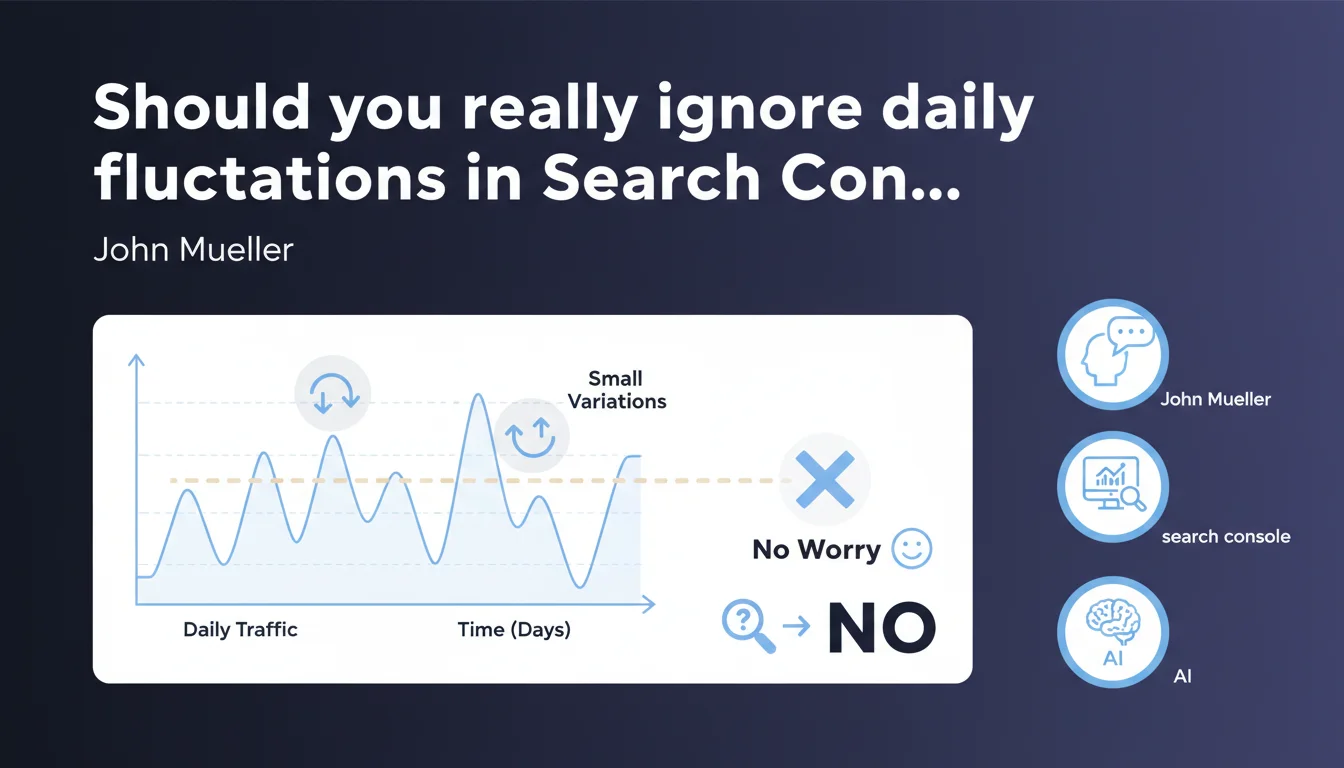
Mueller claims that daily variations in Search Console are normal and signal no problem. Yet every pro knows that certain fluctuations mask weak signals you need to detect. The real question: how do you distinguish background noise from a genuine warning signal?
What you need to understand
What exactly does Google say about these variations?
Google, through John Mueller, affirms that small daily variations in Search Console metrics — impressions, clicks, CTR, average position — are completely normal. All sites experience them, regardless of size or industry.
The message is clear: don't alarm yourself over a jagged graph. These fluctuations don't reveal a technical problem, a penalty, or a loss of algorithmic trust. It's the standard operation of the web.
Why do these variations exist?
Several factors explain these movements: seasonality of search queries, variations in search volume by day of the week, minor index updates, A/B tests that Google constantly runs on its SERPs.
The makeup of search results constantly changes — featured snippets that appear or disappear, news carousels, local search blocks. Your site moves up or down mechanically based on these recompositions, even if your content hasn't changed one bit.
What counts as a "small variation" according to Google?
Here's where it gets tricky: Google never defines this threshold. Is it 5%? 10%? 20%? Mueller remains evasive. You're supposed to figure it out yourself, but without an objective reference point. [To verify]
This vagueness forces practitioners to develop their own sensitivity. An established site with 10,000 clicks/day won't react the same way as a niche site with 200 clicks/day. Context matters enormously.
- Daily variations are normal and expected on all sites
- They do not signal technical problems or penalties
- Multiple external factors: seasonality, Google tests, SERP composition
- No official threshold exists to distinguish "small" from "large" variation
- Field experience remains the best indicator to contextualize these movements
SEO Expert opinion
Does this statement really reflect what happens on the ground?
Yes and no. Mueller is right in principle: most daily fluctuations are just noise. Junior SEOs often panic over a -15% on a Tuesday, only to see everything bounce back the following Wednesday.
But — and this is where experience comes in — some "small variations" are actually weak signals. A steady drop of 3-5% per day for two weeks? That's no longer noise, it's a trend. A sudden 20% drop on a strategic keyword cluster? Even if overall traffic stays flat, that deserves investigation.
When should you actually worry about a variation?
Three scenarios where you should not blindly apply Mueller's advice:
1. Variations concentrated on a specific segment — If overall traffic is flat but one page category or semantic cluster loses 30%, that's a signal. Google may have re-evaluated the relevance of that content, or a competitor emerged.
2. Variations correlated with a technical action — Migration, redesign, internal linking changes, URL structure modifications. Here, even a "small" drop deserves scrutiny, as it might reveal redirection or crawl issues.
3. Variations synchronized with a known Core Update — Even if Google downplays it, major updates sometimes trigger adjustments that spread over several days. A "small variation" can be the start of a deeper shift.
Is Google underestimating the legitimate anxiety of publishers?
Frankly, yes. For a site that derives 80% of its revenue from organic search, a 10% drop — even if "normal" — represents real business impact. Saying "it's normal, don't worry" solves nothing.
Publishers need actionable context, not vague reassurance. Saying "your drop falls within the normal range if it doesn't exceed X% over Y days" would be far more useful. But Google never provides these benchmarks. [To verify]
Practical impact and recommendations
What should you actually do with this information?
First, establish a baseline. Calculate a 7 or 14-day moving average of your key metrics (clicks, impressions, CTR, position). This smoothed curve is what matters, not daily spikes.
Next, define your own custom alert thresholds. For example: if the weekly moving average drops more than 15% versus the previous month, mandatory investigation. If a strategic page loses 30% of its impressions in 3 days, dig immediately.
Set up automatic alerts through tools like Google Sheets + Scripts, Data Studio, or SEO platforms (Screaming Frog, SEMrush, Ahrefs). Don't spend your days refreshing Search Console graphs.
What critical mistakes should you avoid?
First mistake: overreacting to intraday variations. Search Console updates data with a lag and adjustments. This morning's figure might differ from tonight's for the same day. Wait at least 48-72 hours before drawing conclusions.
Second mistake: ignoring seasonal context. Always compare to the same period last year, not last month. A toy e-commerce site in January versus December is like comparing a beach umbrella in winter to summer.
Third mistake: monitoring only Search Console. Cross-reference with Google Analytics (organic sessions, bounce rate, conversions), your rank tracking tool, server logs. A drop in GSC but not in GA? Maybe a data collection issue, not real traffic loss.
How do you distinguish noise from signal in your data?
Apply the triple filter principle:
- Time filter: does the variation persist for at least 7 days?
- Segment filter: does it affect your entire site or a specific segment?
- External filter: is it correlated with a known event (Google update, technical action, seasonality)?
- Automate monitoring with weekly alerts on moving averages
- Document your alert thresholds based on your history and industry
- Cross-reference sources: Search Console + Analytics + Rank Tracking + Logs
- Compare with the same period from one year ago to neutralize seasonality
- Never react on less than 72 hours of consolidated data
Daily variations are indeed normal, but don't ignore them completely. The real skill is filtering out noise to catch weak signals that announce deeper shifts.
For high-stakes sites, setting up a robust monitoring system — with custom thresholds, automatic alerts, and cross-source analysis — takes time and specialized expertise. If you lack internal resources to manage this daily vigilance, working with a specialized SEO agency can be wise to protect your rankings and respond quickly to genuine warning signals.
❓ Frequently Asked Questions
Quelle amplitude de variation quotidienne est considérée comme normale ?
Les variations dans Search Console peuvent-elles annoncer une Core Update à venir ?
Faut-il surveiller tous les KPI de Search Console avec la même attention ?
Comment gérer l'inquiétude client face à ces variations ?
Les variations sont-elles plus importantes sur certains types de sites ?
🎥 From the same video 6
Other SEO insights extracted from this same Google Search Central video · published on 26/05/2022
🎥 Watch the full video on YouTube →
💬 Comments (0)
Be the first to comment.