
Official statement
Other statements from this video 6 ▾
- □ Should you really ignore daily fluctuations in Search Console?
- □ Why can tiny SEO changes trigger unpredictable effects across your Google rankings?
- □ Can crawl speed fluctuations really change what gets indexed on your site?
- □ Do social signals really impact your Google rankings?
- □ Should you really stop checking your daily SEO rankings?
- □ Should you really be concerned about sudden spikes in Google Search Console?
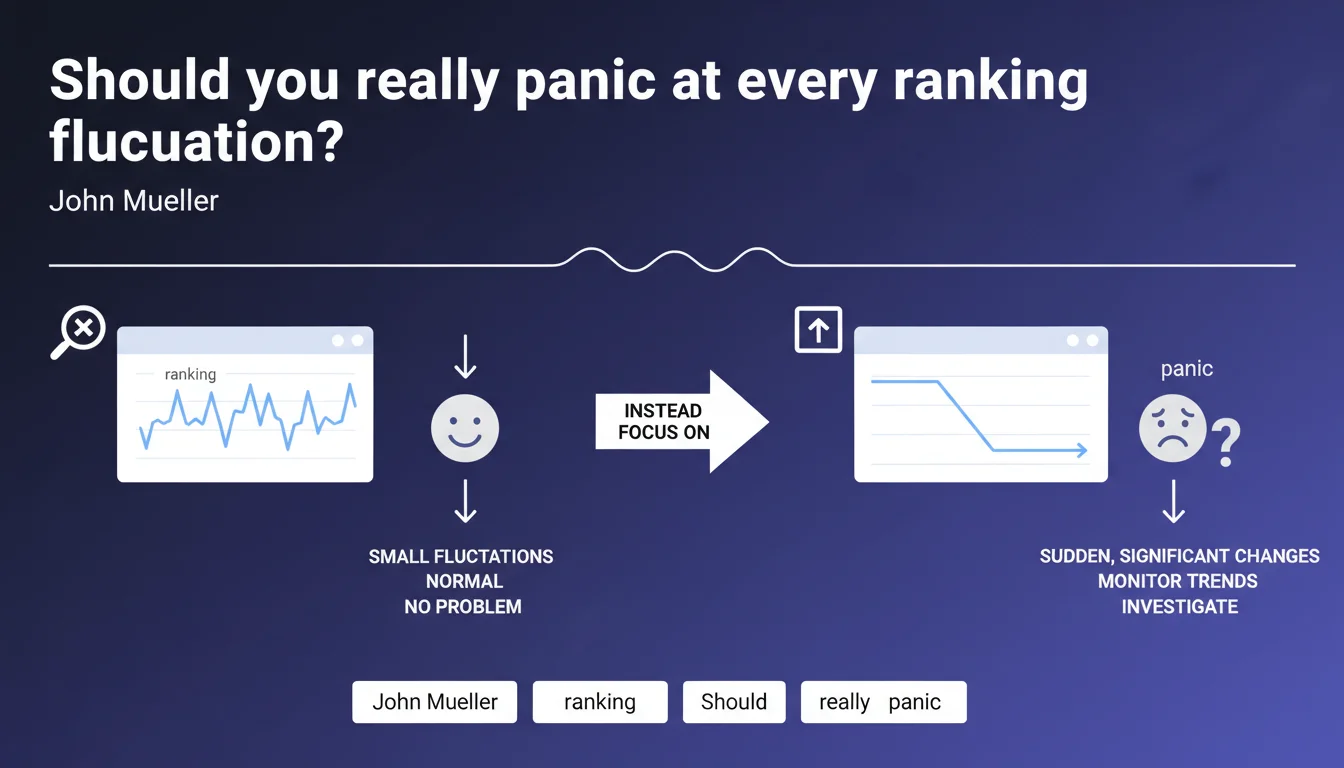
Google confirms that small daily position variations are normal and don't indicate any issues. Only sudden changes or long-term trends over several weeks warrant in-depth analysis. The classic mistake: reacting to every micro-movement instead of maintaining an overall perspective.
What you need to understand
What does Google mean exactly by "small fluctuations"?
Mueller intentionally provides no numerical threshold. No "±3 positions is normal" or "-10% is serious." This statement remains vague — and it's probably deliberate.
Why? Google wants to avoid SEOs setting arbitrary thresholds and triggering unnecessary alerts. But realistically, how do you distinguish normal fluctuation from a real problem without a clear indicator? Mueller doesn't say.
Why do these variations happen if nothing changed on your site?
SERPs aren't static. The algorithm is constantly testing: new content being indexed, competitors updating their sites, search intent being reinterpreted, geographical or personalized variations.
Your site might drop 2 positions one day and rise again the next without any action on your part explaining the movement. It's the ecosystem shifting around you.
Over what timeframe should you monitor "broader trends"?
Mueller mentions trends but remains vague on duration. One week? Three weeks? One month? Impossible to know precisely.
Field experience suggests that a downward trend observed over 14 consecutive days warrants investigation. But Google neither validates nor invalidates this timeframe — another gray area.
- Daily micro-variations are not exploitable warning signals
- Sudden, significant changes (organic traffic drop >20% in 48 hours) require immediate analysis
- Long-term trends (gradual decline over several weeks) should trigger a structural audit
- Monitor your domain's overall visibility, not just a few isolated queries
SEO Expert opinion
Does this statement really reflect what we observe in the field?
Yes and no. Daily fluctuations definitely exist — any tracking tool confirms it. But Mueller omits a crucial point: some niches are far more volatile than others.
An e-commerce site in fashion or tech can see positions move daily for no apparent reason. A B2B institutional site often remains stable for weeks. Industry context changes everything, and Google never mentions this in generic statements like this.
What's missing from this recommendation?
Mueller says nothing about how to identify the threshold between "normal" and "problematic". For a site with 1,000 visits/day, is losing 50 visits normal or concerning? What about for a site with 100,000?
[To verify]: Google has this data at the scale of billions of queries, but shares no metrics to objectify this advice. We're left with gut feeling and personal experience — far from ideal for data-driven decision making.
In what cases does an apparently "small" fluctuation hide a real problem?
If the variation affects your core conversion queries, even losing 2-3 positions can seriously impact revenue. Mueller speaks in terms of overall visibility — but an SEO must reason in terms of revenue.
Another blind spot: fluctuations synchronized with external events (seasonality, news, competitor campaigns) can signal a structural decline masked by ambient noise.
Practical impact and recommendations
How do you concretely distinguish normal fluctuation from a warning signal?
First rule: stop monitoring daily positions like a trader watching stock prices. Switch to weekly frequency at minimum to smooth out noise.
Second rule: never analyze a single metric in isolation. Combine average positions + organic traffic + click-through rate + pages indexed. A false movement on one indicator neutralizes if others stay stable.
- Set alerts only for variations >15% in organic traffic over 7-day rolling windows
- Segment alerts by query type (brand / transactional / informational)
- Create dashboards with trends over 30 and 90 days, not daily snapshots
- Cross-reference GSC data with server logs to detect crawl anomalies that often precede drops
- Document all site modifications to correlate cause and effect
What mistakes should you avoid when dealing with fluctuations?
Mistake number one: reacting hastily. Modifying content, changing structure, adjusting internal linking… when the "drop" was just a temporary movement. Result: you create a real problem yourself.
Another classic trap: ignoring weak signals by telling yourself "it's just normal fluctuation." When several micro-drops accumulate over 4-5 weeks, it's no longer noise — it's a trend.
What should you implement to maintain a healthy view of your performance?
Define alert thresholds adapted to your context: typical traffic volume, seasonality, competition level. A site generating 500 sessions/day won't have the same tolerances as a media outlet with 50,000.
Implement a structured monthly review process: organic trends, technical evolutions (Core Web Vitals, crawl errors), competitive analysis. This prevents falling into the "I lost 3 positions, I panic" reflex.
These configurations require sharp expertise in data analysis and deep knowledge of professional SEO tools. If you don't have internal resources to set up this strategic monitoring, a specialized SEO agency can structure this system and help you interpret signals — preventing both false alarms and dangerous blind spots.
❓ Frequently Asked Questions
À partir de quel pourcentage de baisse de trafic faut-il s'inquiéter ?
Les outils de suivi de positions sont-ils fiables pour détecter des problèmes ?
Faut-il réagir immédiatement à une baisse soudaine de positions ?
Comment savoir si une fluctuation est liée à un update Google ?
Google Search Console suffit-il pour surveiller les tendances ?
🎥 From the same video 6
Other SEO insights extracted from this same Google Search Central video · published on 26/05/2022
🎥 Watch the full video on YouTube →
💬 Comments (0)
Be the first to comment.