
Official statement
Other statements from this video 6 ▾
- □ Faut-il vraiment ignorer les fluctuations quotidiennes dans Search Console ?
- □ Pourquoi les petits changements SEO peuvent-ils provoquer des effets imprévisibles sur Google ?
- □ La vitesse de crawl peut-elle vraiment faire fluctuer votre indexation ?
- □ Les signaux sociaux influencent-ils vraiment le classement Google ?
- □ Faut-il vraiment arrêter de surveiller les positions quotidiennes en SEO ?
- □ Faut-il vraiment paniquer à chaque fluctuation de positionnement ?
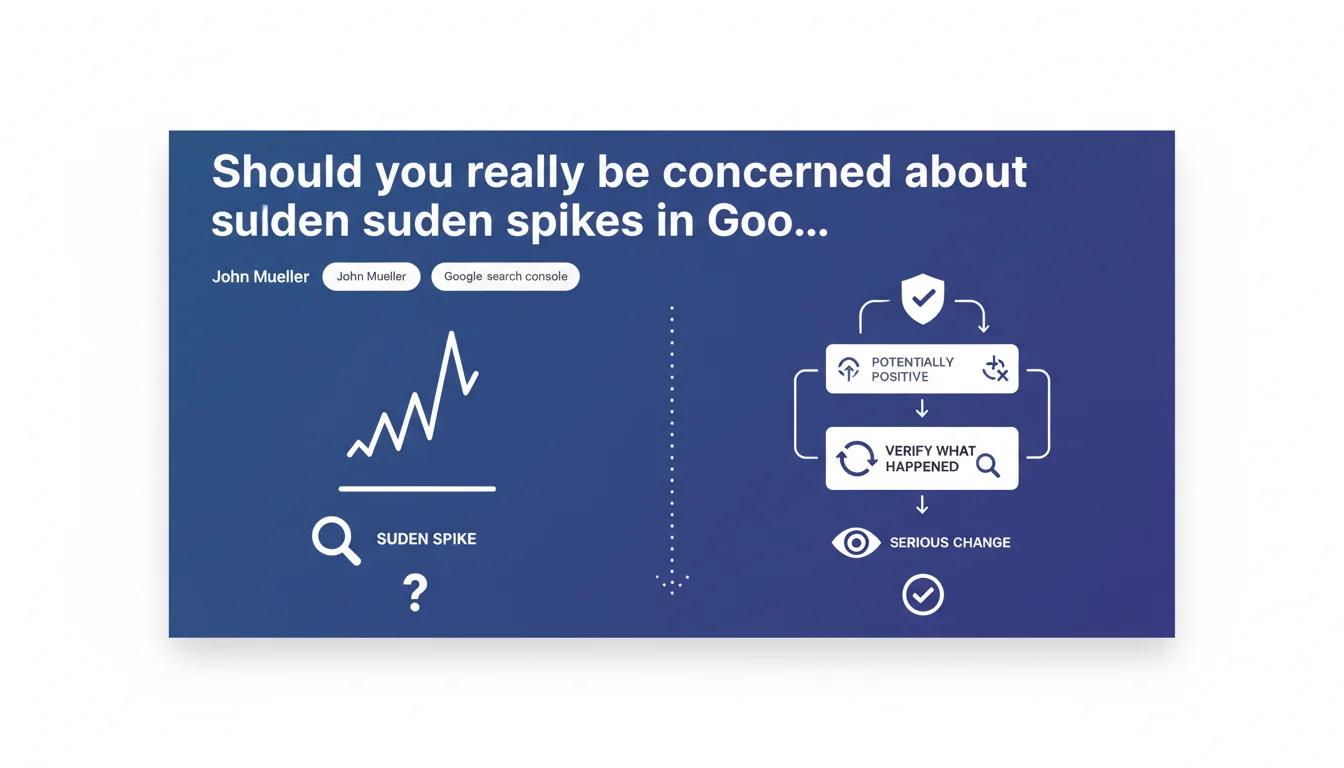
Google confirms that a sudden change in your Search Console data — even a positive one — deserves investigation. An unexpected spike can mask a technical issue, a security breach, or an uncontrolled structural change. Don't just celebrate the increase: dig deeper.
What you need to understand
Why does Google recommend verifying even positive peaks?
The logic is straightforward: a sudden change often signals an anomaly. If your traffic doubles in 48 hours without deliberate action on your part, several scenarios are possible — and not all of them are cause for celebration.
A spike can result from a leak of private URLs accidentally indexed, a technical bug artificially amplifying certain pages, or a one-off media event that won't happen again. Initial euphoria can mask underlying structural fragility.
What types of changes should trigger this verification?
Mueller doesn't quantify what constitutes a "significant peak," but seasoned practitioners recognize the signals: a variation of +50% over a week, a doubling of clicks in a single day, or a 40% drop in impressions without a known update.
Search Console graphs can also reflect display bugs or reporting delays. Before panicking or popping the champagne, always cross-reference this data with your raw server logs and Analytics.
Which tools should you use to find explanations?
Search Console alone isn't enough. Cross-reference with your raw logs, crawl tools, security alerts, and deployment history. A surge in Googlebot crawl activity can precede a drop in indexation — or vice versa.
- Sudden variations = systematic verification, even if they seem positive
- Don't rely solely on Search Console — cross-check multiple data sources
- A spike can mask a technical anomaly, security flaw, or uncontrolled change
- Timing matters: a one-off spike doesn't carry the same meaning as a trend over 2 weeks
SEO Expert opinion
Does this recommendation contradict standard SEO practices?
Not really — but it highlights a common cognitive bias. We spend hours analyzing traffic drops, yet celebrate increases without question. Mueller is pointing out a frequent professional blind spot.
In the field, I've observed sites where a +300% spike overnight came from a mishandled robots.txt change: thousands of staging pages suddenly indexed at once. Traffic seemed to explode, but it was a disaster in the making. Verifying a positive spike isn't paranoia — it's technical hygiene.
What are the limits of this statement?
Mueller deliberately remains vague about thresholds. No numbers, no concrete examples, no diagnostic methodology. [To verify]: does a +20% spike over a week count? What about on a 10-page site versus a 100,000-page site?
This statement lacks granularity. An e-commerce site with regular advertising campaigns will see normal peaks — context matters. Google doesn't provide the framework to distinguish signal from noise.
Does this recommendation apply to all types of sites?
Small single-topic sites with minimal variation are simpler to audit. On large sites with thousands of landing pages and multiple technical teams, tracing the origin of a spike becomes a forensic detective exercise.
News sites, by nature subject to daily spikes, can't investigate every fluctuation. You must therefore define personalized alert thresholds based on your history and sector. Mueller's recommendation is generic — it doesn't replace an adapted monitoring strategy.
Practical impact and recommendations
How do you quickly identify the cause of a suspicious spike?
First instinct: isolate the pages and queries responsible for the change. In Search Console, filter by page or query to see if the spike is concentrated on a specific segment or widespread.
Next, check if a recent technical modification coincides: code deployment, server migration, URL structure change, sitemap or robots.txt modification. Synchronize your technical calendar with your traffic curves.
Also compare with your server logs. If Googlebot suddenly crawls 10x more pages, find out why: newly auto-generated pages, modified internal links, or poorly managed URL parameters. A crawl spike often precedes an indexation spike — and vice versa when things go wrong.
What mistakes should you avoid during investigation?
Don't change anything before identifying the cause. Correcting blindly can worsen the situation. If a spike comes from accidental indexation, brutally deleting the pages involved will create mass 404s — worse than the original problem.
Another pitfall: focusing solely on Search Console. Cross-check with Analytics, your conversions, bounce rate, and session duration. A traffic spike with low quality (95% bounce rate, 5 seconds on-site) isn't something to celebrate — it can signal referral spam or poorly targeted pages.
What if the spike turns out to be benign or intentional?
Document it. Keep a written record of what caused it: content launch, media campaign, powerful backlink, seasonal event. This will prevent you from panicking next year when the same pattern reoccurs.
If the spike is accidental but beneficial (indexation of a section you planned to launch later, for example), capitalize on it to validate the technical structure and internal linking before Google reprocesses. Turn the accident into a controlled opportunity.
- Isolate the pages and queries behind the spike using Search Console filters
- Check temporal alignment with your technical or editorial deployments
- Compare server logs with Search Console data to detect crawl anomalies
- Cross-reference with Analytics: low-quality traffic spikes can hide problems
- Don't fix anything before identifying the root cause — blind action usually makes things worse
- Document every spike and its cause to prevent false alarms in the future
❓ Frequently Asked Questions
Un pic de trafic positif peut-il vraiment cacher un problème ?
À partir de quel pourcentage de variation faut-il s'inquiéter ?
Quels outils utiliser pour analyser un pic dans la Search Console ?
Dois-je vérifier chaque pic, même prévisible (Black Friday, actualité) ?
Que faire si je ne trouve pas la cause d'un pic suspect ?
🎥 From the same video 6
Other SEO insights extracted from this same Google Search Central video · published on 26/05/2022
🎥 Watch the full video on YouTube →
💬 Comments (0)
Be the first to comment.