
Official statement
Other statements from this video 6 ▾
- □ Should you really ignore daily fluctuations in Search Console?
- □ Why can tiny SEO changes trigger unpredictable effects across your Google rankings?
- □ Can crawl speed fluctuations really change what gets indexed on your site?
- □ Do social signals really impact your Google rankings?
- □ Should you really be concerned about sudden spikes in Google Search Console?
- □ Should you really panic at every ranking fluctuation?
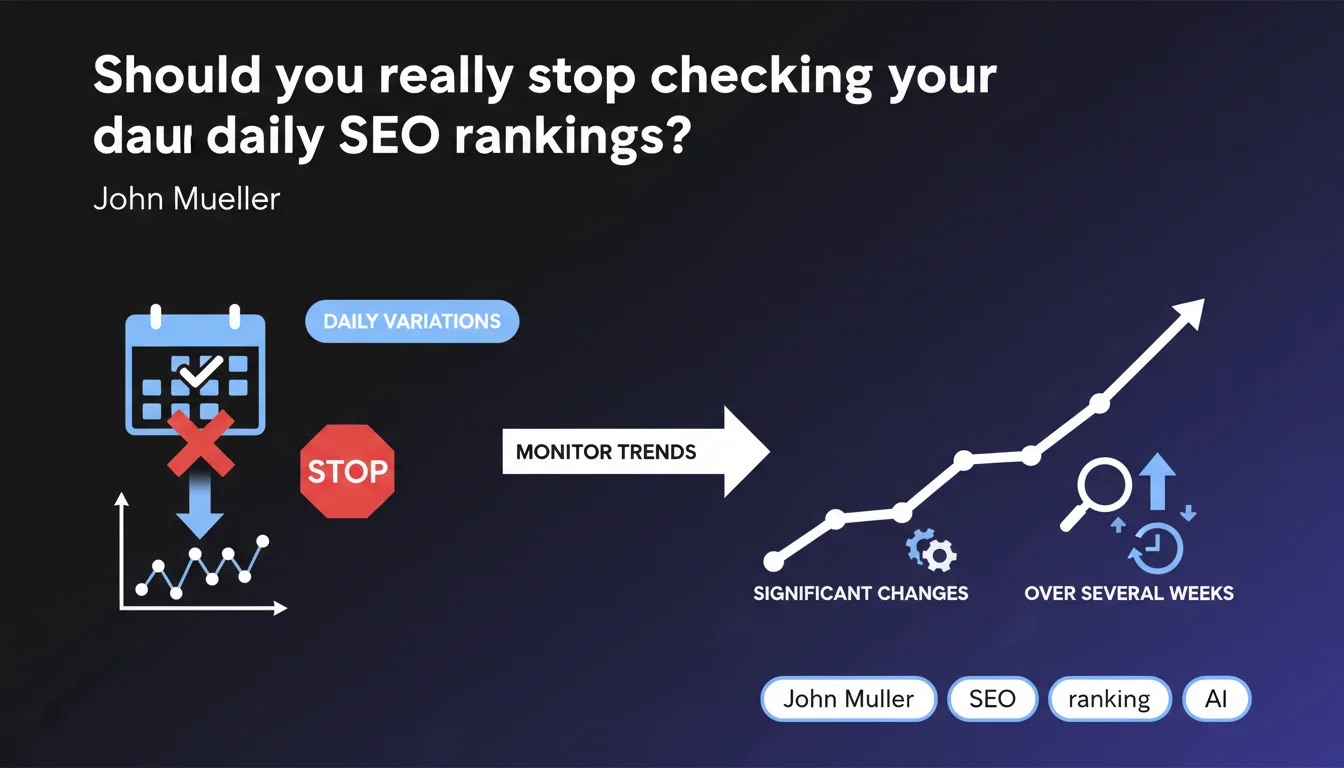
Google recommends focusing on weekly trends rather than daily fluctuations. Continuous evolution in the same direction over several weeks signals a structural change, while daily spikes are often just statistical noise without actionable value.
What you need to understand
Why does Google insist on a long-term vision?
Daily fluctuations in the SERPs are a constant — personalization, algorithmic tests, freshness adjustments, geographic variations. A site can lose 5 positions on Tuesday and recover them on Thursday without any SEO action being taken.
Mueller points to a simple reality: these short-term variations don't necessarily reflect a structural problem. Reacting to every daily movement risks correcting what isn't broken — and potentially damaging what was working.
What counts as a significant trend according to this logic?
A trend observable over several weeks indicates that Google has re-evaluated the site's relevance for certain queries. If organic traffic drops consistently over 3 weeks, that's different from a one-off 15% drop on a Wednesday.
The signal becomes actionable when it's directional and persistent. A curve that moves up or down regularly over 14-21 days deserves analysis — a weird day, does not.
How do you tell the difference between noise and signal?
Practically? Compare weekly averages rather than isolated peaks. If week N shows an average 12% lower than week N-3, and week N+1 confirms it, that's a signal.
Intra-week variations — Monday vs Friday — are often linked to user behavior (fewer B2B searches on weekends, for example) and not an algorithmic change.
- Daily fluctuations are normal and rarely actionable
- A trend over 2-3 weeks minimum indicates a structural change
- Comparing weekly averages allows you to filter out statistical noise
- Intra-week variations often reflect behavioral patterns, not penalties
SEO Expert opinion
Does this approach actually match real-world practices?
Yes and no. The recommendation is fundamentally sound for avoiding reactive over-optimization. But it underestimates a critical aspect: some brutal movements require quick action.
Real example: a client loses 40% of traffic overnight on a strategic query segment. Wait 3 weeks to "confirm the trend"? Absurd. In that case, immediate investigation is essential — technical issue, manual penalty, Search Console bug.
When doesn't this rule apply?
Brutal and localized drops on a topic cluster or page type merit immediate investigation. If 80% of traffic from a category disappears in 48 hours, it's rarely just "noise".
Similarly, after a technical deployment — migration, redesign, structural change — daily monitoring for 2 weeks is essential. That's exactly when you catch errors before they become major trends. [To verify]: Google never specifies at what amplitude a daily variation stops being normal.
Does Mueller's advice hide a Google limitation?
Let's be honest: recommending not to monitor daily is also a way to prevent SEOs from systematically flagging every SERP bug or inconsistency.
Daily oscillations sometimes reveal algorithmic instability itself — Google tests, adjusts, reverts. Saying "look at 3 weeks" buries these imperfections in a smoothed average.
Practical impact and recommendations
What should you change in your SEO tracking?
Stop automated daily reports that generate more anxiety than insights. Instead, set up targeted alerts: drop >25% in 48 hours, complete disappearance of a strategic page, mass 404 errors.
Move to weekly reporting by default, comparing week N vs week N-4. Add a monthly view to detect long-term trends — a gradual 2% weekly slide goes unnoticed daily but represents -8% over a month.
What mistakes should you avoid when interpreting data?
Don't confuse sector volatility with site-specific issues. If your entire sector is fluctuating (verifiable through SERP tracking tools), it's not your site derailing — Google is testing.
Also avoid over-reacting to weekend or holiday spikes. B2B traffic drops on Sunday? Normal. E-commerce explodes on Black Friday? Predictable. These patterns aren't "trends" in Mueller's sense.
How do you structure monitoring concretely?
- Configure 7-day moving averages in your Analytics and Search Console dashboards
- Set up automated alerts only for variations >30% in 48 hours or critical errors
- Produce a weekly report comparing week N vs N-4, identifying winning/losing URLs
- Reserve daily analysis for post-deployment periods (15 days after migration, redesign, major technical change)
- Create a monthly dashboard identifying trends over 12 weeks minimum
- Document external correlations: seasonality, competitor actions, confirmed Google updates
❓ Frequently Asked Questions
Combien de semaines constituent une tendance significative ?
Dois-je complètement ignorer les variations quotidiennes ?
Comment savoir si une baisse quotidienne est normale ou critique ?
Quelle fréquence de reporting adopter en pratique ?
Cette recommandation s'applique-t-elle aussi aux Core Updates ?
🎥 From the same video 6
Other SEO insights extracted from this same Google Search Central video · published on 26/05/2022
🎥 Watch the full video on YouTube →
💬 Comments (0)
Be the first to comment.