
Official statement
Other statements from this video 6 ▾
- □ Should you really ignore daily fluctuations in Search Console?
- □ Why can tiny SEO changes trigger unpredictable effects across your Google rankings?
- □ Can crawl speed fluctuations really change what gets indexed on your site?
- □ Should you really stop checking your daily SEO rankings?
- □ Should you really be concerned about sudden spikes in Google Search Console?
- □ Should you really panic at every ranking fluctuation?
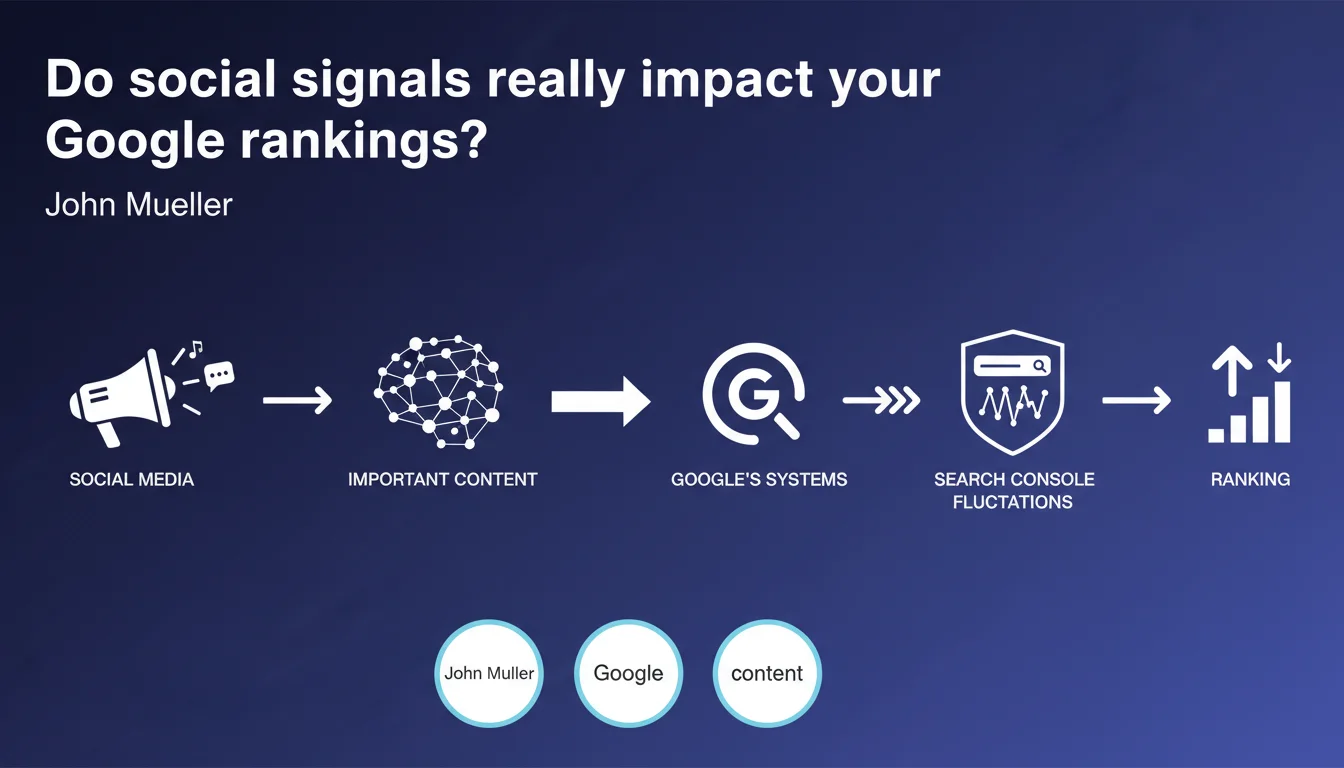
According to John Mueller, content that suddenly gains traction on social media can capture Google's algorithmic attention and cause visibility fluctuations in Search Console. This statement suggests an indirect link between social virality and indexation, but remains unclear on the exact mechanisms involved.
What you need to understand
Does Google monitor social media activity?
Mueller's statement confirms what many have long suspected: Google's systems detect when content goes viral on social platforms. The phrase "focus more closely on that content" deliberately remains vague, but it suggests some form of algorithmic prioritization.
This isn't a direct ranking factor — Google has beaten that point to death. But the cascade effect is absolutely real: a post that explodes generates traffic, attracts natural links, drives branded searches. All of that eventually shows up on Google's radar.
What do "fluctuations in Search Console graphs" actually mean?
Mueller is referring to visible variations in your GSC data. In practical terms, a social spike can trigger an accelerated recrawl of your relevant pages. Google detects that something's moving, so it comes back to take another look.
These fluctuations can translate into an uptick in impressions, sometimes even clicks — but they can also result in sudden drops if the content doesn't live up to expectations once quality algorithms examine it more closely.
Does this statement contradict Google's official position on social media?
Officially, Google maintains that social signals are not direct ranking factors. Technically speaking, that position still holds. What Mueller describes here is an indirect mechanism: social virality as a signal of potential interest, not as an algorithmic boost.
The distinction matters. A million likes won't propel your page to position 1. But if those million likes generate 500 backlinks from news sites, then yes, things will move.
- Indirect signal: social virality captures Google's attention without being a ranking factor
- Accelerated recrawl: content that becomes socially important can be re-explored more quickly
- GSC fluctuations: visible variations in impressions and positions following increased social attention
- Cascade effect: social traffic → natural links → branded searches → real SEO signals
SEO Expert opinion
Is this statement consistent with real-world observations?
Absolutely, and it's actually quite refreshing to see Google explicitly acknowledge this connection. In the field, we've observed for years that viral content on Twitter, LinkedIn, or Reddit often experience an indexation spike within hours.
The problem is that Mueller stays vague about the "how." Does Google have APIs with social platforms? Does it simply detect spikes in referral traffic? Does it analyze domain mentions in public posts? [Needs verification] — we're missing the technical specifics needed to reliably optimize this lever.
What limitations should we place on this claim?
First limitation: content quality remains decisive. A viral post linking to mediocre content won't magically rank well. Google might accelerate its crawl, but if the content doesn't meet E-E-A-T criteria or match search intent, it's pointless.
Second limitation: not all social platforms carry equal weight. A LinkedIn post with 10,000 views in a specialized B2B niche can have more impact than a TikTok with 500,000 views if Google detects the former generates quality editorial backlinks. The platform matters less than the secondary signals it generates.
When does this mechanism fail?
If your site suffers from fundamental technical issues (poor crawlability, catastrophic server response times), a social spike won't change anything. Google might want to recrawl your pages, but if it can't access them, you remain invisible.
Another scenario: locked content or strict paywalls. An article that goes viral on LinkedIn but leads to 100% paywall content will be difficult for Google to index, even if it detects social buzz. The bot sees nothing, it indexes nothing.
Practical impact and recommendations
What concrete steps should you take to capitalize on this mechanism?
First, make sharing your premium content easy. You don't need share buttons everywhere like in 2012, but ensure your Open Graph and Twitter Card tags are flawless. An attractive visual preview mechanically increases shares.
Next, monitor your social referral traffic spikes in Analytics. When you spot content taking off, immediately check GSC for rising impressions. If yes, that's your moment to boost that content through internal linking to capitalize on the momentum.
How do you avoid pitfalls linked to social fluctuations?
First pitfall: clickbait content that performs on social but disappoints in terms of search intent. If your viral LinkedIn headline doesn't match what people actually search for on Google, the spike will be short-lived and could even penalize you through negative user signals (high bounce rate, pogo-sticking).
Second pitfall: neglecting server capacity. Content that goes viral and generates 50,000 visits in 2 hours can bring poorly-dimensioned hosting to its knees. If Googlebot arrives to recrawl while your server is lagging, you've lost.
- Optimize Open Graph and Twitter Card tags to maximize share appeal
- Monitor social referral traffic spikes in real-time via Analytics
- Check GSC variations within 24-48 hours following a social spike
- Strengthen internal linking to content that takes off socially
- Ensure viral content matches actual search intent, not just eye-catching headlines
- Size your server infrastructure to absorb sudden traffic spikes
- Analyze backlinks generated following social virality — that's often where real SEO gains happen
Mueller's statement confirms an indirect but measurable link between social virality and algorithmic attention. The opportunity exists, but it demands solid technical infrastructure and alignment between social content and SEO strategy.
Orchestrating these different levers — real-time monitoring, technical optimization, correlation analysis between social signals and organic performance — can quickly become complex. If your team lacks bandwidth or cross-channel expertise, working with an SEO agency specialized in integrating social signals can save you significant time and help you avoid costly mistakes.
❓ Frequently Asked Questions
Les likes et partages sur les réseaux sociaux sont-ils un facteur de classement Google ?
Combien de temps après un pic social voit-on des effets dans Search Console ?
Tous les réseaux sociaux ont-ils le même impact sur Google ?
Un contenu viral mais de faible qualité peut-il quand même bien ranker ?
Faut-il acheter des partages sociaux pour booster son SEO ?
🎥 From the same video 6
Other SEO insights extracted from this same Google Search Central video · published on 26/05/2022
🎥 Watch the full video on YouTube →
💬 Comments (0)
Be the first to comment.