
Official statement
Other statements from this video 15 ▾
- □ Are ranking fluctuations really normal, or could they be hiding a technical issue?
- □ Does Google really use one global index for all countries?
- □ Should you still trust the site: operator to diagnose your indexation status?
- □ Does user engagement really influence your Google rankings?
- □ Why do high-traffic pages carry more weight in your Core Web Vitals score?
- □ Does Google really segment websites by template type when evaluating Page Experience?
- □ How many internal links should you actually place on each page to boost your SEO?
- □ Why does your internal linking tree structure really matter to Google?
- □ Does your homepage distance really impact how fast Google indexes your pages?
- □ Does Google really ignore your URL structure for SEO rankings?
- □ Why do Search Console positions fail to reflect your actual search rankings?
- □ Does Google really distinguish between 'edit video' and 'video editor' as different user intentions?
- □ Does your FAQ schema markup really need to be on the ranking page to generate rich snippets?
- □ Do footer links carry the same SEO weight as links in your main content?
- □ Does Your Robots.txt Really Need to Return 404 or 200 to Keep Googlebot Happy?
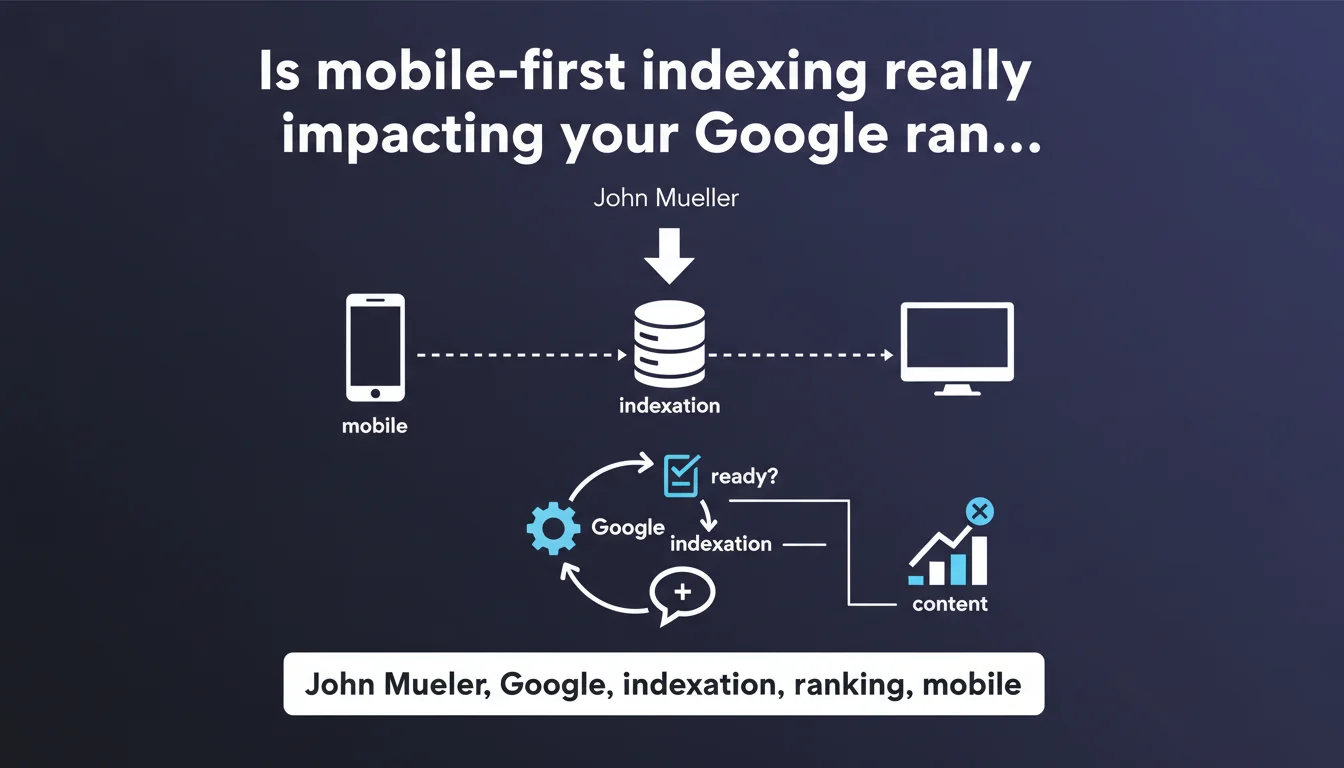
Google states that the shift to mobile-first indexing does not directly affect page rankings. It's solely about determining which version of content (mobile or desktop) will be indexed and used for evaluation. Attempting to manually force this switch is pointless — Google switches sites when it deems them ready.
What you need to understand
Since the gradual rollout of mobile-first indexing, confusion has persisted among many SEO professionals: does this change impact organic positions? Mueller settles it decisively.
The distinction between indexation and ranking remains unclear for many. Yet, it's fundamental to understanding this statement.
What's the difference between indexation and ranking?
Mobile-first indexing refers to the process by which Google chooses which version of a page to crawl and store in its index. Before this change, Google primarily used the desktop version as the reference.
Ranking, on the other hand, determines a page's position in search results based on hundreds of signals. These two mechanisms are distinct, even though they're connected.
Why does Google insist there's no impact?
Because mobile-first doesn't modify the ranking criteria themselves. Google still analyzes content quality, relevance, user experience — but on the mobile version rather than desktop.
If your mobile version offers exactly the same content and quality as your desktop version, no position change should occur during the switch. The problem arises when the two versions diverge significantly.
Can you speed up the mobile-first transition?
No. Mueller is categorical: there's no point in forcing this change. Google switches sites according to its own timeline, when it determines they meet the necessary technical and content criteria.
Attempting to influence this process amounts to futile agitation. Focus on the quality of your mobile version, the rest will follow.
- Mobile-first indexing determines which version Google analyzes, not how it ranks that version
- No direct impact on positions if mobile and desktop versions are equivalent in quality and content
- Google switches sites autonomously — impossible to force the process
- The indexation/ranking distinction is crucial to avoid misconceptions
SEO Expert opinion
Does this claim hold up to real-world observation?
Yes and no. In absolute terms, Mueller is right: mobile-first in itself is merely a change in indexation source. But in practice, many sites lost positions during the switch.
Why? Because their mobile version was stripped down. Truncated content, missing images, limited functionality. Google then indexes a degraded version, and that inevitably impacts quality assessment — therefore ranking. Technically, it's not mobile-first that penalizes, it's the inferior quality of the mobile version. Semantic nuance, but identical consequences.
Where does Mueller's statement lack precision?
Mueller doesn't detail the exact criteria that trigger a site's switch. When is one "ready"? No clear metrics. [To verify]: Does Google evaluate only content parity, or also mobile performance, usability, UX signals?
Furthermore, saying you shouldn't "try to force" this change remains vague. Concretely, what does that mean? Don't submit reindexing requests? Don't modify site structure? The blur persists.
In which cases doesn't this rule really apply?
When your mobile version differs structurally from your desktop, mobile-first becomes an indirect ranking factor. For example: an e-commerce site that hides entire categories on mobile, or a blog that loads only 3 paragraphs of an article versus 20 on desktop.
In these situations, saying "mobile-first doesn't affect ranking" is semantic gymnastics. Certainly, it's not the switch itself that penalizes — it's the lower quality of indexed content. But the final effect? Loss of visibility.
Practical impact and recommendations
What exactly should you verify on your site?
First step: compare your mobile and desktop versions side by side. Use Google's mobile testing tools, but also test in a responsive browser. Is the text content identical? Do all images load? Are internal links present?
Next, examine your robots.txt file and meta robots tags. Some sites still block CSS/JS resources on mobile, which can disrupt rendering for Googlebot. Also verify that your structured data is present on both versions.
What mistakes should you absolutely avoid?
Don't hide essential content behind accordions or tabs that aren't loaded by default on mobile. Google can explore them, but if content is technically hidden or requires interaction, indexation may be incomplete.
Also avoid serving different dynamic content based on user-agent. Google can detect these practices and consider them cloaking if the gap is too significant.
How do you track the evolution of your indexation?
Search Console clearly indicates whether your site has switched to mobile-first or not. Check the "Settings" section to verify status. If it hasn't happened yet, analyze coverage reports to detect any mobile-version-specific issues.
Also monitor your Core Web Vitals on mobile. While Mueller doesn't directly link mobile-first and ranking, Google has confirmed that mobile experience (speed, visual stability, interactivity) influences ranking.
- Compare mobile and desktop content line by line — no major divergence tolerated
- Verify that all resources (CSS, JS, images) are crawlable on mobile
- Ensure that structured data is identical on both versions
- Test mobile rendering via Search Console and third-party tools
- Avoid hidden content or navigation differences between versions
- Monitor Core Web Vitals specifically on mobile
- Don't attempt to force the switch — let Google decide on timing
Mobile-first isn't a direct ranking factor, but it becomes an indirect risk if your mobile version is of lower quality. The essential point: guarantee strict parity between your versions.
If your site's technical audit reveals significant gaps between mobile and desktop, or if you lack resources to harmonize these two environments, it may be wise to enlist a specialized SEO agency. These optimizations often require adjustments to code, structure, and content — projects that benefit from personalized guidance to avoid costly mistakes.
❓ Frequently Asked Questions
Le passage en mobile-first peut-il faire chuter mes positions ?
Comment savoir si mon site est déjà en indexation mobile-first ?
Dois-je demander à Google de basculer mon site en mobile-first ?
Puis-je avoir du contenu différent entre mobile et desktop sans risque ?
Les Core Web Vitals sont-ils liés au mobile-first indexing ?
🎥 From the same video 15
Other SEO insights extracted from this same Google Search Central video · published on 14/03/2022
🎥 Watch the full video on YouTube →
💬 Comments (0)
Be the first to comment.