
Official statement
Other statements from this video 15 ▾
- □ Are ranking fluctuations really normal, or could they be hiding a technical issue?
- □ Does Google really use one global index for all countries?
- □ Should you still trust the site: operator to diagnose your indexation status?
- □ Does user engagement really influence your Google rankings?
- □ Why do high-traffic pages carry more weight in your Core Web Vitals score?
- □ Does Google really segment websites by template type when evaluating Page Experience?
- □ How many internal links should you actually place on each page to boost your SEO?
- □ Why does your internal linking tree structure really matter to Google?
- □ Does your homepage distance really impact how fast Google indexes your pages?
- □ Does Google really ignore your URL structure for SEO rankings?
- □ Why do Search Console positions fail to reflect your actual search rankings?
- □ Does Google really distinguish between 'edit video' and 'video editor' as different user intentions?
- □ Does your FAQ schema markup really need to be on the ranking page to generate rich snippets?
- □ Is mobile-first indexing really impacting your Google rankings?
- □ Does Your Robots.txt Really Need to Return 404 or 200 to Keep Googlebot Happy?
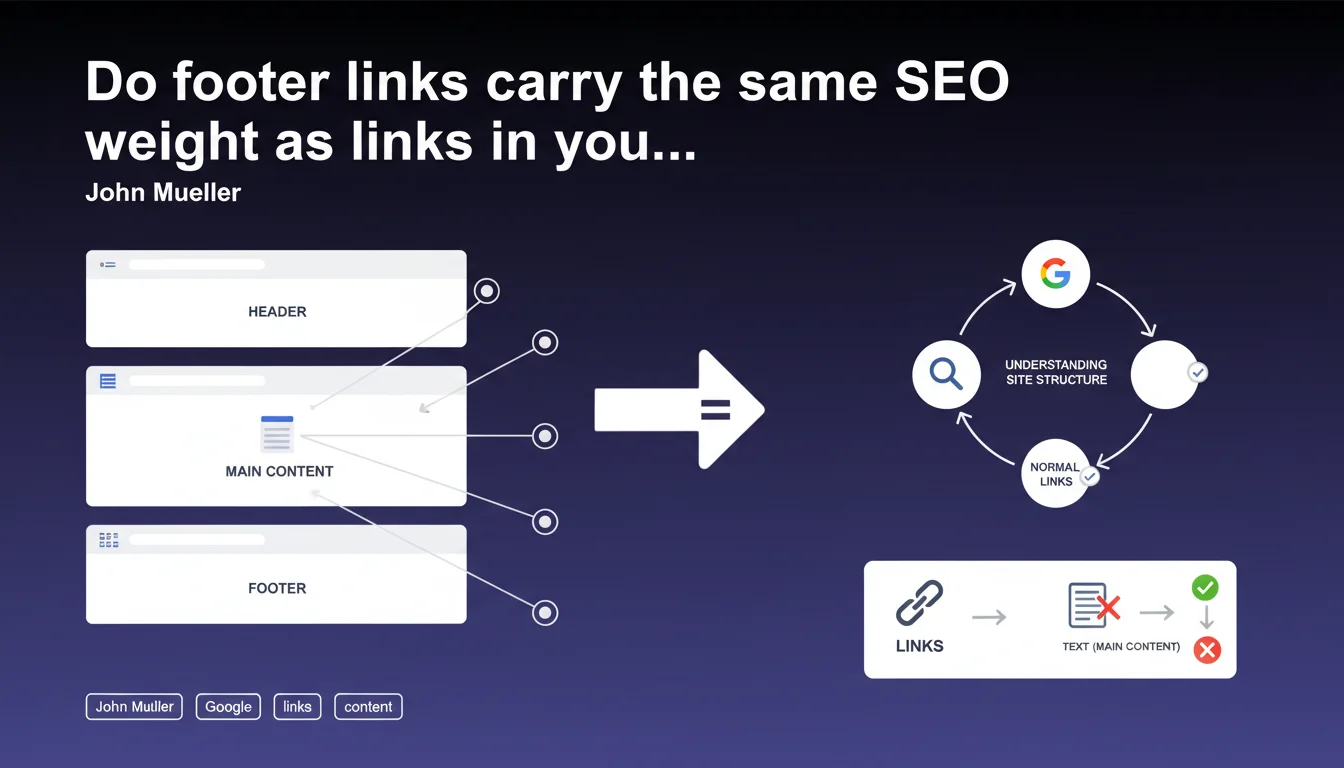
Google makes no distinction between links based on their position on the page (header, footer, sidebar, content). All are treated identically for understanding site structure. However, this equivalence doesn't apply to text, where the algorithm seeks to identify main content.
What you need to understand
Why does this statement challenge a widespread belief?
For years, the SEO community believed that a link's position on the page influenced its weight. The dominant idea was that Google valued links in editorial content more and penalized those in the footer or sidebar, often considered less relevant.
Mueller breaks this logic. According to him, Google doesn't rank links based on their location. A footer link counts as much as a contextual link for understanding site architecture. This position may be surprising, but it radically simplifies how Google treats internal links.
What's the difference with how text is treated?
Google makes a crucial distinction: what applies to links doesn't apply to text. For textual content, the algorithm actively seeks to identify the main content area and ignore peripheral noise (footer, sidebar).
This dichotomy is explained by different objectives. Links serve to understand site structure and navigation, while text serves to evaluate thematic relevance. Two mechanisms, two logics.
What are the essential takeaways?
- Link position = no impact for Google in calculating site structure
- A footer link has the same weight as a contextual link for internal linking
- This rule does NOT apply to text — Google actively filters non-main content
- The link anchor remains determining, regardless of its position
- Multiple links to the same URL are treated according to the first link rule
SEO Expert opinion
Is this statement consistent with what we observe in practice?
Let's be honest: Mueller's statement is at odds with empirical observations. Many tests show that contextual links generate more compelling results than footer links for pushing a page.
Several hypotheses explain this gap. Either Google simplifies its public communication while the algorithm is more nuanced. Or other factors compensate — semantic context around the link, user signals, crawl depth. [To be verified] but the official explanation remains incomplete.
What nuances should be added to this rule?
Mueller speaks of link processing to understand site structure. This isn't the same as PageRank or popularity transmission. Google likely treats all links equally for mapping architecture, but applies other filters to evaluate their importance.
Semantic context plays a role — a link surrounded by relevant text benefits from contextual enrichment that an isolated footer link cannot have. Not to mention that users click more on contextual links, which can generate positive behavioral signals.
In which cases does this rule really not apply?
When footer links become an obvious spam pattern. Hundreds of identical links in the footer across an entire site — this type of practice is still detected and can trigger manual actions or algorithmic penalties.
Also when links are hidden or deceptive. Even though Google treats all links equally, it applies quality filters that can neutralize or penalize abusive practices. Position isn't a criterion, but volume, relevance, and intent are.
Practical impact and recommendations
Should you revise your internal linking strategy after this statement?
No revolution needed. This statement mainly confirms that neglecting footer linking is not a critical error. If your secondary navigation points to strategic pages, they'll be crawled and understood by Google.
But — and this is where it gets tricky — this doesn't mean multiplying footer links will have the same SEO impact as optimizing contextual linking. The field shows the opposite. Continue to prioritize contextual editorial links to push your key pages.
What errors should you avoid in linking implementation?
Don't turn your footer into a directory. Even though Google treats these links normally, a footer saturated with links hurts user experience and can trigger quality filters. Stay reasonable on volume.
Avoid over-optimized anchors in the footer. Under the pretext that these links count, some stuff them with exact keywords. This is a detectable and risky pattern. Favor natural and varied anchors, regardless of link position.
How can you verify that your strategy remains effective?
- Analyze the crawl rate of your strategic pages via Search Console — if they're discovered, it means your linking works
- Measure the ranking evolution of pages linked from the footer vs. those linked contextually
- Verify that your footer links don't create excessive depth — Google follows all links but prioritizes by other criteria
- Control the total number of links per page — beyond 100-150, you dilute link juice
- Test the impact of adding/removing footer links on specific pages with precise tracking
❓ Frequently Asked Questions
Est-ce qu'un lien en footer transmet autant de PageRank qu'un lien contextuel ?
Peut-on avoir 100 liens en footer sans risque ?
Les liens en sidebar ont-ils le même statut que ceux du footer ?
Faut-il mettre des liens vers les pages profondes dans le footer ?
Cette règle s'applique-t-elle aussi aux liens externes ?
🎥 From the same video 15
Other SEO insights extracted from this same Google Search Central video · published on 14/03/2022
🎥 Watch the full video on YouTube →
💬 Comments (0)
Be the first to comment.