
Official statement
Other statements from this video 15 ▾
- □ Les fluctuations de classement sont-elles vraiment normales ou cachent-elles un problème technique ?
- □ Faut-il encore se fier aux résultats de la requête site: pour diagnostiquer l'indexation ?
- □ L'engagement utilisateur influence-t-il réellement le classement Google ?
- □ Pourquoi les pages à fort trafic pèsent-elles plus dans le score Core Web Vitals ?
- □ Google segmente-t-il vraiment les sites par type de template pour évaluer la Page Experience ?
- □ Combien de liens internes faut-il placer par page pour optimiser son SEO ?
- □ Pourquoi la structure en arbre de votre maillage interne compte-t-elle vraiment pour Google ?
- □ La distance depuis la homepage influence-t-elle vraiment la vitesse d'indexation ?
- □ Pourquoi la structure d'URL n'a-t-elle aucune importance pour Google ?
- □ Pourquoi les positions Search Console ne reflètent-elles pas la réalité du classement ?
- □ Google distingue-t-il vraiment 'edit video' et 'video editor' comme des intentions différentes ?
- □ Le balisage FAQ doit-il obligatoirement figurer sur la page indexée pour générer un rich snippet ?
- □ Les liens en footer ont-ils la même valeur SEO que les liens dans le contenu ?
- □ L'indexation mobile-first a-t-elle un impact sur vos classements Google ?
- □ Faut-il vraiment qu'un robots.txt inexistant retourne un 404 pour éviter de bloquer Googlebot ?
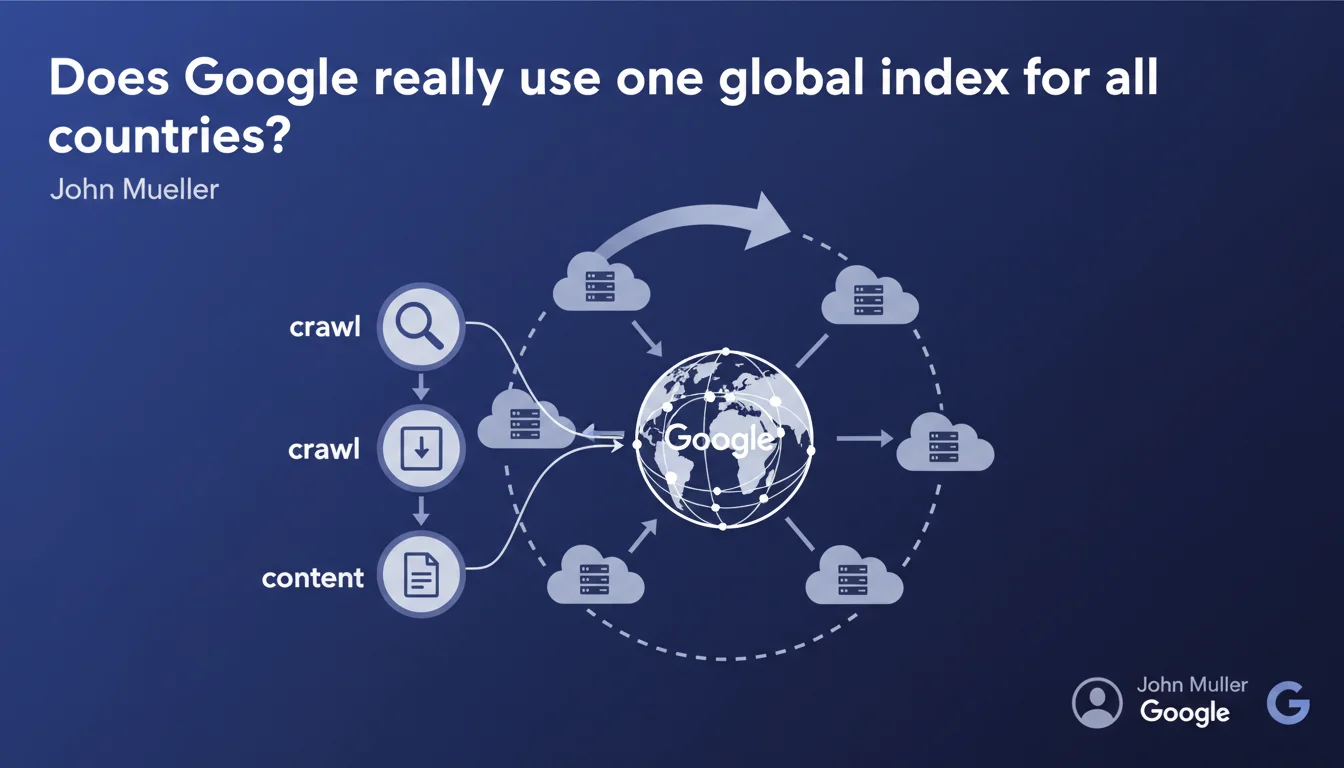
Google maintains one unique global index, not separate indexes by country or region. Content that is crawled and indexed in one data center quickly propagates to other infrastructure. Direct consequence: geographic targeting does not depend on local storage but on signals (hreflang, server IP, ccTLD domain, Search Console).
What you need to understand
Why does Google insist on this concept of a single index?
For years, some SEOs believed that Google maintained separate indexes by country — one for France, one for the United States, etc. This statement from John Mueller shatters that myth: there is only one global index, replicated across multiple data centers to ensure speed and availability.
Content indexed in Mountain View becomes visible in Paris or Tokyo within seconds. This centralized architecture allows Google to synchronize its data efficiently, without fragmenting its infrastructure by geographic zone.
So how does Google determine which content to display in each country?
If the index is unique, the search engine relies on geographic targeting signals to personalize results based on the user's location. These signals include hreflang tags, domain extension (ccTLD), server location, Search Console settings, and language content.
In other words: your site can be present in the global index, but only appear in certain local versions of Google if the signals are properly configured.
What does this change for crawling and indexing?
Concretely, this means that Googlebot doesn't need to recrawl your site from each country to index it locally. Once crawled and indexed, the content is accessible everywhere — it's the ranking that varies based on the geographic location of the query.
- One unique global index, synchronized between data centers
- No geographic segmentation of the index itself
- Local targeting relies on signals (hreflang, ccTLD, language, IP)
- Crawling doesn't need to be repeated by country
- Variations in results come from ranking, not from the index
SEO Expert opinion
Is this statement consistent with real-world observations?
Yes, and it explains why a site hosted in the United States can rank perfectly in France if the signals are correct. SEOs who insist on hosting locally for each market often waste their time — server IP is only one signal among many, and far from the most powerful.
However, this unique architecture does not mean that results are identical everywhere. Local ranking algorithms remain specific: Google.fr and Google.com do not weight the same ranking factors in the same way. [To be verified]: Google remains vague about the exact granularity of these algorithmic variations by region.
In what cases does this single-index logic create problems?
If you manage a poorly tagged multilingual site, you risk seeing your French pages displayed to Spanish users, or vice versa. The index doesn't sort: it's your job to properly tag with hreflang and correctly structure your language versions.
Another pitfall: some SEOs still believe they need to submit their sitemap to each local version of Search Console. Wrong. Once indexed, content is available everywhere — it's the targeting in Search Console (and on-page signals) that guides the display.
What nuances should be added to this statement?
Mueller speaks of one index, but there are indeed separate infrastructures — physically distributed data centers. These centers synchronize quickly, but not instantaneously. In practice, this means that two users querying Google at the same time from two continents may see slightly different results if their queries hit servers that haven't yet synchronized.
Furthermore, Google never specifies the exact delay for propagation between data centers. The phrase "quickly visible" remains vague. From experience, we observe minutes to a few hours maximum — but no official documentation quantifies this timing.
Practical impact and recommendations
What should you do concretely to optimize geographic targeting?
Forget the idea of "submitting to each local Google". Focus on targeting signals: properly implemented hreflang tags, international targeting in Search Console, and linguistic consistency of your content. If you want to rank in Germany with a German version, these signals must be explicit and unambiguous.
Local hosting (server in France for a .fr site) can play a marginal role in latency, and therefore potentially in Core Web Vitals. But it's not a decisive geolocation signal. A properly configured CDN is more than enough if you're targeting multiple markets.
What errors should you avoid with a multilingual or multi-country site?
Classic mistake: letting Google guess which version to display to which user. Without hreflang, the engine relies on the language detected in the content and the IP — but the results are often hit or miss. You end up with Spanish pages ranking in France, or English pages cannibalizing your French versions.
Another pitfall: using subdomains or subdirectories without consistency. If you switch from example.fr to fr.example.com without a redirect or hreflang, Google doesn't understand that it's the same target. Result: authority dilution and confusion in the index.
- Implement hreflang on all relevant pages, in both directions (reciprocal)
- Declare geographic targeting in Search Console (property by language version if needed)
- Use ccTLDs (.fr, .de) or consistent subdirectories (/fr/, /de/)
- Verify that the language of the content matches the hreflang tags
- Avoid IP-based automatic redirects — let the user choose their language
- Test with Search Console the versions displayed according to regions
- Monitor local rankings with multi-country rank tracking tools
❓ Frequently Asked Questions
Dois-je héberger mon site localement dans chaque pays ciblé ?
Si l'index est mondial, pourquoi mes résultats diffèrent entre Google.fr et Google.com ?
Combien de temps faut-il pour qu'une page indexée soit visible partout ?
Faut-il soumettre mon sitemap à chaque version locale de Search Console ?
Hreflang est-il obligatoire si je n'ai qu'une seule langue ?
🎥 From the same video 15
Other SEO insights extracted from this same Google Search Central video · published on 14/03/2022
🎥 Watch the full video on YouTube →
💬 Comments (0)
Be the first to comment.