
Official statement
Other statements from this video 15 ▾
- □ Are ranking fluctuations really normal, or could they be hiding a technical issue?
- □ Does Google really use one global index for all countries?
- □ Should you still trust the site: operator to diagnose your indexation status?
- □ Does user engagement really influence your Google rankings?
- □ Why do high-traffic pages carry more weight in your Core Web Vitals score?
- □ Does Google really segment websites by template type when evaluating Page Experience?
- □ How many internal links should you actually place on each page to boost your SEO?
- □ Why does your internal linking tree structure really matter to Google?
- □ Does your homepage distance really impact how fast Google indexes your pages?
- □ Why do Search Console positions fail to reflect your actual search rankings?
- □ Does Google really distinguish between 'edit video' and 'video editor' as different user intentions?
- □ Does your FAQ schema markup really need to be on the ranking page to generate rich snippets?
- □ Do footer links carry the same SEO weight as links in your main content?
- □ Is mobile-first indexing really impacting your Google rankings?
- □ Does Your Robots.txt Really Need to Return 404 or 200 to Keep Googlebot Happy?
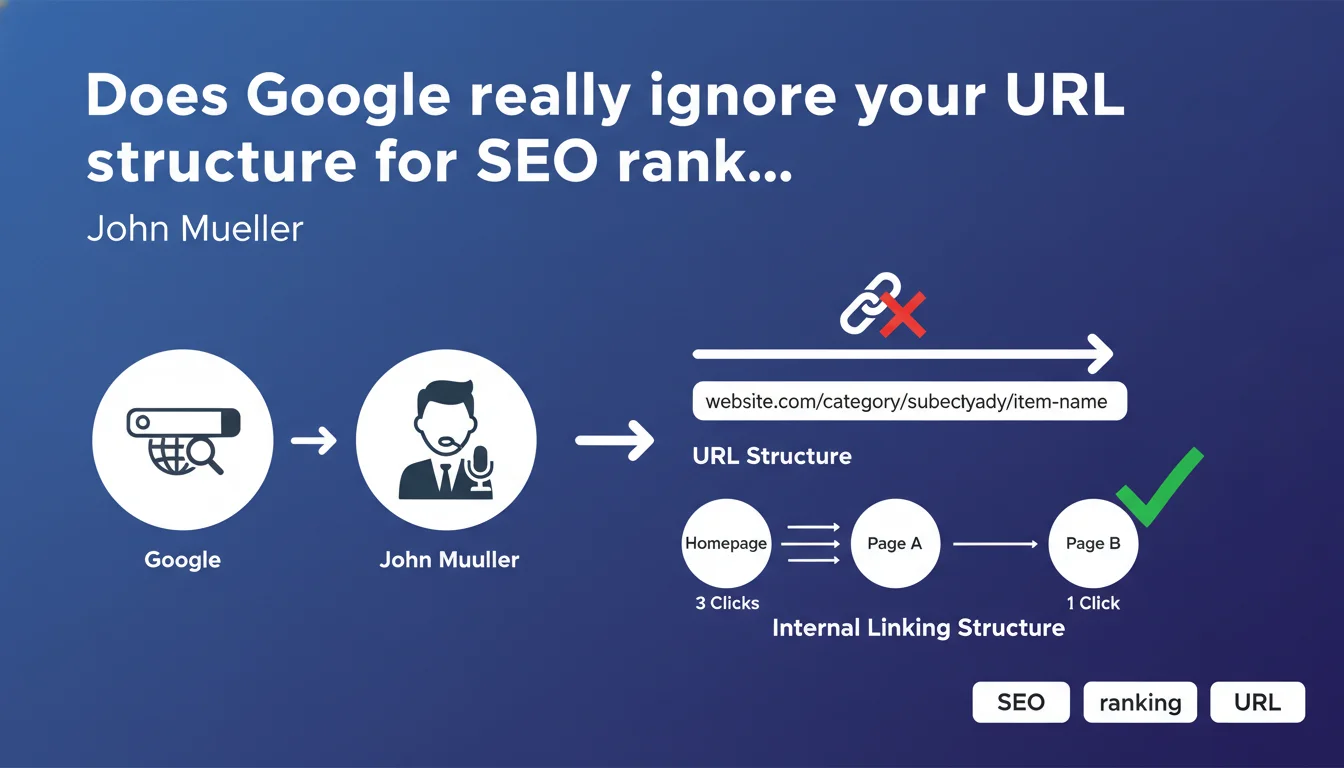
Google completely ignores URL structure and the number of slashes when determining page importance. Only internal linking matters: a page accessible in 2 clicks from the homepage carries more weight than a page buried 5 clicks deep, regardless of its URL.
What you need to understand
Does Google really read URLs the way we thought?
No. And this breaks with historical SEO beliefs. For years, we built hierarchical URL architectures — /category/subcategory/product — assuming Google would automatically deduce the site's structure from them.
Mueller sets the record straight: the number of slashes sends no hierarchy signal to Google. A URL like /product-123 can easily be considered more important than a page at /a/b/c/d/page if it's better linked from the homepage.
What really determines how deep a page is?
The number of clicks needed from the homepage. It's internal linking that creates hierarchy, not the URL. A page accessible in 2 clicks receives more link juice than a page 6 clicks away, even if its URL is "flat".
Concretely: if your important page is buried 5 clicks from the homepage but has a pretty URL, Google doesn't care. Conversely, an ugly URL but directly linked from the homepage will carry more weight.
Does this mean clean URLs are pointless?
No. Clear URLs remain useful for UX, CTR in search results, and semantic understanding. But they don't create SEO hierarchy on their own.
Google can still extract semantic context from a well-constructed URL — for example understanding that /running-shoes concerns running footwear. But it won't deduce that this page is a "child" of a /shoes page just because they share a URL segment.
- Internal linking defines page depth and importance for Google
- The number of slashes in a URL is completely ignored as a hierarchy signal
- Clean URLs keep value for UX and CTR, not for SEO structure
- An important page must be accessible in a minimum number of clicks from the homepage
SEO Expert opinion
Does this statement match what we observe in the real world?
Yes, and it's even verifiable. Top-performing sites often have strategic pages linked from the homepage or menus, even with URLs that follow no apparent hierarchical logic.
Crawl audits consistently show that pages at high click depth (4+ clicks) receive less internal PageRank and are crawled less frequently — regardless of their URL. There's no mystery here.
Should we abandon any coherent URL structure altogether?
No, that would be a mistake. Structured URLs make site management easier: category grouping in Search Console, crawl rules, migrations, bulk redirects.
They also improve user understanding in search results and can boost CTR. A URL like /complete-seo-guide inspires more confidence than an incomprehensible string.
But — and this is where many get it wrong — you must not confuse URL structure with linking structure. One is cosmetic, the other is decisive.
In what cases does this rule cause problems?
On large e-commerce sites with thousands of products. If you link everything from the homepage, you dilute PageRank and create an over-optimized hub. You need to find a balance between acceptable click depth (3 max ideally) and logical navigation structure.
[To verify]: Google says linking matters, but never quantifies how many clicks make a page "too deep". The 3-4 click limit is an empirical field rule, not a Google standard.
Practical impact and recommendations
What should you prioritize optimizing on your site?
Internal linking, without hesitation. Identify your strategic pages and ensure they're accessible in a minimum number of clicks from the homepage. Use Screaming Frog or Oncrawl to analyze crawl depth.
Next, audit your orphaned pages — those with no internal links. Even with a perfect URL, they're invisible to Google if no internal links point to them.
Should you rewrite all your existing URLs?
No, unless they cause a real UX or tracking problem. Changing a URL without solid reason generates unnecessary redirects and temporary ranking loss risk.
If you're doing a redesign, focus on rebuilding your internal linking structure before touching URLs. Many sites lose traffic post-redesign because they broke their internal link structure, not because of new URLs.
How do you verify that your internal linking is healthy?
Run a complete crawl with Screaming Frog or your preferred tool. Export the "Crawl Depth" metric and filter all strategic pages exceeding 3 clicks from the homepage.
Then create short link paths from the homepage or internal hubs (categories, guides). Prioritize links within editorial content rather than footers, which carry less weight.
- Audit click depth for all strategic pages (target: maximum 3 clicks)
- Eliminate orphaned pages by creating contextual internal links
- Prioritize links from the homepage and high internal PageRank pages
- Use descriptive and varied anchor text to strengthen semantic relevance
- Avoid URL refactoring without prior internal linking analysis
- Regularly monitor internal PageRank distribution via tools like Oncrawl or Botify
❓ Frequently Asked Questions
Est-ce que Google ignore complètement la structure des URLs ?
Faut-il supprimer les catégories de mes URLs produits ?
Combien de clics maximum depuis la homepage ?
Les liens en footer comptent-ils autant que ceux dans le contenu ?
Peut-on avoir une URL plate et une bonne hiérarchie SEO ?
Thematic analysis
🎥 From the same video 15
Other SEO insights extracted from this same Google Search Central video · published on 14/03/2022
🎥 Watch the full video on YouTube →
💬 Comments (0)
Be the first to comment.