
Official statement
Other statements from this video 15 ▾
- □ Does hreflang really boost your ranking in a targeted country?
- □ Should you really reduce the number of pages to optimize your international SEO?
- □ Does Google really use only main content to identify language on multilingual pages?
- □ Does Google really use domain authority to rank websites?
- □ Is your content trapped behind buttons that Googlebot refuses to click?
- □ Are JavaScript interstitials really safe for your SEO?
- □ Can a technical bug during a Core Update really cause your site to crash in rankings?
- □ Can technical problems really trigger a ranking drop during a Core Update?
- □ Does Google penalize you for translating content between languages?
- □ Can poor machine translations really sabotage your international SEO strategy?
- □ Should you really use Google's Indexing API for all your content?
- □ Can Googlebot actually access your .htaccess file?
- □ Does Google really give its own platforms an unfair advantage in search results?
- □ Does the meta description really impact your Google rankings?
- □ Should you really choose your structured data based on the rich results you're targeting in the SERPs?
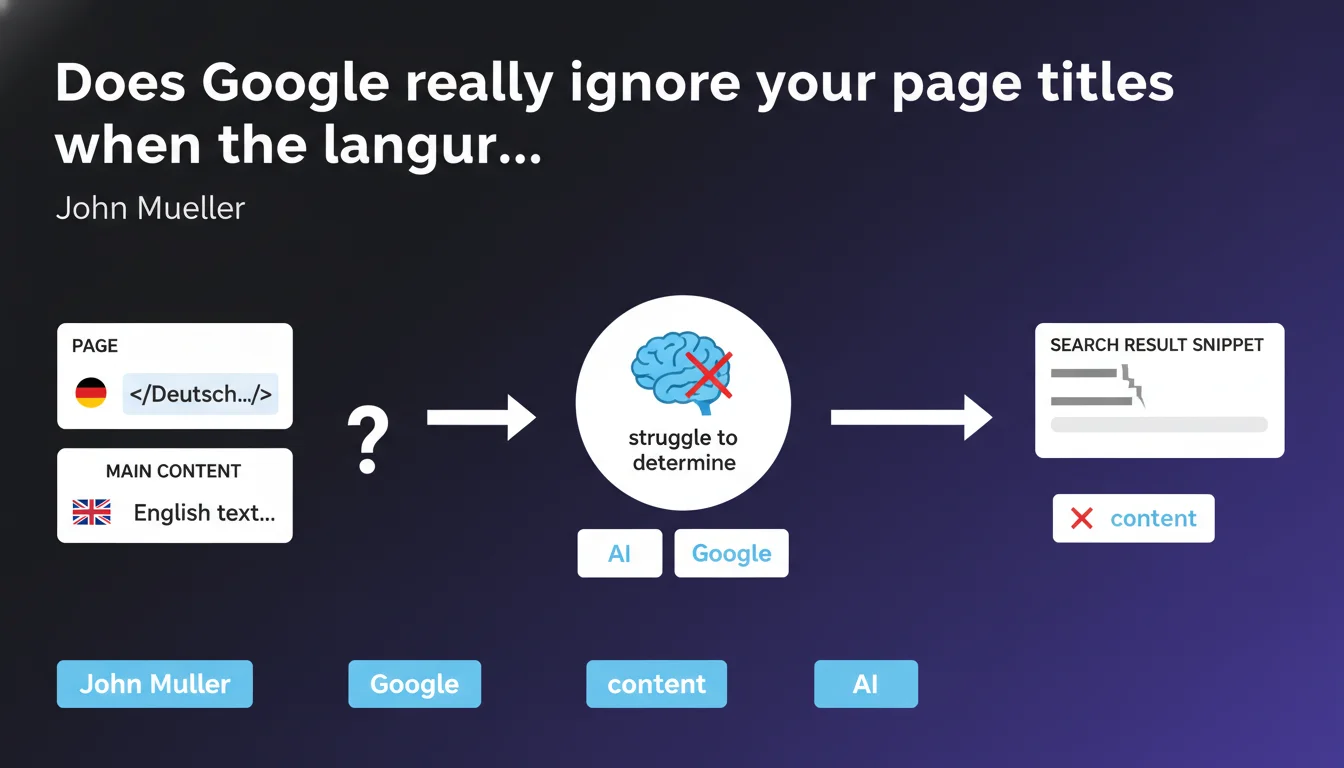
Google refuses to display page titles when their language differs from that of the main content. A title in German on an English-language page will simply be excluded from SERPs. This inconsistency prevents Google from determining which language version to offer users, forcing the search engine to generate its own titles.
What you need to understand
Mueller's statement points to a problem of linguistic inconsistency that Google simply won't tolerate. When the title and content speak two different languages, the algorithm faces a contradictory signal it cannot resolve.
The result? It completely ignores your title tag and creates one itself. You lose all control over the most visible element of your snippet.
Why does this inconsistency cause problems for Google?
The search engine relies on language to determine which search results should display your page. A title in German suggests German-language content, but if the main text is in English, Google no longer knows which audience you're targeting.
This ambiguity creates a conflict in geographic and linguistic targeting. The algorithm can't guess whether you're aiming at German speakers, English speakers, or both — so it chooses the safest solution: ignore your title.
In which scenarios does this situation occur?
Three classic scenarios: poorly configured multilingual sites, partially translated content (only the title was adapted), and deployment errors where a template in the wrong language was applied by mistake.
We also see this issue on sites that mix multiple languages in their technical tags, thinking they'll reach a wider audience. Spoiler: it doesn't work.
- Google ignores titles that are inconsistent with the main content language
- This inconsistency prevents proper linguistic targeting in SERPs
- The search engine then generates its own titles, escaping your control
- Multilingual sites and partial translations are most at risk
- Deliberately mixing languages to "cast a wider net" is counterproductive
SEO Expert opinion
Does this rule also apply to meta description tags?
Mueller mentions only titles, but linguistic inconsistency logically affects all tags visible in SERPs. If your meta description is in Spanish while your content is in French, Google will replace it too.
The logic is the same: the search engine seeks to present a coherent snippet that faithfully reflects what users will find when they click. A description in the wrong language creates unnecessary friction.
What about pages with multiple legitimate languages in the content?
This is where it gets complicated. Mueller refers to "main content," which suggests that secondary elements (quotations, code snippets, legal notices) in another language wouldn't trigger this behavior.
[To be verified] But Google never specifies what percentage of text must be in the target language for a page to be considered monolingual. An article in French with 30% of quotations in English? Complete gray area.
In practice, I've seen 50/50 bilingual pages where Google arbitrarily chose a dominant language — not necessarily the one in the title. Hreflang remains your best ally to clear up the ambiguity, even though Mueller doesn't mention it here.
Is this statement consistent with observed practices?
Absolutely. We've observed for years that Google will rewrite your titles if they don't match the content — language is just one criterion among others (relevance, length, keyword stuffing).
But let's be honest: Google also rewrites perfectly coherent titles when it thinks it can "do better." This statement sets a clear rule for one specific case, but won't prevent the search engine from tinkering with your snippets for other opaque reasons.
Practical impact and recommendations
How do you verify that your titles follow this rule?
First step: a complete crawl of your site with Screaming Frog or Oncrawl, with language detection enabled. Compare the declared language (html lang tag) with the language detected in the title and in the main body.
For multilingual sites, verify that each URL has its corresponding lang tag, and that titles haven't remained in a default language after translation. Poorly configured CMSs love this kind of trap.
If you use dynamic content or templates, ensure that language variables are correctly injected everywhere — not just in the body text.
What should you do if you legitimately need to mix two languages?
Typical case: a Quebec site that juggles French and English, or a tech blog that cites English code in French articles. The solution? Clarify the dominant language with html lang and hreflang.
For the title, stick to the language of your main audience. If 80% of your readers are French speakers, your title should be in French — even if 40% of the content contains English technical terms.
And if you're really targeting two distinct linguistic audiences with the same content? Create two separate URLs with cross-linked hreflang tags. It's more work, but it's the only approach Google understands without ambiguity.
What errors should you absolutely avoid?
- Never partially translate a page thinking "just the title is enough"
- Don't mix languages in the title to target multiple markets simultaneously
- Don't use a different language in the title "because it sounds better" in English
- Don't deploy multilingual templates without checking each technical tag
- Don't forget to synchronize html lang, hreflang and the actual language of the content
- Don't count on Google to "guess" your linguistic intent
Linguistic consistency between title and content is non-negotiable. Google unhesitatingly ignores titles that don't match the main language of the page, leaving you with no control over your snippets.
For complex sites — multilingual, multi-market, or with technical content mixing multiple languages — this seemingly simple rule can reveal deep architectural flaws. A complete technical audit then becomes essential to map out inconsistencies and define a correction strategy suited to your context.
These optimizations often touch on the very structure of your site and require specialized technical expertise. If your multilingual infrastructure displays contradictory signals or if you lack visibility into the consistency of your tags at scale, specialized support can save you precious time and help you avoid costly visibility errors.
❓ Frequently Asked Questions
Google détecte-t-il automatiquement la langue du contenu ou se fie-t-il à la balise html lang ?
Un titre en anglais avec des mots-clés français peut-il déclencher ce problème ?
Ce comportement affecte-t-il aussi les balises Hn à l'intérieur de la page ?
Les pages avec du contenu traduit automatiquement sont-elles à risque ?
Hreflang peut-il compenser une incohérence entre titre et contenu ?
🎥 From the same video 15
Other SEO insights extracted from this same Google Search Central video · published on 29/04/2022
🎥 Watch the full video on YouTube →
💬 Comments (0)
Be the first to comment.