
Official statement
Other statements from this video 14 ▾
- □ Does your URL structure really affect how hreflang works on Google?
- □ Are ccTLDs really losing their SEO weight for geographic targeting?
- □ Should you really ignore the HTML lang attribute for multilingual SEO?
- □ Will Google finally automate hreflang tag detection?
- □ Why does Google trust hreflang more than the HTML lang attribute?
- □ Should you really worry about hreflang if only 9% of websites actually use it?
- □ Should you abandon hreflang in sitemaps and switch to HTML or HTTP headers instead?
- □ Does hreflang automatically trigger Google to crawl all your alternative URLs?
- □ Do you really need to include a self-referencing hreflang tag on every page?
- □ Does Google really index your multilingual pages separately with hreflang, or does it only store one version?
- □ Why are your hreflang pages disappearing from Search Console without being deindexed?
- □ Can your x-default hreflang tag really point to any page on your site?
- □ Is hreflang really enough to handle nearly identical pages that only differ by currency or VAT?
- □ Why did Google discontinue its official hreflang validator tool?
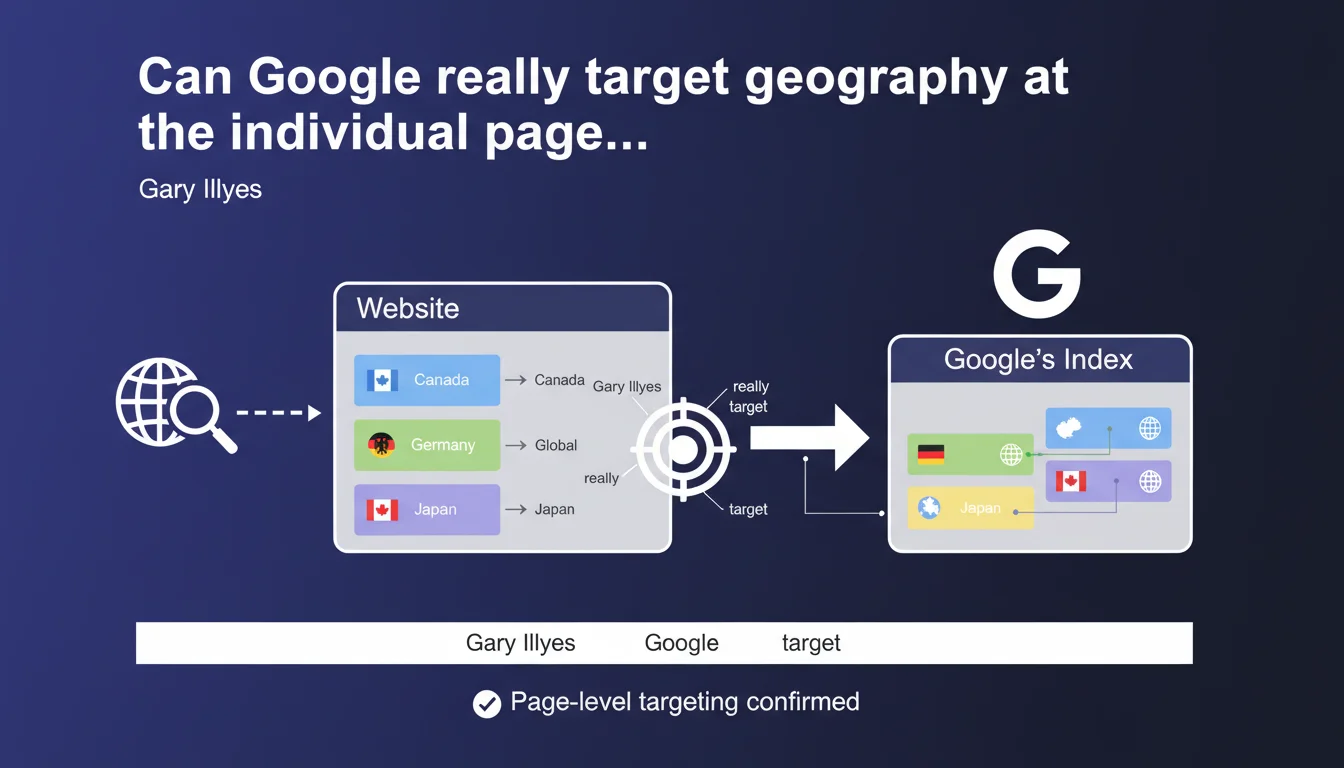
Google claims it can determine geographic targeting at the individual page level, independent of the rest of the site. In practice, a French page on a .com domain can be treated as targeting France, even if the overall site targets other markets. This granularity transforms multi-country strategies on generic domains.
What you need to understand
How does Google identify a page's geographic targeting?
Google analyzes several page-level signals to determine its geographic targeting: content language, hreflang tags, geographic mentions in the text, currency used, local contact information displayed.
This approach contrasts with the old model where geographic targeting was primarily defined at the domain level (.fr, .de) or via Search Console for generic domains. Now, each URL has its own geographic footprint.
Why does this page-by-page distinction change the game?
It allows multi-country sites on generic domains (.com, .org) to precisely target different markets without multiplying domains. A folder-based architecture (/fr/, /de/, /uk/) becomes technically as effective as a multi-domain strategy.
Let's be honest: this significantly simplifies technical and budgetary management for international brands. No need to juggle ten different ccTLD extensions anymore.
Which signals take priority in this evaluation?
Hreflang tags remain the most explicit signal for indicating language and regional targeting. Content language, URL structure, local backlinks, and proximity signals (address, phone, currency) complete the analysis.
Google cross-references these clues to determine whether a page targets Paris, Montreal, or Kinshasa — same French content, different geographic intentions.
- Geographic targeting is evaluated page by page, not just at the domain level
- Hreflang tags, content language, and local signals are analyzed individually
- A global site can host sections targeting specific countries without a dedicated domain
- This granularity facilitates multi-country strategies on generic domains
SEO Expert opinion
Is this statement consistent with real-world observations?
Yes, and it's been observable for several years. Sites in subfolders (/fr/, /es/) on .com perform as well as equivalent ccTLDs, provided that geographic signals are consistent.
The problem? Google remains vague about the exact weighting of each signal. We know hreflang counts, but what's the relative importance of text content versus local backlinks? [To verify] — Google has never quantified these weights.
What nuances deserve to be highlighted?
Gary Illyes speaks of "can determine," not "systematically determines." This distinction is crucial: Google has the technical capability to do it, but that doesn't guarantee it does so for every page of every site.
In practice, small sites with ambiguous signals risk having their geographic targeting misinterpreted. A .com with French content but no hreflang, no French backlinks, and no clear geographic mention? Google will make assumptions — not always correct ones.
In what cases does this logic fail?
When signals contradict each other. Classic example: French content, hreflang="fr-FR", but all backlinks come from Canada and the displayed address is Quebec-based. Google must decide — and it will likely favor Canada.
Another problematic case: sites with duplicate content across countries (approximate translation or identical). Google can merge pages in its index and arbitrarily choose which to display based on geographic query.
Practical impact and recommendations
What concretely should you do to leverage this granularity?
Implement exhaustive hreflang tags on all pages targeting different countries. Not just on the homepage — on every URL of every geographic section.
Strengthen local signals: physical address, local phone number, appropriate currency, backlinks from sites in the target country. The more clues converge, the more confident Google is in its interpretation.
What mistakes destroy page-level geographic targeting?
First mistake: inconsistent or incomplete hreflang tags. If /fr/ points to /de/ as a German alternative but /de/ doesn't point back to /fr/, the signal is broken.
Second mistake: mixing languages and countries. French content with hreflang="fr" without specifying the country (fr-FR, fr-CA, fr-BE) leaves Google guessing. Be explicit.
Third mistake: ignoring sub-resources. If your French pages load scripts hosted on a US CDN without geographic headers, it clouds the picture — but the impact remains marginal compared to on-page signals.
How do you verify your targeting is working?
Use Search Console to confirm that Google indexes your pages in the correct geographic indexes. Check performance by country: if your /fr/ pages appear primarily in Belgium or Canada, your France targeting isn't strong enough.
Test with geo-targeted searches via VPN or tools like SEMrush/Ahrefs that allow you to simulate queries from different countries. If your pages don't rank in the targeted country, dig into contradictory signals.
- Implement hreflang on all pages of each geographic version
- Display local coordinates (address, phone, currency) consistent with targeting
- Obtain backlinks from sites in the target country
- Verify indexation by country in Search Console
- Audit contradictory signals (language vs. backlink geolocation)
- Avoid duplicate content across geographic versions
❓ Frequently Asked Questions
Faut-il un domaine par pays ou un sous-dossier suffit-il ?
Google peut-il mélanger le ciblage géographique entre pages d'un même site ?
Les backlinks influencent-ils le ciblage géographique d'une page ?
Que se passe-t-il si les hreflang contredisent le contenu de la page ?
Un site monolingue peut-il cibler plusieurs pays ?
🎥 From the same video 14
Other SEO insights extracted from this same Google Search Central video · published on 25/07/2024
🎥 Watch the full video on YouTube →
💬 Comments (0)
Be the first to comment.