
Official statement
Other statements from this video 14 ▾
- □ Does your URL structure really affect how hreflang works on Google?
- □ Are ccTLDs really losing their SEO weight for geographic targeting?
- □ Can Google really target geography at the individual page level?
- □ Should you really ignore the HTML lang attribute for multilingual SEO?
- □ Will Google finally automate hreflang tag detection?
- □ Why does Google trust hreflang more than the HTML lang attribute?
- □ Should you really worry about hreflang if only 9% of websites actually use it?
- □ Should you abandon hreflang in sitemaps and switch to HTML or HTTP headers instead?
- □ Does hreflang automatically trigger Google to crawl all your alternative URLs?
- □ Do you really need to include a self-referencing hreflang tag on every page?
- □ Does Google really index your multilingual pages separately with hreflang, or does it only store one version?
- □ Why are your hreflang pages disappearing from Search Console without being deindexed?
- □ Can your x-default hreflang tag really point to any page on your site?
- □ Why did Google discontinue its official hreflang validator tool?
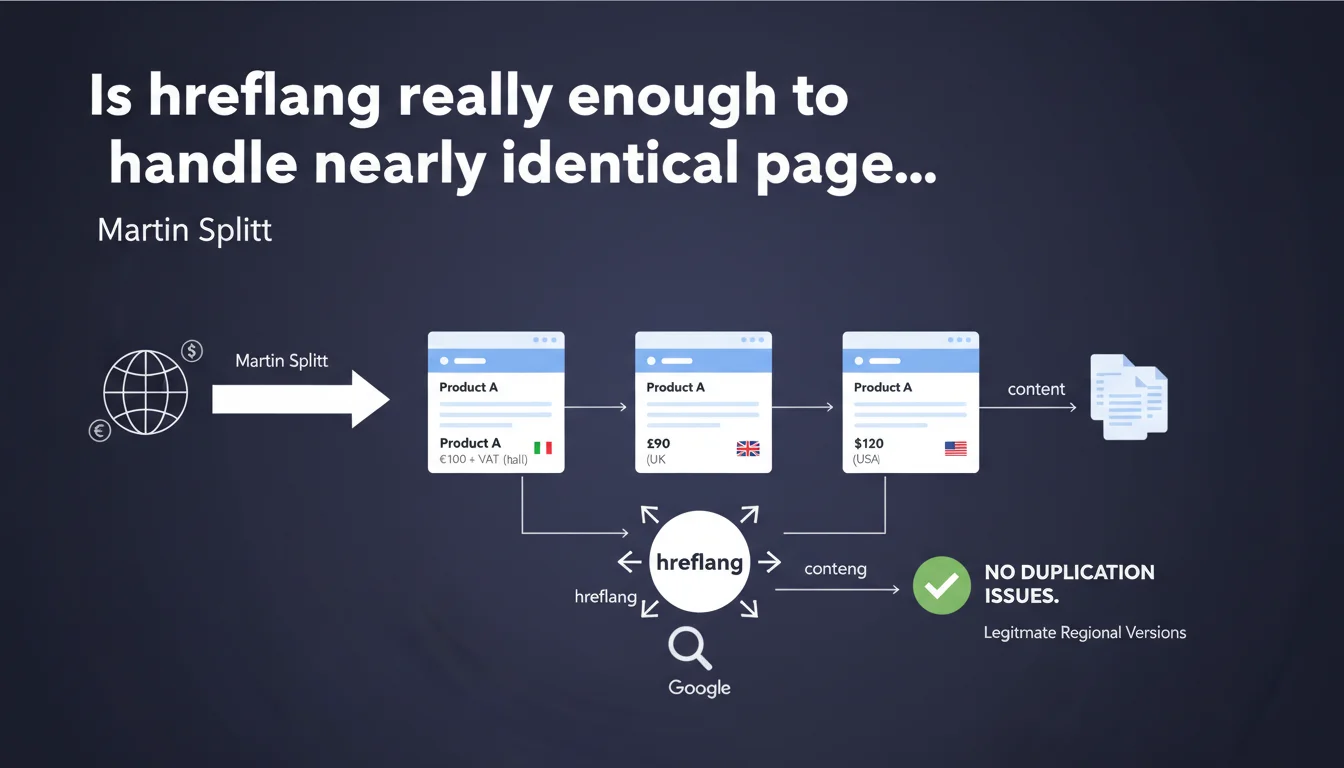
Google confirms that very similar pages varying only by VAT, currency, or price can be managed with hreflang without duplication risk. These variations are recognized as legitimate regional versions, not duplicate content. Concretely, there's no need for cross-regional canonicals or robots.txt to block these pages.
What you need to understand
Why is this statement crucial for multilingual e-commerce sites?
International retailers have long hesitated over the technical management of nearly identical product pages. The same item sold in France for €99 including VAT and in Germany for €83 excluding VAT poses a dilemma: will Google consider these pages as duplicate content?
Martin Splitt's statement is clear: if the differences concern only local economic elements (VAT, currency, price), hreflang is sufficient. No penalty, no crawl budget dilution. These variations are legitimate in Google's eyes, which understands that a store must adapt its prices according to markets.
What are the limits of this tolerance?
Attention — this flexibility applies only to price and currency differences. If editorial content, product descriptions, visuals, or customer reviews differ significantly, you're outside the scope. Google expects the rest of the page to be identical or nearly identical.
The nuance is critical: hreflang indicates linguistic or regional versions of the same content. If each market has its own marketing copy, it's no longer a "version" but distinct content — and in that case, the treatment differs.
What concretely changes for webmasters?
No more technical contortions to hide certain versions or use complex cross-regional canonicals. Standard hreflang implementation becomes the recommended solution, without additional tricks.
- Well-implemented hreflang: bidirectional tags, correct language-region codes (fr-FR, de-DE, etc.)
- No cross-regional canonicals: each page can have its own self-referential canonical
- Consistent URL structure: /fr/, /de/, /uk/ or subdomains — whatever works as long as hreflang is in place
- Distinct or unified XML sitemap: both approaches work if hreflang is present
SEO Expert opinion
Is this statement consistent with practices observed in the field?
Yes and no. Sites that properly implemented hreflang never really had issues with these price variations — but many still applied cross-regional canonicals out of caution. This statement formalizes an already-tolerated practice without truly revolutionizing consensus.
Where it gets tricky: Google doesn't specify at what level of difference you shift into "distinct content." A price that changes, OK. But if the UK page includes an exclusive promotion, a different reassurance block, or extended legal mentions? [To be verified] — the boundary remains fuzzy.
What nuances should be added to this rule?
Let's be honest: hreflang is one of the most poorly implemented signals on the web. Google Search Console is overflowing with uncorrected hreflang errors. Saying that "hreflang solves the problem" assumes it's correctly deployed, which is far from guaranteed.
Second nuance — and it's rarely stated: this tolerance doesn't mean Google will systematically index all versions. With tight crawl budgets, some variants may be discovered late or remain pending. Hreflang prevents duplication, not slow indexation issues.
In which cases can this approach fail?
First case: dynamically generated product pages with URL parameters (?currency=EUR, ?country=FR). If hreflang points to unstable parameterized URLs, Google can get lost. Prefer clean and stable URLs.
Second case: sites using geo-targeted cloaking. If a French user accesses /product/ and sees EUR content while a bot sees USD content, hreflang won't help — that's cloaking, full stop.
Practical impact and recommendations
What concretely must you do to apply this recommendation?
Audit hreflang as a priority. Before relying on this statement, verify that your current implementation is clean. Search Console > International Targeting > Language should display zero errors. If alerts persist for months, this Google tolerance won't help you.
Next, normalize your regional URLs. Each market must have a stable URL without dynamic parameters. Typical structure: /fr/product-x/, /de/produkt-x/, /uk/product-x/. Each page carries its bidirectional hreflang tags, including to itself with x-default if needed.
What errors must be avoided absolutely?
Don't mix canonical and hreflang in contradictory ways. If you're canonicalizing /de/ to /fr/, don't declare /de/ as a German version with hreflang — that's incoherent. Canonical says "this page is a duplicate," hreflang says "this page is a legitimate variant." Google can't resolve this contradiction.
Another trap: forgetting reciprocity. If /fr/ declares /de/ in hreflang, then /de/ must declare /fr/ in return. A single missing tag breaks the entire chain. Automate this verification via scripts or plugins.
How do you verify your site is compliant?
- Complete crawl with Screaming Frog or Oncrawl: extraction of all hreflang tags
- Verification of bidirectionality: each page A pointing to B must be referenced by B in return
- Control of ISO language-region codes: fr-FR, de-DE, en-GB (not just "fr" if regional targeting)
- Test in Search Console: International Targeting section with zero critical errors
- Validation that each regional URL has a self-referential canonical or none (no cross-regional canonicals)
- Monitoring server logs: is Google crawling all variants or are some being ignored?
❓ Frequently Asked Questions
Dois-je utiliser des canonical inter-régions pour des pages qui ne diffèrent que par le prix ?
Hreflang empêche-t-il Google de considérer ces pages comme du contenu dupliqué ?
Que se passe-t-il si mes pages diffèrent aussi par les descriptions produits ou les avis clients ?
Puis-je utiliser des paramètres d'URL pour gérer les variantes de devise avec hreflang ?
Hreflang garantit-il que Google indexera toutes mes versions régionales ?
🎥 From the same video 14
Other SEO insights extracted from this same Google Search Central video · published on 25/07/2024
🎥 Watch the full video on YouTube →
💬 Comments (0)
Be the first to comment.