
Official statement
Other statements from this video 10 ▾
- □ Les snippets mal optimisés peuvent-ils vraiment faire chuter votre trafic organique ?
- □ Pourquoi vos requêtes de crawl tombent-elles à zéro dans Search Console ?
- □ Robots.txt en disallow bloque-t-il vraiment la génération de snippets dans les SERP ?
- □ Search Console suffit-il vraiment à détecter tous vos problèmes de crawl ?
- □ Search Console suffit-elle vraiment pour diagnostiquer vos problèmes d'indexation ?
- □ Quels outils Google faut-il vraiment utiliser pour auditer correctement un site ?
- □ Lighthouse peut-il vraiment remplacer un audit SEO professionnel ?
- □ Un robots.txt mal configuré peut-il vraiment bloquer vos snippets et votre crawl ?
- □ Faut-il vraiment tester son robots.txt avant chaque modification ?
- □ Faut-il bloquer certaines sections de votre site dans le robots.txt ?
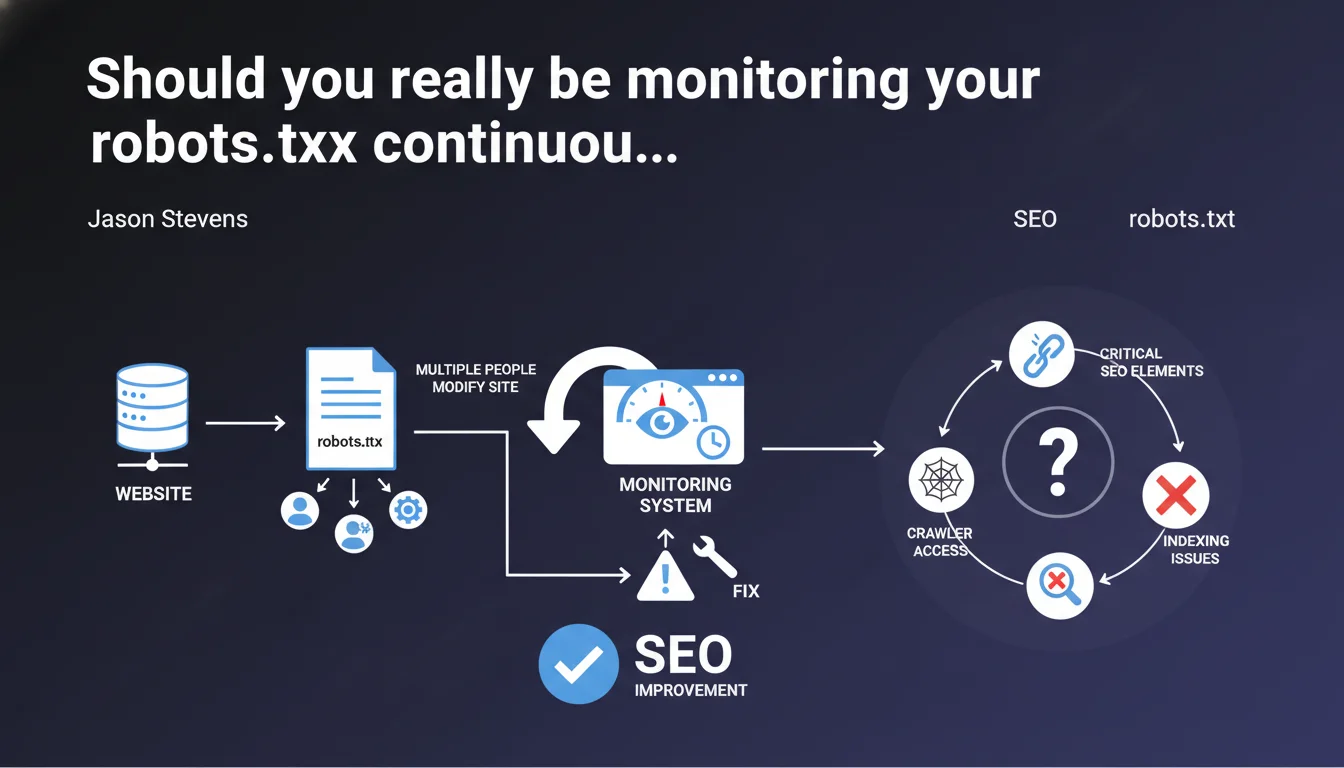
Google officially recommends implementing automated monitoring of the robots.txt file and other critical SEO elements. Why? Because multiple people can work on a site, and an accidental modification can block entire sections from being crawled without you noticing immediately.
What you need to understand
Why does Google insist on monitoring robots.txt?
The robots.txt file is one of the rare technical elements capable of instantly blocking Googlebot's access to all or part of a site. One misplaced line, a hasty copy-paste during an update, and an entire section disappears from search results.
Jason Stevens' statement highlights an organizational problem: multiple people often have access to the robots.txt file. Developers, external agencies, marketing teams, interns testing things — anyone can theoretically modify this file without necessarily understanding the SEO implications.
What makes automated monitoring necessary rather than simple manual checks?
Manual verification isn't enough because you never know when the modification happens. A robots.txt can be overwritten during a deployment at 2 AM on a Friday night, or during the SEO team's vacation.
Automated monitoring detects the change in real-time and sends an alert. This allows you to intervene before Googlebot crawls the site with the new blocking directives — and therefore before pages start disappearing from the index.
What other critical SEO elements deserve this type of monitoring?
Google explicitly mentions "other critical SEO elements" without specifying which ones. We can reasonably assume these are anything that can block indexation or severely damage performance.
- Meta robots tags at the template level (a global noindex accidentally deployed)
- Canonical tags suddenly pointing to the wrong URL
- 301/302 redirects added in bulk during a migration
- XML Sitemap disappearing or returning a 404
- Loading time and Core Web Vitals degrading suddenly
- SSL certificate expiring without automatic renewal
All these elements share a common point: their modification can go unnoticed for days if nobody actively monitors them.
SEO Expert opinion
Is this recommendation really new?
No, and that's what's interesting. Monitoring robots.txt is a standard practice that's been around for years in structured SEO teams. But Google is now choosing to state it explicitly, which probably signals they're still observing too many cases where sites shoot themselves in the foot without realizing it.
This official statement formalizes a best practice and makes it actionable. If a client asks you why you're installing monitoring, you can now cite Google directly.
Isn't the real problem elsewhere?
Let's be honest — the root of the problem isn't technical, it's organizational. Too many people have access to robots.txt without understanding what they're doing. Too many CMS platforms allow modifying this file without validation or traceability.
Monitoring solves detection, not prevention. What's really needed is a validation workflow before any modification: mandatory review, staging, automatic rollback if anomaly detected. But how many organizations have that in place?
What's missing from this statement?
Google provides no recommended tool for doing this monitoring. You can use third-party services, custom scripts, or generalized technical monitoring tools — but nothing is mentioned on the Google Search Console side for example.
It would make sense for GSC to offer native alerts when robots.txt changes, like they do for coverage errors. But for now, that doesn't exist. [To verify] if this feature is on their roadmap.
Practical impact and recommendations
How do you implement effective robots.txt monitoring?
The simplest solution is to automate regular verification of the file's content and trigger an alert if something changes. Several approaches are possible depending on your technical stack.
You can use monitoring tools like OnCrawl, Botify, or Sitebulb that include this functionality. Alternatively, a simple Python or Node.js script that fetches robots.txt every hour and compares the hash with the previous version does the job.
- Check robots.txt at minimum every 24 hours, ideally every hour
- Configure alerts (email, Slack, webhook) if modifications are detected
- Store version history to quickly identify what changed
- Include file HTTP headers in monitoring (response code, redirects)
- Regularly test that the alert system works (controlled fake modification)
What other files and parameters should you monitor as priority?
Don't stop at robots.txt. XML sitemaps must also be monitored: verify they're accessible, not returning errors, and that the URL count hasn't dropped dramatically.
Meta robots tags at the template level are critical. A global noindex accidentally deployed can deindex an entire site within days. Regularly crawl your main templates to detect this type of change.
- Monitor XML sitemaps (accessibility, URL count, response time)
- Crawl template pages to detect unwanted meta robots tags
- Monitor SSL certificates and their expiration dates
- Alert on Core Web Vitals degradation via CrUX API or RUM
- Check server configuration files (.htaccess, nginx.conf) if you have access
How do you avoid false positives and unnecessary alerts?
A monitoring system that's too sensitive generates noise and eventually gets ignored. Configure intelligent thresholds: a minor modification like a comment change in robots.txt doesn't justify a panic alert at 3 AM.
Use whitelists for expected changes (planned deployments) and progressive notification rules: warning for minor changes, critical alert for massive blocks. Document each detected modification to build exploitable history.
❓ Frequently Asked Questions
À quelle fréquence faut-il vérifier le fichier robots.txt ?
Existe-t-il un outil Google pour monitorer le robots.txt ?
Que faire si une modification bloquante est détectée ?
Le monitoring doit-il inclure uniquement le robots.txt ou d'autres fichiers ?
Comment éviter que le robots.txt soit modifié par erreur ?
🎥 From the same video 10
Other SEO insights extracted from this same Google Search Central video · published on 10/01/2023
🎥 Watch the full video on YouTube →
💬 Comments (0)
Be the first to comment.