
Official statement
Other statements from this video 10 ▾
- □ Les snippets mal optimisés peuvent-ils vraiment faire chuter votre trafic organique ?
- □ Pourquoi vos requêtes de crawl tombent-elles à zéro dans Search Console ?
- □ Robots.txt en disallow bloque-t-il vraiment la génération de snippets dans les SERP ?
- □ Search Console suffit-il vraiment à détecter tous vos problèmes de crawl ?
- □ Search Console suffit-elle vraiment pour diagnostiquer vos problèmes d'indexation ?
- □ Quels outils Google faut-il vraiment utiliser pour auditer correctement un site ?
- □ Un robots.txt mal configuré peut-il vraiment bloquer vos snippets et votre crawl ?
- □ Faut-il vraiment monitorer votre robots.txt en continu ?
- □ Faut-il vraiment tester son robots.txt avant chaque modification ?
- □ Faut-il bloquer certaines sections de votre site dans le robots.txt ?
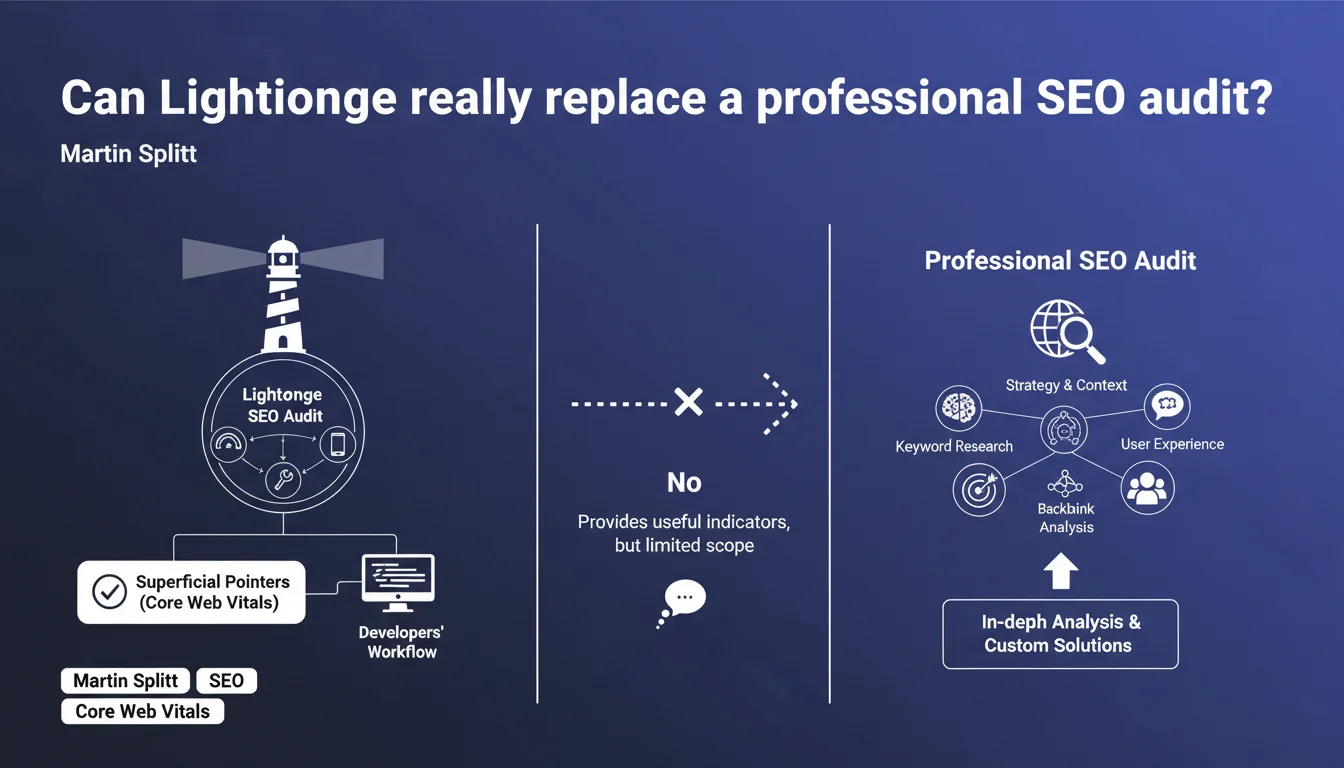
Martin Splitt confirms that Lighthouse SEO audits remain intentionally superficial. The tool is designed first and foremost for developers, providing basic technical guidance—particularly on Core Web Vitals—directly in their work environment. For a comprehensive SEO audit, you need to go much further.
What you need to understand
Why does Google keep SEO audits so limited in Lighthouse?
Lighthouse was never designed to be a comprehensive SEO audit tool. Its positioning is deliberate: providing basic technical benchmarks to developers who lack the time or expertise to dive into advanced SEO considerations.
The objective is pragmatic — delivering a first level of validation on objectively measurable criteria (title tags, meta descriptions, robots.txt, basic indexability, web performance). Everything related to semantic optimization, strategic internal linking, or information architecture remains out of scope.
What's the connection between Lighthouse and Core Web Vitals?
Lighthouse natively integrates Core Web Vitals monitoring, making it a relevant tool for developers who want to ensure their code doesn't penalize user experience. LCP, FID, and CLS are measured in a lab environment, providing an initial diagnosis.
The catch: these metrics in a lab environment don't always reflect real-world browsing conditions. Field data (CrUX) remains Google's reference. Lighthouse gives you a trend, not absolute truth.
In what context does this tool actually make sense?
Lighthouse shines during development or code reviews. It allows you to catch gross errors before production: missing title tags, non-indexable content, images without alt attributes.
For a live site with organic visibility challenges, the tool quickly hits its limits. It tells you nothing about semantic relevance, keyword cannibalization, internal linking quality, or crawl depth.
- Lighthouse = surface-level technical audit, not a strategic SEO diagnosis
- Useful for developers who want to validate technical basics without deep SEO expertise
- Core Web Vitals in lab: indicative, but insufficient for driving a performance strategy
- Covers neither semantic optimization, nor architecture, nor content strategy
SEO Expert opinion
Is this statement consistent with what we observe in the field?
Yes, and it's actually refreshing to see Google own it so frankly. Too many people confuse a 100/100 Lighthouse score with a site perfectly optimized for SEO. Splitt sets the record straight: Lighthouse was never meant to replace a complete SEO audit.
In practice, we regularly see sites that blow Lighthouse scores out of the water but stagnate in organic visibility. Why? Because they've neglected the essentials: information architecture, content strategy, topical authority, semantic optimization. Lighthouse measures none of that.
What nuances should we add about Core Web Vitals?
Core Web Vitals metrics in Lighthouse are measured in a lab environment, on an isolated page, under ideal conditions. This isn't what Google uses for ranking — it favors field data (CrUX) aggregated over 28 days.
A site can display excellent Lighthouse performance and get penalized in real conditions due to external factors: network latency, user device power, third-party scripts that trigger randomly. [To verify]: Google has never clarified the exact weight of Core Web Vitals in the overall ranking algorithm.
Should you really trust Lighthouse for SEO audits?
For a developer who wants to ensure they haven't broken indexability or introduced gross errors, yes. For an SEO consultant auditing a site with visibility stakes, absolutely not.
Lighthouse doesn't detect cannibalization, doesn't measure crawl depth, doesn't flag duplicate content issues, doesn't verify internal linking consistency. It will never replace Screaming Frog, Oncrawl, Botify, or Semrush for serious work.
Practical impact and recommendations
What should you actually do with Lighthouse?
Use Lighthouse as a first technical filter during development or before deployment. It quickly catches blocking errors: pages non-indexable by robots.txt, misconfigured canonical tags, missing titles.
Integrate it into your CI/CD pipelines to automatically validate that each release meets a minimum technical compliance threshold. But never stop there — it's just a starting point.
What mistakes should you avoid with this tool?
Never confuse a high Lighthouse score with a site well-optimized for SEO. We see too many sites with 100/100 scores languishing on page 3 because the architecture is shaky, content is mediocre, or internal linking is nonexistent.
Another trap: taking Core Web Vitals in lab at face value. These metrics are useful for spotting obvious problems, but they don't reflect real performance. Always cross-reference with CrUX data from PageSpeed Insights.
How do you verify your site is truly optimized?
Start with a complete crawl using Screaming Frog or equivalent to identify real issues: excessive crawl depth, orphaned content, redirect chains, duplication. Lighthouse sees none of that.
Next, check your CrUX data in Search Console to get a realistic view of Core Web Vitals as perceived by your users. If the gap with Lighthouse is significant, dig deeper: third-party scripts, server latency, CDN cache impact.
- Integrate Lighthouse into development pipelines to validate technical basics
- Never rely solely on a Lighthouse score to validate an SEO strategy
- Systematically cross-reference lab metrics (Lighthouse) with field data (CrUX)
- Supplement with exhaustive crawling to detect architecture and linking issues
- Regularly audit semantic relevance and topical authority — Lighthouse says nothing about these
❓ Frequently Asked Questions
Lighthouse peut-il remplacer un outil comme Screaming Frog pour un audit SEO ?
Les scores Lighthouse ont-ils un impact direct sur le classement Google ?
Les Core Web Vitals mesurés dans Lighthouse sont-ils fiables ?
Faut-il viser un score Lighthouse de 100/100 en SEO ?
Dans quel contexte Lighthouse est-il vraiment utile pour le SEO ?
🎥 From the same video 10
Other SEO insights extracted from this same Google Search Central video · published on 10/01/2023
🎥 Watch the full video on YouTube →
💬 Comments (0)
Be the first to comment.